


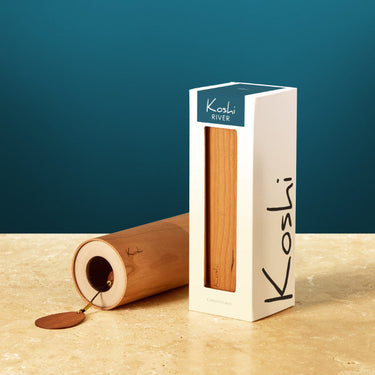
Koshi River Wind Chime • 440Hz • Earth Symphony

Fluid, nuanced and uplifting, the Koshi River Chime is part of the new Koshi Earth Symphony collection, inspired by the continuous movement of rivers.

Handcrafted and individually hand-tuned at the foot of the French Pyrenees, River contains twelve steel rods arranged around the notes D# • D# • G# • G# • A# • A# • B • B • D# • G# • A# • B, creating a G# minor harmonic structure.

Each rod is tuned by hand with reference to 440Hz, allowing the notes to settle into a broad and coherent harmonic ensemble.

Four of the twelve rods are doubled at identical frequencies, acting as sympathetic resonators. These repeated pitches help extend the resonance and give River a deeper, more immersive sonic character.

The result is a broad, flowing and positive sound in which the notes move naturally into one another, creating a sense of continuous motion.

River can be played by hand during meditation, yoga and sound practice, combined with singing bowls and gongs, or suspended in a sheltered position where movement of the air allows the chime to play naturally.

Within the Earth Symphony collection, River may symbolically evoke movement, passage, transformation, change and hope.

River is one of four complementary Koshi Earth Symphony melodies:

Mountain • Forest • River • Ocean

The classic Koshi 4 Elements collection remains a separate range featuring Terra, Aqua, Aria and Ignis with 8 rods and an adjusted 432Hz reference.

Product Details

  • Brand: Koshi
  • Collection: Koshi Earth Symphony
  • Melody: River
  • Inspiration: Rivers, movement and changing natural landscapes
  • Notes: D# • D# • G# • G# • A# • A# • B • B • D# • G# • A# • B
  • Scale / Harmonic Centre: G# minor
  • Sound Character: Fluid, broad, positive and flowing
  • Product Type: Tuned wind chime / wind bell / meditation chime
  • Rods: 12 individually hand-tuned steel rods
  • Sympathetic Resonators: 4 rods doubled at identical frequencies
  • Tuning: With reference to 440Hz
  • Rod Construction: Steel rods soldered with silver onto a metal base
  • Resonance Chamber: Cherry wood
  • Clapper: Brass and coconut shell
  • Plastic: Plastic-free construction as supplied
  • Approx. Body Height: 16cm
  • Approx. Diameter: 6.3cm
  • Approx. Total Length: 35.5cm including cord
  • Approx. Weight: 145g
  • Use: Meditation, yoga, sound baths, breathwork, ceremony, music, relaxation and sheltered wind-bell use
  • Craft: Handcrafted and individually hand-tuned
  • Origin: Foot of the French Pyrenees, France
  • Sold: Individually
  • Other Earth Symphony Chimes: Mountain, Forest and Ocean
  • Separate Collection: Koshi 4 Elements — Terra, Aqua, Aria & Ignis • 8 rods • adjusted 432Hz

River • Earth Symphony

River is one of four melodies within the Koshi Earth Symphony collection.

Where the classic Koshi 4 Elements range takes inspiration from Earth, Water, Air and Fire, Earth Symphony turns toward four great natural landscapes:

Mountain • Forest • River • Ocean

River explores the continuous motion and changing character of flowing water.

Its musical character may evoke movement, passage, transformation and hope.

The twelve rods create a broad harmonic field in which notes seem to move naturally from one to another, giving the melody a fluid and forward-moving quality.

The River association is symbolic and musical rather than a claim of fixed energetic effects.

Notes & Harmonic Structure

River is built around the notes:

D# • D# • G# • G# • A# • A# • B • B • D# • G# • A# • B

These notes form a G# minor harmonic structure.

Each of the twelve rods is individually tuned by hand.

Four pitches are doubled at identical frequencies, creating what Koshi describes as sympathetic resonators.

These repeated rods reinforce selected frequencies and contribute to the instrument's greater depth, sustain and immersive resonance.

Rather than functioning as twelve isolated tones, the rods work together as one complete harmonic ensemble.

Twelve Hand-Tuned Steel Rods

River contains twelve steel rods.

This gives Earth Symphony a broader sonic architecture than the classic 8-rod Koshi 4 Elements collection.

Each rod is individually tuned before being soldered with silver onto a metal base.

The additional rods create more harmonic relationships within the instrument and allow the sound to develop with greater breadth and sustain.

The effect is not simply greater volume.

It is a wider field of interacting notes, repeated frequencies and harmonics.

Sympathetic Resonators

One of the defining technical features of Earth Symphony is the use of doubled rods.

Four rods are tuned to frequencies already present elsewhere in the instrument.

These doubled pitches act as sympathetic resonators.

When related notes sound, the repeated frequencies reinforce parts of the wider harmonic structure.

This contributes to River's sense of depth, flow and extended resonance.

440Hz Tuning Reference

Koshi River is tuned with reference to 440Hz.

This does not mean that every rod produces a single 440Hz tone.

Each rod has its own pitch within the G# minor structure.

The 440Hz reference forms part of the wider tuning system used to position those pitches accurately within the complete harmonic ensemble.

Each rod is tuned individually until it sits correctly within the instrument.

How to Play the Koshi River

Hold the chime by its cord and let the wooden body hang freely.

Turn it gently with a small movement of the wrist.

The central clapper then begins to strike the rods, bringing out a cascade of broad and flowing notes.

The broader the movement, the more rods are set in motion.

For more isolated tones, swing the chime gently in a pendulum motion.

There is no need to shake the instrument strongly.

Gentle movement allows the resonance and relationship between the rods to develop more naturally.

Use as a Wind Bell

River can also be suspended so that a gentle breeze moves the internal clapper.

This allows it to function as a tuned wind bell.

Because the movement of the air determines which rods sound and in what order, the resulting musical patterns remain changing and unpredictable.

For longevity, indoor use or a dry, sheltered outdoor position is preferable to permanent exposure.

Avoid prolonged rain, damp, frost and severe weather.

Koshi River Meditation Chime

River works beautifully as a meditation chime where a flowing and more gently progressive musical character is preferred.

A gentle movement at the beginning of a practice can mark the transition into stillness, while another at the end can signal the return to ordinary awareness.

Its longer resonance gives the notes space to move, interact and fade naturally.

This makes River especially suited to listening practices centred on change, movement and attentive awareness.

During Meditation

River can be used at the beginning or end of meditation, during breathwork, between stages of a practice or simply as a focus for attentive listening.

Its flowing character can bring a sense of movement into otherwise quiet spaces without becoming intrusive.

There is no required sequence.

Yoga Chime

River also suits yoga and movement practice.

Its light weight makes it easy for a teacher or practitioner to move through a space, while the sustained notes can mark transitions without sounding abrupt.

It can work especially well during restorative yoga, savasana, breathwork, flowing sequences, slow transitions and quiet mindfulness periods.

Its musical character may suit moments where you want the sound to feel mobile, open and gently progressive.

Sound Bath & Sound Practice

Within sound practice, River can sit naturally alongside singing bowls, gongs and other harmonic instruments.

Its twelve-rod structure creates a broad but fluid tonal layer that can add movement within the wider soundscape.

Because the chime is light enough to move easily, a practitioner can also allow the sound to travel through the room.

River can be used to introduce a session, mark transitions, add flowing harmonic movement, soften changes between stronger instruments or guide attention toward silence.

References to sound baths or sound therapy describe the contexts in which the instrument may be used and do not imply guaranteed therapeutic outcomes.

Cherry Wood Resonance Chamber

River uses a cherry wood resonance chamber.

The wooden chamber surrounds the twelve steel rods and helps amplify and sustain their vibration.

This allows the notes and harmonics to linger and interact rather than disappearing immediately after the first strike.

The combination of cherry wood and steel contributes to River's long, clear and warm resonance.

Brass & Coconut Shell Clapper

River uses a brass and coconut shell clapper.

As the chime moves, the clapper strikes different rods naturally, creating changing combinations of notes and harmonics.

The manufacturer describes the Earth Symphony construction as plastic-free.

Sound Character

River has a fluid and positive sound character.

Its G# minor structure gives the melody depth while the movement between notes creates a flowing sense of progression.

The twelve rods extend the resonance and help create a broad musical field.

The sympathetic resonators reinforce selected frequencies and contribute to the feeling of continuity.

This makes River especially suited to situations where you want a sound that feels moving, spacious and gently transformative.

River Symbolism

River takes its inspiration from the continuous movement of rivers.

Its musical character may evoke:

  • movement
  • passage
  • transformation
  • change
  • hope
  • continuity
  • flow

These associations describe the inspiration behind the melody rather than guaranteed energetic properties of the instrument.

You can choose River entirely because you enjoy its sound.

Designed to Play with Mountain, Forest & Ocean

The four Koshi Earth Symphony melodies were designed to work alone or in dialogue with one another.

Mountain • Forest • River • Ocean

Their chords remain musically coherent when different combinations are played together.

River retains its own fluid identity while still finding its place within the wider Earth Symphony ensemble.

Mountain can provide a broader grounded presence, Forest a deeper contemplative texture, while Ocean brings its own distinct landscape-inspired sound.

You do not need all four to enjoy Earth Symphony, but the collection has been designed so that its melodies can respond freely to one another.

Koshi Earth Symphony & 4 Elements

Koshi now has two distinct musical collections.

Earth Symphony contains Mountain, Forest, River and Ocean.

Each Earth Symphony chime uses 12 steel rods, 4 doubled sympathetic resonators, a 440Hz tuning reference, a fine-wood resonance chamber, a brass and coconut shell clapper, and plastic-free construction as supplied.

The classic Koshi 4 Elements collection contains Terra, Aqua, Aria and Ignis.

Those chimes use 8 rods, treated bamboo resonance chambers and an adjusted 432Hz reference.

The two collections are separate musical systems.

Which Koshi Collection Should I Choose?

Choose Earth Symphony if you want a broader, more immersive Koshi sound with twelve rods and a 440Hz reference.

Choose the classic 4 Elements range if you prefer the original eight-rod Koshi format with Terra, Aqua, Aria and Ignis and an adjusted 432Hz reference.

Within Earth Symphony, River is especially suited to someone drawn to a fluid, broad and gently positive musical character.

Care & Storage

Koshi River is a handcrafted musical instrument and benefits from gentle handling.

Keep the cherry wood resonance chamber dry and wipe it gently with a soft cloth when required.

For the longest life:

  • protect from prolonged rain and damp
  • avoid frost and extreme weather
  • avoid prolonged strong sunlight or excessive heat
  • do not twist or pull internal components
  • protect from drops and hard impacts
  • avoid soaking or harsh cleaning products
  • store indoors in a dry place when not in use

Quick FAQs

What is the Koshi River chime?
River is one of four melodies in the Koshi Earth Symphony collection.

What notes does River use?
D# • D# • G# • G# • A# • A# • B • B • D# • G# • A# • B.

What scale is River based around?
G# minor.

How many rods are inside the River chime?
Twelve individually hand-tuned steel rods.

What are sympathetic resonators?
Four rods are doubled at identical frequencies. These repeated pitches reinforce parts of the harmonic structure and contribute to greater depth and sustain.

Is Koshi River tuned to 440Hz?
River is tuned with reference to 440Hz as part of its wider tuning system.

Does every rod play 440Hz?
No. Each rod has its own pitch. The 440Hz figure is the tuning reference used for the overall musical system.

What does River sound like?
Fluid, broad, positive and flowing.

What is the resonance chamber made from?
Cherry wood.

What is the clapper made from?
Brass and coconut shell.

Is River plastic-free?
Yes. The manufacturer describes the Earth Symphony construction as plastic-free.

Can I use River for meditation?
Yes. It can introduce or conclude meditation or be used as a focus during attentive listening.

Can it be used for yoga?
Yes. River can be used during breathwork, restorative practice, flowing sequences, transitions and savasana.

Can River be used in sound baths?
Yes. Its wider twelve-rod resonance can add a broad and flowing harmonic layer alongside singing bowls, gongs and other instruments.

Can River be played with Mountain, Forest and Ocean?
Yes. The four Earth Symphony melodies are designed to remain musically coherent when played together.

Is River a wind chime or musical instrument?
Both descriptions are appropriate. It can be suspended as a tuned wind bell or deliberately played by hand.

How large is Koshi River?
Approximately 16cm high × 6.3cm diameter, with a total length of around 35.5cm including the cord.

How much does it weigh?
Approximately 145g.

Where is Koshi River made?
It is handcrafted and hand-tuned at the foot of the French Pyrenees, France.

Can I leave it outdoors?
Permanent outdoor exposure is not recommended. A dry, sheltered position is preferable to prolonged rain, damp, frost and severe weather.

What is the difference between River and the Koshi 4 Elements range?
River belongs to Earth Symphony and has 12 rods, a cherry wood resonance chamber, sympathetic resonators and a 440Hz reference. Terra, Aqua, Aria and Ignis belong to the classic 4 Elements collection with 8 rods, treated bamboo chambers and an adjusted 432Hz reference.

NB

Koshi River belongs to the Earth Symphony collection:

River • G# minor • 12 hand-tuned steel rods • 4 doubled sympathetic resonators • 440Hz reference

The complete Earth Symphony collection is:

Mountain • Forest • River • Ocean

Terra, Aqua, Aria and Ignis belong to the separate classic Koshi 4 Elements collection with 8 rods and an adjusted 432Hz reference.

Please Note

Descriptions such as fluid, positive, flowing, transformative, hopeful or River-inspired refer to the musical character and landscape inspiration of the instrument.

References to meditation, yoga, sound baths, sound therapy, breathwork or holistic sound practice describe ways the instrument may be used and do not imply guaranteed medical, therapeutic or energetic effects.

Protect the cherry wood resonance chamber from prolonged damp, frost and severe weather.

Bestellungen & Versand
Bestellungen, die vor 15:00 Uhr eingehen, werden noch am selben Tag bearbeitet und versandt. Wir versenden weltweit.

Sendungsverfolgung
Bitte verfolgen Sie Ihr Paket anhand der Sendungsdetails, die Sie in Ihrer Versandbestätigungs-E-Mail erhalten haben. Die Sendungsverfolgung wird in der Regel innerhalb von 24 Stunden nach dem Versand aktualisiert und fortgesetzt, bis die Lieferung bestätigt ist.

Zölle & Steuern
EU- und internationale Zölle und Steuern liegen in der Verantwortung des Kunden und müssen, falls zutreffend, vor Ort entrichtet werden. Für Kunden außerhalb Großbritanniens wird die britische Steuer automatisch beim Checkout entfernt, sobald das Versandziel ausgewählt wurde.

Verzögerungen durch den Zoll
Einige internationale Bestellungen können sich aufgrund von Zollkontrollen verzögern, die außerhalb unserer Kontrolle liegen. In Stoßzeiten können die Verzögerungen länger sein.

Rücksendungen
Bei Bestellungen, für die eine kostenlose Lieferung galt, können für zurückgesandte Artikel die ursprünglichen Versandkosten und eventuelle Abholkosten anfallen.

Abgelehnte oder stornierte internationale Bestellungen
Internationale Bestellungen, die abgelehnt, zurückgesandt und dann storniert werden, können mit einem Aufschlag von 10 % belegt werden. Pakete können auf Anfrage erneut versandt werden, wobei jedoch eine zusätzliche Gebühr anfallen kann.