
Despacho Ceremony Explained – The Andean Art of Sacred Offering
The Despacho is one of the most beautiful and profound ceremonies in the Andean shamanic tradition. Originating with the Q'ero people of the high Andes in Peru — considered the last direct descendants of the Inca — the Despacho is a sacred offering made to Pachamama (Mother Earth) and the Apus (mountain spirits) as an act of gratitude, reciprocity, and prayer.
What Does "Despacho" Mean?
The word "Despacho" comes from the Spanish word meaning "to dispatch" or "to send." A Despacho is a bundle of sacred offerings that is "sent" to the spirit world — to Pachamama, the Apus, and the divine forces of nature — as a prayer made physical.
The Principle of Ayni – Sacred Reciprocity
At the heart of the Despacho ceremony is the principle of Ayni — the Andean concept of sacred reciprocity and right relationship. Ayni teaches that we are in constant relationship with the living world around us, and that maintaining balance requires conscious acts of giving and receiving. The Despacho is the primary way in which Andean people express Ayni.
What Goes Into a Despacho?
A Despacho is assembled on a large piece of paper or cloth, then folded into a bundle and either burned, buried, or placed in a river. Contents typically include:
- Coca leaves (or bay leaves) – The most sacred plant in Andean tradition, used to carry prayers
- Seeds and grains – Representing abundance, fertility, and new life
- Flowers and petals – Representing beauty and the offering of sweetness to the spirits
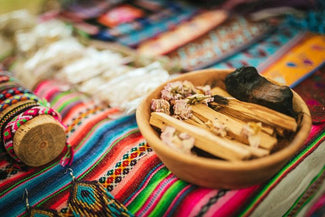
- Incense and copal – To carry prayers upward on the smoke. Shop Resin Incense & Charcoal Discs →
- Shells and feathers – Representing the elements and the natural world. Shop Smudging Feathers →
- Crystals and stones – Carrying specific intentions and energies. Shop Crystals →
- Florida Water – Used as a cleansing and offering agent. Shop Florida Water →
Types of Despacho
- Ayni Despacho – For gratitude, reciprocity, and maintaining harmony with the natural world. The most common type.
- Healing Despacho – For physical, emotional, or spiritual healing
- Abundance Despacho – For attracting prosperity, fertility, and new opportunities
- Death Rite Despacho – To support the transition of a soul after death
- New Year / Solstice Despacho – To mark seasonal transitions and set intentions for the coming cycle
How is a Despacho Completed?
- Burned – The bundle is burned in a fire, smoke carries prayers to the spirit world. Used for transformation and release.
- Buried – Buried in the earth, returning the offering directly to Pachamama. Used for grounding, healing, and abundance.
- Placed in water – Placed in a river or the sea. Used for release, flow, and letting go.
Can Anyone Perform a Despacho?
Traditionally, Despacho ceremonies are led by a trained Andean shaman or paqo. However, the Q'ero elders have shared this tradition openly, and many people now create simple Despacho offerings at home as a personal practice of gratitude and prayer. Approach it with deep respect, genuine gratitude, and a sincere heart.
Shop Shamanic & Ceremonial Tools
- Ritual Tools, Altars & Yoga
- Altar Items & Offerings
- Prayer Flags & Ritual Kits
- Resin Incense & Charcoal Discs (Copal)
- Shamanic Drums
- Rattles & Maracas
- Crystals for Ceremony
- Florida Water – Spiritual Cologne
- Smudging Feathers & Dreamcatchers
- Mestana Mesa Cloths
- Altar Manta Cloths
Related Guides
- Shamanic Tools Guide
- Shamanic Drums Explained
- Creating a Sacred Space
- Smudging & Energy Cleansing Guide
- Incense Guide