



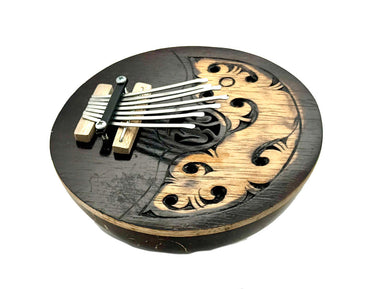
Kalimba Finger Piano 14–16cm • Tuneable Carved Coconut Thumb Piano / Calimba

A handmade coconut Kalimba from Bali, combining a carved wooden top with a natural half-coconut resonator and seven metal keys.

Also commonly searched for as a Calimba, thumb piano or finger piano, this compact acoustic instrument is played by plucking the metal tines with the thumbs or fingers. Its rounded coconut body helps give the sound a warm, resonant character, while the simple seven-key layout makes it approachable for beginners and enjoyable for casual music-making.

Product Details:

  • Product: Coconut Kalimba / Calimba / Thumb Piano / Finger Piano
  • Approx. diameter: 14–16cm
  • Approx. height: 10–12cm
  • Keys: 7 metal keys / tines
  • Body: Natural half-coconut resonator
  • Top: Carved wooden soundboard
  • Construction: Handmade
  • Origin: Bali
  • Playing style: Plucked with the thumbs or fingers
  • Tuning: Tuneable
  • Sound: Warm, resonant acoustic tone
  • Suitable for: Beginners, casual music-making, simple melodies and rhythm
  • Sold: Individually

Natural variation in coconut shell shape, carving, wood grain, colour and overall dimensions is normal.

NB: The exact key, scale and factory tuning are not confirmed in the supplied information, so these should not be stated unless separately verified.

What Is a Coconut Kalimba?

A coconut Kalimba is a small plucked instrument that uses a hollow coconut shell as part of its resonating body.

The metal tines are mounted on a wooden top and played with the thumbs or fingers. When plucked, the vibration passes through the wooden soundboard and coconut shell, helping create a fuller acoustic tone.

Kalimbas belong to the wider family of African lamellophones, although this particular version is handmade in Bali and uses a decorative coconut-body design.

Kalimba, Calimba, Thumb Piano or Finger Piano?

This type of instrument is commonly known by several names.

Kalimba is the standard modern spelling, while Calimba is a common alternative spelling used in searches and product listings. It may also be described simply as a thumb piano or finger piano because of the way the metal tines are played.

All of these terms can help buyers identify the same general style of instrument.

Seven-Key Design

This model has seven metal keys, also known as tines.

The smaller number of notes makes the layout relatively simple to understand and can suit:

  • beginners
  • casual music-making
  • simple melodies
  • rhythmic patterns
  • improvisation
  • travel and relaxation

The exact scale is not confirmed, so it is better described as a seven-key tuneable Kalimba rather than assigning it a specific musical key.

Tuneable Metal Tines

The pitch of the metal tines can be adjusted where appropriate.

Tuneable tines allow the instrument to be maintained or altered over time, although tuning should be done carefully to avoid damaging the keys or wooden mounting.

If a specific tuning is required, it is best to use a suitable tuner rather than relying only on ear.

Handmade Coconut Resonator

The half-coconut body is both decorative and functional.

Its hollow shape acts as a natural resonator, helping amplify the vibration of the metal tines. Because every coconut shell and carved top is slightly different, each instrument can vary in:

  • diameter
  • height
  • wood grain
  • carving detail
  • coconut texture
  • tone
  • resonance

These variations are part of its handmade character.

Suitable for Beginners

The straightforward playing method and seven-key layout make this a friendly instrument for people exploring Kalimba for the first time.

Simple repeating patterns can be learned quickly, while more confident players can experiment with rhythm and melody.

It can also be used as a compact acoustic instrument for relaxation, informal music-making and creative play.

How to Play

Hold the coconut body comfortably in both hands and pluck the metal tines with your thumbs or fingers.

Try:

  • alternating between left and right thumbs
  • repeating simple rhythmic patterns
  • plucking one note at a time
  • experimenting with short melodies
  • allowing each note to resonate before playing the next

A light, controlled touch is generally enough to produce a clear tone.

Quick FAQs

What size is the Kalimba?
Approximately 14–16cm in diameter and 10–12cm high.

How many keys does it have?
Seven metal keys / tines.

Is it tuneable?
Yes. The supplied information describes it as tuneable.

Is Calimba the same as Kalimba?
Calimba is a common alternative spelling. Kalimba is the standard spelling.

Is it suitable for beginners?
Yes. The simple seven-key layout makes it approachable for casual and beginner use.

What is the body made from?
A natural half-coconut shell with a carved wooden top.

Where is it made?
Bali.

What key is it tuned to?
The supplied information does not confirm a specific key or scale.

Care

Keep the instrument dry and away from prolonged damp, strong heat and direct sunlight.

Wipe the wooden and coconut surfaces gently with a soft dry cloth.

Keep the metal tines dry to help reduce tarnishing, and avoid forcing or bending them unnecessarily when adjusting tuning.

Bestellungen & Versand
Bestellungen, die vor 15:00 Uhr eingehen, werden noch am selben Tag bearbeitet und versandt. Wir versenden weltweit.

Sendungsverfolgung
Bitte verfolgen Sie Ihr Paket anhand der Sendungsdetails, die Sie in Ihrer Versandbestätigungs-E-Mail erhalten haben. Die Sendungsverfolgung wird in der Regel innerhalb von 24 Stunden nach dem Versand aktualisiert und fortgesetzt, bis die Lieferung bestätigt ist.

Zölle & Steuern
EU- und internationale Zölle und Steuern liegen in der Verantwortung des Kunden und müssen, falls zutreffend, vor Ort entrichtet werden. Für Kunden außerhalb Großbritanniens wird die britische Steuer automatisch beim Checkout entfernt, sobald das Versandziel ausgewählt wurde.

Verzögerungen durch den Zoll
Einige internationale Bestellungen können sich aufgrund von Zollkontrollen verzögern, die außerhalb unserer Kontrolle liegen. In Stoßzeiten können die Verzögerungen länger sein.

Rücksendungen
Bei Bestellungen, für die eine kostenlose Lieferung galt, können für zurückgesandte Artikel die ursprünglichen Versandkosten und eventuelle Abholkosten anfallen.

Abgelehnte oder stornierte internationale Bestellungen
Internationale Bestellungen, die abgelehnt, zurückgesandt und dann storniert werden, können mit einem Aufschlag von 10 % belegt werden. Pakete können auf Anfrage erneut versandt werden, wobei jedoch eine zusätzliche Gebühr anfallen kann.