


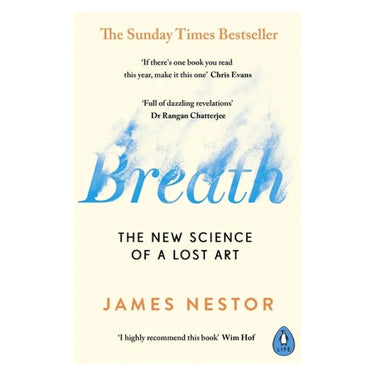
DER PHÄNOMENALE INTERNATIONALE BESTSELLER, WIE ER IN STEVEN BARTLETTS „DIARY OF A CEO“ VORGESTELLT WURDE. „Wer hätte gedacht, dass etwas so Einfaches wie die Veränderung unserer Atmung so revolutionär für unsere Gesundheit sein kann, vom Schnarchen über Allergien bis hin zur Immunität? Ein faszinierendes Buch, voller verblüffender Enthüllungen.“ Dr. Rangan Chatterjee

Nichts ist für unsere Gesundheit und unser Wohlbefinden so essenziell wie das Atmen: Luft einziehen, ausatmen, 25.000 Mal am Tag wiederholen. Doch als Spezies haben die Menschen die Fähigkeit verloren, richtig zu atmen, mit schwerwiegenden Folgen. In „Breath“ reist der Journalist James Nestor um die Welt, um die verborgene Wissenschaft hinter alten Atemtechniken zu entdecken und herauszufinden, was schiefgelaufen ist und wie man es beheben kann.


  • Taschenbuch
  • 280 Seiten
  • Penguin Hay House Publications – der weltweit führende Verlag für Mind, Body, Spirit
  • Der #1 Sunday Times Bestseller
  • Führender Autor

Zitat:

  • „Ich kann dieses Buch sehr empfehlen“ Wim Hof


Über den Autor:


James Nestor hat für Scientific American, Outside Magazine, Men's Journal, National Public Radio, The New York Times und weitere Publikationen geschrieben. Sein Buch „Deep: Freediving, Renegade Science, and What The Ocean Tells Us About Ourselves“ war Finalist für den PEN American Center Best Sports Book of the Year und ein BBC Radio 4 Book of the Week. Nestor ist in Dutzenden nationalen Radio- und Fernsehsendungen aufgetreten, darunter ABC's Nightline, die CBS Morning News und NPR. Er lebt und atmet in San Francisco.

Science, History & Ancient Breathing Practices

A major part of Breath is the connection Nestor draws between modern respiratory research and breathing practices with much older roots.

The book explores how people have deliberately altered breathing for centuries through traditions involving meditation, prayer, physical training and contemplative practice.

Nestor compares these approaches with research into respiratory physiology and investigates why seemingly small changes in breathing pattern can affect how breathing feels and how the body responds.

The result is part science journalism, part history and part personal investigation.

Breathing, Sleep & Snoring

Sleep is one of the prominent themes in the book.

The supplied description highlights Nestor's exploration of breathing in relation to healthy sleep patterns and snoring.

He investigates the role of the airway, breathing habits and nasal versus mouth breathing, presenting research and observations that challenge readers to pay closer attention to something normally performed without thought.

The book may be useful for understanding the topic, but persistent snoring, sleep apnoea or breathing difficulties require professional medical assessment rather than self-treatment through breathing exercises alone.

Exercise & Physical Performance

Breath also considers the relationship between breathing and exercise.

Nestor examines how breathing rate, rhythm and technique may affect the experience of physical activity and looks at practices used by athletes and others who deliberately train their breathing.

This does not mean there is one universal breathing method for every type of exercise.

Instead, the book introduces readers to the idea that breathing can be trained and observed rather than treated as something completely outside conscious influence.

Nasal Breathing & Breathing Habits

One of the recurring subjects in Breath is the distinction between breathing through the nose and breathing through the mouth.

Nestor explores why nasal breathing has received attention in both traditional practices and modern respiratory research, as well as what can happen when breathing habits change.

This is one of the reasons the book has appealed not only to readers interested in wellness, but also to those curious about sleep, sport and human physiology.

People with chronic nasal obstruction or respiratory conditions should seek qualified medical guidance rather than forcing a particular breathing method.

A Book About Breathing Rather Than a Quick-Fix Programme

Although Breath contains practical ideas and examples, it is best understood as an investigative book rather than a promise that one breathing technique will solve every health problem.

Nestor presents a wide range of research, experiments and traditional practices and encourages readers to reconsider assumptions about an automatic biological process.

That makes the book particularly suitable for readers who enjoy popular science that moves between physiology, history and personal experience.

What the Book Explores

Across its 280 pages, Breath looks at subjects including breathing mechanics, nasal and mouth breathing, sleep, snoring, physical performance and historical breathing techniques.

It also examines how different cultures have developed deliberate breathing practices and why modern researchers have returned to some of the same questions.

The supplied promotional description goes further by referring to allergies, asthma, immunity and autoimmune disease. Those subjects should be approached carefully: breathing practices may be an area of research or supportive wellbeing practice, but they should not be treated as proven replacements for medical treatment.

Why Breath Became So Widely Read

Part of the book's appeal is the familiarity of its subject.

Everyone breathes continuously, yet most people spend very little time thinking about how breathing works.

Nestor turns that everyday function into a broader investigation involving anatomy, evolution, sport, sleep and traditional practice.

The supplied description also notes that the book has received prominent recommendations and media attention, including discussion on Steven Bartlett's Diary of a CEO and a recommendation from Wim Hof.

Who May Enjoy This Book?

Breath may appeal particularly to readers interested in popular science, human biology, sleep, exercise and evidence-informed wellbeing.

It may also suit those curious about meditation or traditional breathing practices who want to understand how these ideas are discussed alongside modern scientific research.

Readers looking for a purely clinical respiratory textbook should be aware that the book is written as accessible investigative journalism rather than as a medical reference work.

Quick FAQs

What is Breath: The New Science of a Lost Art about?
It is an investigative nonfiction book by James Nestor examining breathing, respiratory science, sleep, exercise and historical breathing practices.

Who wrote Breath?
Journalist and author James Nestor.

How long is the book?
The supplied product information lists 280 pages.

What format is it?
Paperback.

Is Breath a self-help book?
It contains practical ideas, but its main format is investigative popular science combining research, history and personal experimentation.

Does the book discuss nasal breathing?
Yes. Nasal versus mouth breathing is one of the important subjects explored.

Does it cover sleep and snoring?
Yes. The relationship between breathing, sleep and snoring is discussed within the book.

Can breathing exercises cure asthma, allergies or autoimmune disease?
The promotional material makes strong claims in these areas, but breathing techniques should not be treated as proven cures or substitutes for medical care.

Is the book suitable for readers interested in meditation and breathwork?
Yes. It explores both contemporary research and older breathing traditions, making it relevant to readers interested in breathwork as well as science.

Care & Storage

Store the paperback in a dry place away from excessive moisture and prolonged direct sunlight.

Avoid heavily bending the spine if you want to preserve the book in good condition.

Disclaimer

This book discusses breathing, health and physiological research for educational purposes. It should not replace personalised medical advice, diagnosis or treatment. Anyone with respiratory disease, cardiovascular concerns, sleep apnoea or other significant health conditions should seek appropriate professional guidance before making substantial changes to breathing practices.

Bestellungen & Versand
Bestellungen, die vor 15:00 Uhr eingehen, werden noch am selben Tag bearbeitet und versandt. Wir versenden weltweit.

Sendungsverfolgung
Bitte verfolgen Sie Ihr Paket anhand der Sendungsdetails, die Sie in Ihrer Versandbestätigungs-E-Mail erhalten haben. Die Sendungsverfolgung wird in der Regel innerhalb von 24 Stunden nach dem Versand aktualisiert und fortgesetzt, bis die Lieferung bestätigt ist.

Zölle & Steuern
EU- und internationale Zölle und Steuern liegen in der Verantwortung des Kunden und müssen, falls zutreffend, vor Ort entrichtet werden. Für Kunden außerhalb Großbritanniens wird die britische Steuer automatisch beim Checkout entfernt, sobald das Versandziel ausgewählt wurde.

Verzögerungen durch den Zoll
Einige internationale Bestellungen können sich aufgrund von Zollkontrollen verzögern, die außerhalb unserer Kontrolle liegen. In Stoßzeiten können die Verzögerungen länger sein.

Rücksendungen
Bei Bestellungen, für die eine kostenlose Lieferung galt, können für zurückgesandte Artikel die ursprünglichen Versandkosten und eventuelle Abholkosten anfallen.

Abgelehnte oder stornierte internationale Bestellungen
Internationale Bestellungen, die abgelehnt, zurückgesandt und dann storniert werden, können mit einem Aufschlag von 10 % belegt werden. Pakete können auf Anfrage erneut versandt werden, wobei jedoch eine zusätzliche Gebühr anfallen kann.