

Explore the Gaelic Roots, Spiritual Meaning and Simple Modern Rituals of Samhain

The darkening of the year can make even an ordinary evening feel more reflective. Leaves gather at the doorstep, the heating comes on, and the natural world seems to ask us to slow down. Samhain explained - meaning, traditions, rituals and spiritual significance - begins with this seasonal turning point, rather than with costumes or dramatic ideas about the supernatural.
Observed around 31 October to 1 November, Samhain is an ancient Gaelic festival associated with the end of harvest and the beginning of winter. For many modern Pagans, Druids, Wiccans and spiritually curious people, it remains a meaningful time to honour ancestors, reflect on what has passed and prepare inwardly for the quieter months ahead.
What does Samhain mean?
Samhain is usually pronounced sow-in, though pronunciation can vary by region and language tradition. The name is commonly understood as referring to the summer's end. In the Gaelic calendar, it marked the shift from the lighter half of the year to the darker half, with the new seasonal year beginning as winter approached.
This was not simply a date in an old calendar. For farming communities in Ireland and Scotland, it was a practical threshold: livestock were brought in, harvest work was completed and households prepared for colder, leaner days. Fires, food, hospitality and community all had their place. The spiritual meaning grew from life as it was lived - close to land, weather, animals and the reality of seasonal change.
Historical evidence for early Samhain comes largely from medieval Irish literature, archaeology and later folk custom. That means we should be careful about claiming certainty over every modern ritual or belief. Some present-day practices are reconstructions, some are inspired by folklore, and some are personal expressions. That does not make them empty. It simply invites honesty, respect and thoughtful intention.
Samhain traditions and their connection to Halloween
Samhain is often described as the origin of Halloween, but the relationship is more layered than that. Halloween developed through a mixture of Gaelic seasonal customs, Christian observances such as All Hallows' Eve and local traditions that changed over generations. They share a date and certain themes, but they are not interchangeable.
Traditionally, Samhain was associated with bonfires, communal gatherings, divination customs and offerings. In folklore, it was sometimes seen as a liminal time - a threshold when the usual boundaries between worlds felt less fixed. Stories of the spirits of the dead, fair folk and protective customs belong to this cultural landscape.
For modern practitioners, the idea of a thinning veil is often held symbolically rather than literally. It can describe a heightened awareness of memory, grief, intuition and the unseen influence of those who came before us. Some people work with this language spiritually; others prefer to see Samhain as a season for remembrance and reflection. Both approaches can be sincere.
It is also worth separating respectful ancestor practice from a vague fascination with the eerie. An ancestor altar does not need to be elaborate, and it should not turn real people into decorative symbolism. It may hold a photograph, a name, an inherited object, a family recipe or a quiet acknowledgement of those whose lives shaped your own. For those with painful, unknown or complicated family histories, ancestors can also mean teachers, elders, cultural roots, chosen family or the wider human story.
The spiritual significance of Samhain
Samhain asks a question that modern life often avoids: what needs to be allowed to end? This is not about forcing a dramatic transformation before winter. It may be as ordinary as releasing an overfull diary, recognising a habit that drains you, or accepting that a chapter has genuinely changed.
Many practitioners see Samhain as a time for three connected practices: remembrance, release and rest. Remembrance honours what has been. Release creates space for what is no longer needed. Rest recognises that not every season is for visible growth. In the Lake District, the shift can be felt in the early darkness across the fells and the change in the air. The landscape does not apologise for becoming quieter, and neither do we have to.
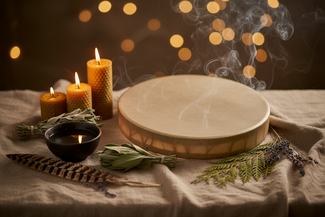
This makes Samhain especially suitable for grounded spiritual tools. A candle can create a point of focus for reflection. Incense or a sacred spray may help mark the transition from everyday activity into a few intentional minutes. A journal, tarot deck or oracle cards can offer a prompt when you are unsure what you are carrying forward. These tools do not have to produce a particular answer. Their value often lies in helping us listen more carefully.
If grief feels close at this time of year, keep your practice gentle. Ritual can support reflection, but it is not a replacement for speaking with trusted people or seeking professional help when it is needed.

Simple Samhain rituals for home
A meaningful Samhain ritual need not involve special clothing, complex correspondences or a large altar. Begin with an intention that feels true to your life. You might want to remember someone, clear the atmosphere of your home after a demanding period, or welcome a more restful rhythm.
Share a simple seasonal meal
Not every Samhain practice needs to take place at an altar. Food, hospitality and the end of the harvest belong naturally within the seasonal character of the festival.
A simple meal made with autumn produce can become a way of acknowledging where your food has come from and the people who share your table. Apples, root vegetables, bread, oats, nuts or a warming soup need no elaborate spiritual meaning added to them. Preparing and eating them with attention may be ritual enough.
You might pause before eating to remember someone who is no longer at the table, give thanks for what has sustained you through the year, or acknowledge the farmers, growers and many hands involved in bringing food to your home.
For some people, sharing food with family or friends will feel more meaningful than performing a formal ceremony. Samhain can be encountered around the kitchen table as readily as at an altar.
Create a small ancestor space
Choose a shelf, windowsill or corner of your altar. Place a photograph or written name there, perhaps alongside a natural object, a candle and a small offering of seasonal food or flowers. Spend a moment sharing a memory, expressing thanks or sitting quietly.
If you do not wish to work with personal ancestors, make the space one of gratitude instead. You could honour the people who have supported you, the traditions that nourish you or the countless hands behind the food on your table. When you are finished, remove food offerings promptly and safely.
Use fire or candlelight with care
Fire has a long association with Samhain, yet a single tealight or pillar candle can be enough for a home ritual. Before lighting it, write down one thing you are ready to leave behind - perhaps a worry, resentment or expectation. Read the words quietly, then tear up the paper and dispose of it safely. Avoid burning paper indoors unless you have a suitable fireproof vessel and proper ventilation.
As the candle burns, consider what you need to protect during the darker season. It may be your sleep, your energy, your creativity or your boundaries. Release is more useful when it is followed by practical care.
Cleanse and settle your space
Energy cleansing at Samhain does not need to suggest that your home is full of something frightening. It can be a simple reset after busy months, visitors, work stress or emotional heaviness. Open a window where practical, tidy one small area and use incense, resin, a smudge stick or a room mist in a way that suits your household.
Choose materials thoughtfully. Some people prefer the scent and ritual of incense; others need a smokeless option because of pets, children, allergies or shared living spaces. A sacred spray, bell, singing bowl or meditation chime can mark the same intention without smoke. Move slowly through the room and focus on the atmosphere you are creating: calm, clarity, warmth or rest.

Step outside and notice the season
Samhain is rooted in a seasonal turning, so one of the simplest ways to approach it is to notice what is actually happening outside.
Take a quiet walk at dusk, feel the change in temperature, notice which trees have lost their leaves and how quickly darkness arrives. You do not need to interpret everything as a sign. Simply paying attention can reconnect the festival with the changing land rather than experiencing it only through objects and ritual.
If it feels appropriate, bring home a fallen leaf, acorn or small natural object that can be gathered responsibly and place it on your seasonal altar. Return it to the earth when the season changes.
Reflect with cards or journalling
Tarot and oracle cards are often chosen at Samhain for reflection rather than prediction. Try drawing one card for what the past season taught you, and another for what deserves your attention through winter. Keep the questions open. Instead of asking what will happen, ask what you are being invited to understand.
Journalling can be equally powerful. Write a short list of what you are thankful for, what feels complete and what you would like to tend quietly over the coming months. There is no need to solve everything in one sitting.
A respectful way to approach Samhain
Samhain has deep roots in Gaelic culture and is a living festival for many people today. Approaching it respectfully means resisting the urge to treat it as a generic aesthetic or to repeat historical claims that cannot be supported. Learn what you can, acknowledge the tradition and allow your own practice to be personal without claiming ancient authority for it.
It also means letting the season be what it is. Some people will hold ceremony with their coven or community; others will cook a seasonal meal, walk at dusk or light a candle after the children are in bed. The scale of the ritual matters far less than the quality of attention.
As autumn closes around us, Samhain offers no demand to become someone new overnight. It offers a quieter invitation: remember what matters, set down what has become too heavy, and make a little room for the stillness ahead.

Explore Further with Sacred Essence
Explore the Shop Samhain & Seasonal Practice:
- Candles
- Incense Collection
- Incense Sticks
- Incense Cones
- Resins & Charcoal
- Tarot & Oracle Cards
- Altar & Ritual Tools
Continue Your Journey — Read other Seasonal Blogs:
- All Blogs
-
Autumn Equinox Rituals
- A Candle Fire Ceremony
- Lamas - First Harvest
- How to Create a Spiritual Altar
As the year grows quieter, Samhain reminds us that letting go is not an emptying of life, but part of its natural turning. ✨
Sacred Essence 🌈