


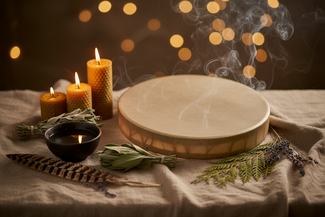
A candle fire ceremony can be as simple as lighting one flame at the end of a difficult day, then sitting long enough to notice what you are ready to put down. It does not need dramatic words, rare tools or a perfectly arranged altar. Its value often lies in the pause: a conscious moment to name an ending, honour what has happened and choose how you want to move forward.
Fire has long held a place in spiritual, religious and seasonal traditions around the world. It can represent warmth, light, transformation, protection and remembrance. A personal candle ritual is not the same as recreating a specific cultural or ceremonial practice, however. It is best approached with humility, clear intention and respect for traditions that hold fire ceremonies within particular communities.
For many people, a simple candle practice offers a grounded way to work with change. It may sit alongside meditation, prayer, journalling, Reiki, tarot reflection or simply a quiet cup of tea after a demanding week.
What is a candle fire ceremony?
A candle fire ceremony is an intentional ritual using a candle flame as a focus for reflection, release or renewal. Some people write down a thought, habit or situation they wish to leave behind and safely burn the paper. Others do not burn anything at all. They may light a candle, speak an intention aloud, meditate with the flame, then let the candle burn for a short and supervised time.
The flame is not required to make a change happen for you. Instead, it gives shape to a decision that can otherwise remain vague. Saying, “I am ready to create better boundaries,” is different from taking the practical steps that follow. Yet marking that decision can make it feel more real, memorable and emotionally honest.
This is why candle ceremonies can be useful at turning points: after an argument, at the end of a season, before a new job, following a house move or when a familiar pattern no longer feels helpful. They can also be used for gratitude and welcome, not only release.
Begin with an intention, not a perfect ritual
Before choosing your candle, decide what the ceremony is for. A broad intention such as “release” can be meaningful, but a more specific one may give the practice greater clarity. You might be letting go of self-criticism after a setback, acknowledging grief, welcoming confidence before an important conversation or creating a calmer atmosphere in your home.
Keep the language truthful. There is no need to force a positive statement that does not feel believable. “I am willing to take one small step towards rest” may be more useful than declaring that everything is already resolved. Many practitioners find that an honest intention supports deeper reflection than a grand promise.
If you use divination cards, you could draw one card beforehand as a prompt. If you work with crystals, a piece of smoky quartz, black tourmaline or clear quartz may be placed nearby as a tactile anchor for your meditation. These associations are personal and traditional rather than guarantees. Choose an item because it supports your focus, not because you feel you must collect a particular set of tools.
Choosing a candle
A plain unscented candle is often the most practical choice, especially if you are sensitive to fragrance or sharing a home with others. A tealight in a suitable holder works well for a brief ceremony. A pillar candle may suit a longer meditation, provided it is secure and watched throughout.
Some people choose colours to reflect their intention. White is often used for clarity, peace and simplicity; black may be chosen for protection or release; green for growth; pink for compassion; and yellow for confidence and clear thinking. Colour can add a useful visual language, but the intention matters more than getting the symbolism “right”.
Natural wax candles are a popular option for home ritual, though the best candle is ultimately one that burns safely in an appropriate holder. Keep the wick trimmed to around 5 mm, place the candle on a heat-resistant surface and keep it away from curtains, pets, children and draughts.
How to hold a simple candle fire ceremony
Start by making the space feel settled. You might tidy the table, open a window briefly, silence your phone or use a little incense, a sacred spray or a meditation chime. None of these are essential. The purpose is to signal that you are stepping out of distraction for a few minutes.
Place your candle in a stable holder and sit comfortably. Take several slow breaths, letting your shoulders soften. Notice where your body is supported by the chair or floor. Grounding first can be particularly helpful if your intention involves anger, anxiety or a strong emotional response.
Light the candle and spend a moment watching the flame. Rather than trying to empty your mind, allow yourself to notice what is present. You may wish to say a few words such as, “I acknowledge what this has taught me, and I release what I no longer need to carry.” If formal language does not suit you, speak naturally or remain silent.
Then write a short sentence on a small piece of plain paper. Be specific and kind. “I release the need to replay that conversation” is gentler and more workable than “I release all my problems.” You can also write what you are welcoming in its place: steadier sleep, clearer boundaries, patience, courage or a practical next step.
If you choose to burn the paper, do so only in a fireproof bowl, cauldron or metal dish on a non-flammable surface. Tear the paper into small pieces and burn one piece at a time. Never hold paper over the candle, never use a glass jar not designed for heat, and never add herbs, essential oils or other materials to the flame. Keep water nearby, ventilate the room and extinguish everything fully when you finish.
A safer and equally meaningful alternative is to fold the note and place it beneath the candle holder while you meditate, then tear it up and put it in your household waste or recycling where appropriate. You could also keep an intention note in a journal for a month, returning to it as a reminder of the actions you want to take.
Fire safety is part of the ceremony
A respectful relationship with fire includes knowing when not to use it. Avoid a flame if you are tired, have been drinking alcohol, are feeling overwhelmed, live in accommodation with restrictions, or cannot give the candle your full attention. An LED candle can still create a clear ritual focus, particularly in shared homes, care settings, workplaces or around children and animals.
Never leave a candle burning unattended, even for a minute. Extinguish it before leaving the room or going to sleep, and allow the holder and wax to cool before moving them. A candle snuffer is useful, but gently blowing out a small candle is also fine if it can be done safely. What matters is care, not ceremony for its own sake.
Be cautious with incense and resins too. Their scent may help some people settle into a ritual mood, while others experience headaches, asthma symptoms or discomfort. Fresh air and simplicity are often the better choice.
Making the meaning last after the flame goes out
The most useful part of a release ritual may happen the next morning. Ask yourself what one ordinary action would honour the intention you set. If you released overcommitment, perhaps you decline one unnecessary request. If you welcomed calm, you might take a ten-minute walk without your phone. If you named a difficult relationship pattern, you may decide to seek a conversation, counselling or other appropriate support.
This is where spiritual practice meets real life. Candles, crystals and ritual objects can be beautiful companions, but they work best alongside practical boundaries, rest, communication and professional help when it is needed. A ceremony can help you recognise a truth. It does not ask you to carry that truth alone.
You may find that your most meaningful candle fire ceremony is not the one that feels the most dramatic. It may be the quiet flame lit on a rainy evening, a few sincere words, and one small choice that makes tomorrow feel more aligned with the life you want to live.