Q’ero Shaman Ceremonial Ponchos from the Peruvian Andes
We are honoured to offer Paqo Shaman Ponchos handmade by Q’ero artisans from the Peruvian Andes. These distinctive woven garments draw on Andean textile traditions and are associated with ceremony, community, spiritual practice and connection to Pachamama, or Mother Earth.
Within Q’ero tradition, Paqos are spiritual practitioners whose ceremonial work is closely connected with the mountains, land and ancestral customs of the Andes. The ponchos in this collection reflect the strong colours, woven patterns and symbolic character associated with Q’ero and Andean textile culture.
Each piece is individually woven and carries its own combination of colour, pattern and character, making these ponchos suitable for ceremonial use, ritual practice, gatherings or as meaningful examples of traditional Peruvian textile craftsmanship.
Q’ero ponchos sit at the meeting point between practical clothing, community identity and ceremonial life.
Different garments may be used for different purposes. Some are brightly coloured and visually expressive, while others use darker, more restrained designs suited to particular ceremonial contexts. Materials, construction, colours and detailing can also vary from one poncho to another.
Within this collection you may find both traditional-style woven pieces and machine-made Peruvian garments produced for contemporary Q’ero Paqo use. Each individual product page should therefore be treated as the definitive source for its material, construction, dimensions and design.
Craftsmanship, Materials & Construction
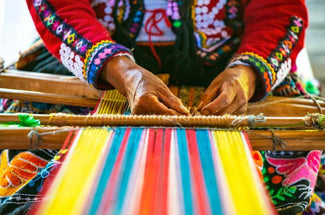
Q’ero and wider Andean textile traditions are known for strong colour, geometric pattern, practical wool garments and close relationships between clothing, place and community.
The ponchos in this collection are sourced from Peru and may use alpaca wool, fine sheep wool or a combination of fibres depending on the individual garment.
Construction also varies.
Some pieces may be handwoven or handmade, while others are machine made by Peruvian artisans for Q’ero Paqos who wear them in contemporary ceremonial and everyday contexts.
We therefore avoid describing the entire collection as handwoven or naturally dyed unless those details are confirmed for a specific poncho.
Ponchos for Ritual & Fire Ceremony
Ponchos can be worn by Q’ero Paqos during ritual gatherings, ceremonial work and fire ceremonies as well as in ordinary life.
The loose traditional form allows a poncho to be layered easily over other clothing, making it practical in the cooler conditions of the Andes and during outdoor ceremonial gatherings.
Some darker designs are associated in the supplied Paqo tradition with protection, concealment and inward ceremonial focus.
More colourful ponchos may have a stronger public or celebratory presence.
The meaning of an individual garment comes from its particular design rather than from one universal colour code applied to all Q’ero ponchos.
K’uychi, Pachamama & Symbolic Colour
Individual ponchos may carry their own symbolic language.
For example, in the black K’uychi design within this collection, K’uychi — the Quechua word for rainbow — is understood in the supplied Q’ero Paqo tradition as the Jaguar Bridge between worlds, associated with passage and transformation.
Brown detailing is connected with Pachamama, Mother Earth, while black is associated with protection, concealment and inward focus.
These meanings belong to the context supplied with particular garments and should not be assumed to apply identically to every Q’ero or Andean textile.
Who Are the Q’ero Paqos?
The Q’ero are Indigenous Quechua-speaking communities of the Peruvian Andes with living cultural and spiritual traditions.
A Paqo is a practitioner within an Andean spiritual framework.
The word is often translated loosely as “shaman” for English-speaking audiences, but Paqo carries a more specific cultural meaning and should not simply be treated as another name for a generic shaman.
That is why both terms appear on this collection: “shaman poncho” helps customers understand the type of ceremonial garment they are looking for, while Q’ero Paqo provides the more culturally specific context.
Practical Wear Beyond Ceremony
Although ceremonial significance is central to many of these garments, ponchos remain practical clothing.
Their generous shape makes them easy to layer for outdoor gatherings, travel and cooler weather, while alpaca and wool fibres provide warmth without requiring the fitted construction of a conventional coat.
Some customers choose these ponchos primarily for ritual practice; others appreciate them as distinctive examples of Peruvian clothing and textile design.
Both uses can sit comfortably together.
Ponchos, Mesa Cloths & Q’ero Ceremonial Textiles
Paqo practice may involve a wider group of textiles and carrying pieces in addition to ponchos.
Within the Sacred Essence Q’ero collection you can also explore Mestana mesa cloths, Unkuna inner cloths, altar mantas, Inti Watana wraps and mesa ties, shoulder bags, Chuspas, Khuya bags and medicine or prayer pouches.
These items serve different practical and ceremonial roles and should not be treated as interchangeable parts of one fixed universal “toolkit”. Their use can vary according to practitioner, lineage and context.
Supporting Peruvian Makers
Purchasing one of these ponchos supports the Peruvian makers and supply relationships through which the garments reach this collection.
Where we have specific information about the individual maker, community, construction method or textile process, we include it on the relevant product page.
We avoid making broader claims about community benefit, Indigenous economic support or preservation of ancient traditions unless those relationships can be documented directly.
Frequently Asked Questions
What is a Q’ero Paqo poncho?
A poncho made for or associated with Q’ero Paqo use in Peru. Depending on the garment, it may be worn for ceremony, fire ritual, outdoor gatherings or everyday life.
Are all Q’ero ponchos handwoven?
No. Construction varies. Some may be handwoven, while others are machine made in Peru by Peruvian artisans for Q’ero Paqos. Check the individual product page for the exact construction.
What are Q’ero ponchos made from?
Materials can include alpaca wool, fine sheep wool or blends depending on the individual garment.
What does Paqo mean?
Paqo is a term used for a practitioner within Andean spiritual traditions. “Shaman” is sometimes used as an approximate English description but is not an exact equivalent.
Are these ponchos worn for fire ceremonies?
Some styles are worn by Q’ero Paqos during fire ceremonies and other ritual gatherings. Individual product pages explain the use-context of each design.
What does K’uychi mean?
K’uychi is Quechua for rainbow. In the supplied symbolism of particular Q’ero Paqo designs, it can represent the Jaguar Bridge between worlds and themes of passage and transformation.
What does Pachamama mean?
Pachamama is an important Andean sacred concept associated with Mother Earth, land, fertility, place and reciprocity.
Can I wear a Q’ero poncho casually?
Yes. These are practical garments as well as ceremonial clothing and can also be worn for travel, outdoor use or everyday wear.
Are the ponchos one size?
Many traditional poncho designs have a generous one-size construction, but dimensions vary. Check each individual product page for exact measurements.
How should I care for an alpaca poncho?
Follow the care instructions on the individual garment. Where appropriate, alpaca garments are generally hand washed gently in cool to lukewarm water with mild detergent, reshaped while damp and air dried away from high heat.