
Resin Incense & Charcoal Discs – How to Burn Resin Incense
How to burn resin incense safely and effectively — a complete guide to resins, charcoal discs, burners, and ritual use.
There is something that changes in a room when resin hits a hot charcoal disc. The smoke rises slowly, the fragrance opens and deepens, and the air itself seems to shift. Frankincense, myrrh, copal, dragon's blood — these resins have been carried across trade routes, burned in temples, offered to the dead, and used to mark the threshold between the ordinary and the sacred for thousands of years. They have survived because they work: they cleanse, they ground, they open, they protect. Browse our Resin Incense & Charcoal collection → | Shop Incense Burners →
How to Choose Your Resin – A Quick Guide
- For meditation, prayer, or sacred space — Frankincense; the most universally used resin for spiritual practice
- For deep cleansing, healing, or ancestral work — Myrrh, or Frankincense & Myrrh together
- For ceremony, shamanic practice, or offering — Copal; the traditional resin of Mesoamerican and Andean ceremony
- For protection or amplifying intention — Dragon’s Blood; the most potent protective resin
- For warmth, comfort, or emotional healing — Benzoin; sweet, vanilla-like, deeply welcoming
- Not sure — start with Frankincense; it is the most versatile and universally accessible of all resins
Resin Incense – Quick Comparison
| Resin | Scent | Best For | Tradition |
|---|---|---|---|
| Frankincense | Warm, woody, slightly citrus | Meditation, prayer, sacred space, stress relief | Egyptian, Jewish, Christian, Islamic, Buddhist |
| Myrrh | Deep, earthy, slightly bitter | Healing, grounding, ancestral work, grief, transition | Egyptian, Hebrew, Islamic, Chinese medicine |
| Copal | Bright, clean, slightly sweet | Ceremony, space clearing, offering, shamanic practice | Maya, Aztec, Andean Q’ero |
| Dragon’s Blood | Rich, warm, earthy with sweetness | Protection, banishing, amplifying intention, strength | Mediterranean, Arabic, magical traditions |
| Benzoin | Sweet, warm, vanilla-like | Comfort, prosperity, emotional ease, blending | Southeast Asian, Middle Eastern, European perfumery |
What Is Resin Incense?
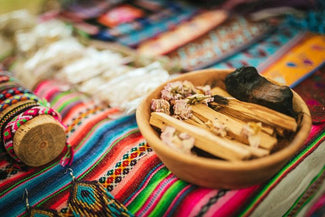
Resin incense is the hardened sap or gum of a tree or plant — collected by making small cuts in the bark and allowing the substance to harden slowly in the air. The resulting pieces are placed on a burning charcoal disc to release their fragrance and smoke. Because they are pure and unprocessed, without binding agents, accelerants, or synthetic fragrance, resins produce a richer, more complex, and more authentic smoke than manufactured incense sticks. What you are burning is the tree itself.
Resin Incenses – Their Stories & Uses
Frankincense
Frankincense is the resin of the Boswellia tree, native to Oman, Somalia, Ethiopia, and Yemen. It has been burned in sacred ceremony for over 5,000 years — in the temples of ancient Egypt, the Jewish Temple in Jerusalem, Catholic and Orthodox churches, and in Sufi, Buddhist, and shamanic traditions. Its smoke was believed to carry prayers upward, purify the space between the human and the divine, and prepare the mind for worship. Research has identified compounds in frankincense smoke that reduce anxiety and promote a genuine sense of stillness.
Best for: Meditation, prayer, opening sacred space, spiritual cleansing, stress relief
In ritual: Burn before meditation or prayer to settle the mind. Use to open ceremony or mark the beginning of intentional practice. Burn during full moon rituals, altar work, or any time you want to create a palpable sense of the sacred.
Shop Frankincense →
Myrrh
Myrrh is the resin of the Commiphora tree, native to Northeast Africa and the Arabian Peninsula. Used in ancient Egyptian embalming rituals, the Hebrew Temple, traditional Chinese medicine, and the Islamic tradition for thousands of years. Its scent is deeper and earthier than frankincense — slightly bitter, warm, and heavy. Where frankincense lifts and opens, myrrh grounds and deepens. The two are frequently burned together, balancing each other perfectly.
Best for: Deep cleansing, healing work, grounding, ancestral connection, grief and transition
In ritual: Burn during grief rituals, ancestral offerings, or work connected to healing and release. Use alongside frankincense at the new or full moon. Particularly resonant for marking endings.
Shop Myrrh →
Copal
Copal is the sacred resin of Mesoamerica — burned by the Maya and Aztec as an offering to the gods and a bridge between the human world and the spirit world. Its name comes from the Nahuatl word copalli, meaning incense. It remains central to the Despacho ceremony of the Andean Q’ero tradition, and to Day of the Dead altars, where its smoke is believed to guide the spirits of the dead back to visit their families. The scent is bright, clean, and slightly sweet — one of the most powerfully cleansing resins available.
Best for: Space cleansing, ceremony, offering, connecting with spirit, shamanic practice
In ritual: Burn to open ceremony and call in spirit. Use for space clearing after illness, conflict, or difficult events. See our Shamanic Journeying guide → and Despacho Ceremony guide →
Shop Copal →
Dragon’s Blood
Dragon’s Blood is the deep red resin of the Dracaena tree, found across the Canary Islands, the Socotra archipelago, and parts of Asia. Traded across the Mediterranean world and appearing in Greek, Roman, and Arabic texts as a substance of remarkable power. Its scent is rich, warm, and deeply aromatic — earthy and resinous, with a slight sweetness. It burns more intensely than frankincense and is one of the most popular resins for protective and intention-amplifying work.
Best for: Protection, banishing negativity, amplifying intention, strength
In ritual: Burn to set a protective boundary around a space before ritual or ceremony. Use to amplify the potency of other resins in a blend. Burn during intention-setting rituals where you want clarity and conviction.
Shop Dragon’s Blood →
Benzoin
Benzoin is the resin of the Styrax tree, native to Sumatra and Java. Its scent is unlike any other resin — sweet, warm, and vanilla-like, with a softness that feels immediately welcoming. Used in perfumery, medicine, and ceremony across Southeast Asia, the Middle East, and Europe for centuries. Where other resins cleanse or protect, benzoin warms. Particularly beautiful burned in a home that needs lifting — after a period of difficulty, during recovery, or simply on a grey winter afternoon.
Best for: Purification, prosperity, emotional comfort, welcoming energy, blending
In ritual: Burn to create a warm, inviting atmosphere for gatherings or healing rituals. Blend with frankincense for a deeply comforting combination. Burn at the new year or any new beginning to invite warmth and abundance.
Shop Benzoin →
What You Need to Burn Resin Incense
- A heat-proof burner — brass, ceramic, soapstone, or cast iron. Shop Incense Burners →
- Burner sand — 2–3cm in the base of your burner to insulate from the heat. Shop Burner Sand →
- Charcoal discs — self-lighting discs designed for incense burning (never barbecue charcoal). Available as a single roll of 10, a box of 10 rolls, or a box of 80 discs
- Tongs — to hold and place the charcoal safely while it lights. Available as 7.5cm tongs, 18cm long tongs, or a tong & spoon set
- Your resin incense — start with just 2–3 small pieces; you can always add more
How to Burn Resin Incense – Step by Step
- Prepare your burner — place on a heat-proof surface and fill the base with 2–3cm of burner sand
- Light the charcoal disc — using tongs, hold at an angle and apply a flame until it sparks and begins to glow across the surface
- Place in the burner — concave (hollow) side facing up. Allow to heat for 2–3 minutes until glowing orange-red with a light covering of grey ash
- Add your resin — place 2–3 small pieces into the hollow. The resin will melt and smoke almost immediately
- Add more as needed — a single disc remains hot for 45–60 minutes. Add fresh resin every 10–15 minutes for continuous smoke
- Allow to cool completely — this takes an hour or more. Never move a hot burner or dispose of ash that may still be warm
Using Resin in Ritual & Practice
Opening Sacred Space
Light a disc, place frankincense or copal, and carry the burner slowly through each room clockwise. Speak your intention aloud — what you are inviting in, what you are asking to leave. The smoke marks the boundary between ordinary time and sacred time. See our Creating a Sacred Space guide →
Before Meditation or Prayer
Light frankincense five minutes before you sit. The act of preparation — lighting the disc, waiting for it to ash over, placing the resin — is itself a ritual of slowing down and becoming present. By the time the smoke rises, the mind has already begun to shift. See our Meditation guide →
Ceremony & Offering
Copal and myrrh are the traditional resins for ceremony — for Despacho, for ancestral altar work, for fire ceremony. Place a small bowl of unburned resin on your altar as an offering; burn it at the close of ceremony as the final release. See our Fire Ceremony guide → and Shamanic Tools guide →
Space Clearing After Difficulty
After illness, conflict, grief, or a period of stagnation, burn frankincense and copal together throughout your home. Open all the windows. Move slowly. Allow the smoke to reach corners, doorways, and places that feel heavy. Follow with a sacred spray for a complete reset. See our Energy Cleansing guide →
Seasonal & Moon Rituals
Frankincense at the full moon; myrrh at the dark moon or new moon for release work; copal at seasonal ceremonies and solstices; benzoin at the new year or any new beginning. See our Creating Sacred Space guide →
Blending Resins
- Frankincense & Myrrh — the most ancient combination; elevating and grounding simultaneously, deeply purifying; used in temples for thousands of years
- Frankincense & Copal — bright, clean, and powerfully cleansing; excellent for space clearing and opening ceremony
- Dragon’s Blood & Frankincense — protective and spiritually uplifting; use when you want the space to feel both clear and fortified
- Myrrh & Benzoin — warm, deep, and comforting; beautiful for healing rituals and emotional support work
- Copal & Myrrh — earthy and ceremonial; the combination most often used in Andean and Mesoamerican practice
Sourcing & Quality – What to Look For
Provenance matters — Boswellia (frankincense) trees are under significant ecological pressure due to overharvesting in parts of Africa and the Middle East. Quality suppliers source responsibly and can speak to their supply chain. Cheap, unprovenanced frankincense is often from over-tapped trees producing inferior resin.
Resin vs fragrance-soaked wood chips — some products sold as “resin incense” are actually wood chips or sawdust soaked in synthetic fragrance oil. Genuine resin pieces are irregular, hard, and often slightly translucent or amber-coloured. They should be fragrant even before burning.
Colour and clarity — quality frankincense ranges from pale yellow-green to amber and has a bright, crystalline quality. Dark, crumbly, or powdery resin is often old, poorly stored, or of inferior grade. Myrrh is naturally darker — reddish-brown to near-black — and naturally more brittle.
Scent before burning — good resin is fragrant when cold. Scratch the surface lightly — it should release a clear, recognisable scent. Resins that only smell when burned, or that smell synthetic when cold, may not be pure.
Charcoal quality — use specifically designed incense charcoal (such as Excelsior or Swift-Lite discs). These contain a small amount of accelerant to allow easy lighting. Never use barbecue charcoal indoors — it produces toxic levels of carbon monoxide.
Safety
- Always burn in a well-ventilated space — open a window or door
- Never leave burning charcoal unattended
- Keep away from children and pets
- Use a heat-proof surface under your burner at all times — the base gets very hot
- Keep flammable materials well away from the burner
- Do not use barbecue charcoal or self-lighting BBQ briquettes indoors
- Allow at least an hour for the charcoal to cool completely before handling or disposing of ash
Storing Your Resins
- Keep dry — moisture is the enemy of resin; it causes clumping, mould, and degradation of the aromatic compounds. Store in a cool, dry place away from the bathroom or kitchen.
- Airtight containers — unlike most fragrant materials, resins benefit from airtight storage, which preserves their volatile aromatic compounds. Small glass jars with lids are ideal.
- Away from direct sunlight — UV light degrades resin quality over time; a drawer or cupboard is preferable to an open shelf.
- Charcoal discs — keep in their foil packaging until use and store in a dry environment. Damp charcoal is extremely difficult to light and may not reach full temperature. A silica gel sachet in the storage box is useful in humid climates.
- Label your blends — if you mix resins in advance, label the jar with contents and date; resin blends keep well for years when stored correctly.
Shop Resin Incense & Equipment
- All Resin Incense & Charcoal
- Charcoal Discs – Single Roll of 10
- Charcoal Discs – Box of 10 Rolls
- Charcoal Discs – Box of 80 Discs
- Incense Burner Sand 200g
- Charcoal Tongs 7.5cm
- Charcoal Tongs 18cm
- Tong & Spoon Set
- Incense Burners & Censers
- All Incense
- Sacred Sprays & Aura Mists
Frequently Asked Questions
Why won’t my charcoal disc light?
The most common causes are damp charcoal or insufficient flame contact. Charcoal discs absorb moisture easily and become very difficult to light when damp — store in a sealed container with a silica gel sachet. When lighting, hold the disc in tongs at a 45-degree angle and apply a steady flame for 15–20 seconds until you see it begin to spark and fizz across the surface. Do not rush; it needs sustained heat to ignite fully.
How long does a charcoal disc last?
A standard 33mm disc burns at full heat for approximately 45–60 minutes. It will remain warm enough to burn resin for up to 90 minutes, though the smoke production reduces as it cools. One disc is usually sufficient for a full meditation session or ceremony.
How much resin should I use?
Start with 2–3 small pieces. Resin burns quickly and more intensely than you expect — a common beginner mistake is adding too much at once, which creates an overwhelming amount of smoke. Add more in small amounts every 10–15 minutes rather than loading the disc at the start.
Can I mix different resins?
Yes — blending is one of the great pleasures of working with resins. The traditional combinations (frankincense & myrrh, copal & myrrh) are excellent starting points. Experiment with small quantities first to understand how the scents interact before committing to a larger blend.
Why does my resin smell different from what I expected?
Resins smell significantly different cold versus burning. Frankincense in particular is much warmer, sweeter, and more complex when burned than when cold. The burning temperature also affects the scent — resin placed on a fully ashed, slightly cooler disc produces a gentler, more nuanced smoke than resin on a very hot fresh disc. Allow your disc to develop a thin layer of grey ash before adding resin for the best results.
Is it safe to burn resin incense indoors?
Yes, with proper ventilation. Open at least one window and ensure the room has airflow. People with respiratory sensitivities, asthma, or young children in the room should exercise caution with all smoke — sacred sprays are a fully smoke-free alternative for energetic cleansing and space work.
What’s the difference between resin incense and incense sticks?
Resin incense is pure, unprocessed tree sap burned on charcoal — no binders, fillers, or synthetic fragrance. Incense sticks combine fragrance (natural or synthetic) with a bamboo core and binding agent. Resins produce a richer, more complex, and more authentic smoke; sticks are more convenient and consistent. Both have their place. See our Incense Sticks guide → and main Incense guide →
Related Guides
- Incense Guide – Types, Uses & How to Burn
- Incense Sticks – Uses, Benefits & How to Choose
- Smudging & Energy Cleansing Guide
- Energy Cleansing Explained
- Creating a Sacred Space
- Meditation Guide
- Shamanic Tools Guide
- Fire Ceremony Guide
- Despacho Ceremony Explained
- Palo Santo Guide