

Smudging & Energy Cleansing Guide – How to Smudge Your Home
Smudging is one of the oldest and most widely practised forms of energetic cleansing in the world. The burning of sacred herbs — to purify a space, a person, or an object; to prepare for ceremony; to mark a transition; to shift what feels stagnant or heavy — is a practice found across virtually every indigenous culture that has ever existed. In the traditions of specific Nations of North and Central America, the smoke of White Sage is medicine: it carries prayers upward, creates a boundary between the ordinary and the sacred, and prepares the ground for healing. In Andean traditions of South America, Palo Santo is burned to open ceremony and invite positive energy. In the temples of Egypt and India, resins and herbs were burned for purification, protection, and communion with the divine.
Today, smudging is practised by millions of people around the world — in homes, yoga studios, therapy rooms, and ceremony. The breadth of that adoption speaks to something real and verifiable: smudging changes the atmosphere of a space in a way that is tangible and immediate. Browse all smudge sticks & sage → | Shop Palo Santo →
How to Choose Your Smudging Tool – A Quick Guide
- White Sage smudge stick — the most powerful clearing tool; strong, decisive, traditional; first choice for deep space clearing and ceremony
- Blue Sage — gentler and sweeter; better for daily use, healing, and abundance work; good for those who find White Sage too strong
- Palo Santo — warm and uplifting; use after sage to seal the cleared space with positive energy; also stands alone for light daily cleansing
- Herb blend smudge sticks — sage combined with Cedar, Lavender, Mugwort, or Sweet Grass for specific intentions
- Loose sage on charcoal — the most traditional ceremonial method; sustained, immersive smoke for extended ritual work
- Resin incense on charcoal — Frankincense, Copal, Dragon’s Blood; deep ceremonial cleansing with the oldest purification tradition
- Sacred sprays — smoke-free energetic cleansing; sacred sprays are ideal where burning is not possible
Smudging Tools – Comparison
| Tool | Clearing Strength | Scent | Best For |
|---|---|---|---|
| White Sage smudge stick | Very strong | Strong, herbal, camphorous | Deep clearing, ceremony, reset after difficulty |
| Blue Sage | Medium | Softer, floral | Daily use, healing, abundance |
| Palo Santo | Medium | Warm, sweet, citrus | Uplifting, welcoming, sealing after sage |
| Herb blend sticks | Medium | Varies | Intention-specific: calm, protection, dreams |
| Loose sage on charcoal | Very strong | Full and sustained | Extended ceremony, group ritual |
| Resin on charcoal (Frankincense, Copal) | Strong | Rich, resinous, ancient | Deep ceremonial clearing, sacred space |
| Sacred sprays | Light–medium | Varies by blend | Smoke-free spaces, travel, daily maintenance |
What Is Smudging?
Smudging is the practice of burning dried sacred herbs and directing the resulting smoke around a person, object, or space with clear intention. The smoke is understood to attach to stagnant, unwanted, or heavy energy and carry it away as it disperses. What remains is a space that feels lighter, cleaner, and more open — reset to a neutral state from which something new and positive can be invited in.
A complete smudging practice typically has two movements: the clearing — removing what no longer belongs — and the inviting — consciously welcoming in what you want to replace it. White Sage handles the clearing powerfully. Palo Santo handles the inviting beautifully. Used in sequence, they create a complete energetic reset. See our Sage vs Palo Santo guide → and our Energy Cleansing Explained guide →
Smudging Tools – In Detail
White Sage Smudge Sticks
White Sage — Salvia apiana — is the most sacred and widely used smudging plant. Native to the coastal mountains and high desert of Southern California and Baja California, it has been used in ceremony by specific Nations including the Chumash, Tongva, and Cahuilla for thousands of years. Its smoke is strong, herbal, and camphorous — unmistakably purifying. It clears stagnant, heavy, and negative energy quickly and decisively. Available in a range of sizes from small travel sticks to large ceremony bundles. Shop White Sage → | Shop all smudge sticks →
Blue Sage & Desert Sage
Blue Sage — Salvia azurea — offers a gentler, sweeter cleansing energy — lighter, more floral, and more suitable for everyday use or for those who find White Sage overpowering. Strongly associated with healing, abundance, and positive energy. Desert Sage — Artemisia tridentata — is earthier and more herbal, with a particularly strong purifying quality suited to deep space clearing. Shop sage varieties →
Palo Santo
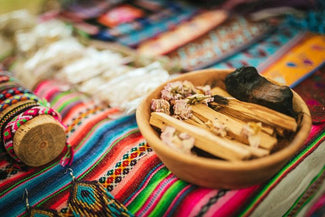
Palo Santo — Bursera graveolens, “Holy Wood” — is the perfect companion to sage. Where White Sage clears with a firm hand, Palo Santo uplifts and welcomes with warmth. Its scent is sweet, woody, and gently citrus — immediately settling and comforting. In Andean tradition, burned after clearing to fill the space with positive, protective energy. Use it after sage to complete the reset. Shop Palo Santo → | Read the Palo Santo Guide →
Loose Sage & Herb Blends on Charcoal
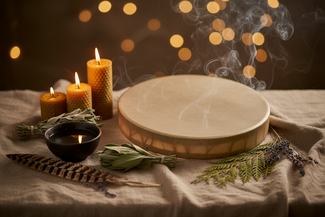
Loose dried sage and herb blends burned on a charcoal disc in a fireproof bowl is the most traditional ceremonial method. The smoke is continuous and the experience more immersive than a stick — ideal for extended ritual work or group ceremony. Herb blends often combine sage with Cedar, Lavender, Rosemary, Mugwort, or Sweet Grass for specific intentions. Shop loose sage & herb blends →
Resin Incense on Charcoal
For deep ceremonial cleansing, sacred resins — Frankincense, Myrrh, Copal, Dragon’s Blood — burned on charcoal discs are among the most powerful tools available. Copal is the traditional cleansing resin of Mesoamerican ceremony; Frankincense has been burned in sacred space for over 5,000 years across multiple traditions. See our full Resin Incense & Charcoal Discs Guide → | Shop resin incense →
Abalone Shells & Smudge Bowls
A fireproof vessel is essential for safe smudging — to catch ash and embers, and to rest your smudge stick safely. Abalone shells are the traditional vessel in many Native American smudging traditions, considered sacred and representing the water element. Ceramic smudge bowls and brass censers are equally effective alternatives. Shop smudge bowls & burners →
Feathers & Smudging Fans
A feather or fan is traditionally used to direct and waft the smoke during smudging. It also represents the air element — completing the elemental balance alongside fire (the flame), water (the abalone shell), and earth (the sage itself). Shop smudging feathers →
Crystals for Smudging
Selenite placed in a space after smudging holds the cleared energy and prevents it becoming heavy again. Black Tourmaline at doorways provides ongoing energetic protection. Clear Quartz amplifies intention. See our Crystal Guide →
Sourcing & Quality – What to Look For
Ethical sourcing — White Sage has faced significant overharvesting pressure due to global demand. Buy from suppliers who can speak to their sourcing: sustainably wild-harvested or cultivated, from suppliers who have transparent relationships with the land. Avoid very cheap, unlabelled sage of unknown origin.
Condition — Quality White Sage smudge sticks should be pale silver-green, dry but not crumbling, tightly wrapped, and intensely fragrant even before lighting. Brown, loose, or odourless sage is old, poorly stored, or low quality.
Palo Santo — ethically sourced Palo Santo is harvested only from naturally fallen trees that have lain on the forest floor for years — never from living trees. This is both ecological and traditional practice. Pale, fragrant wood with a visible resin content is the mark of quality.
Herb blend ingredients — all herbs in a blend should be clearly named. Avoid generic “mixed herb” bundles of unknown composition.
How to Smudge Your Home – Step by Step
- Gather your tools — smudge stick or Palo Santo, a fireproof bowl or abalone shell, a feather or your hand, and matches or a lighter
- Set your intention — decide clearly what you are releasing and what you are inviting in. Speak it aloud. Intention is the most important element of the practice.
- Open windows and doors — this allows the smoke and the energy it carries to leave the space.
- Light your smudge stick — hold at a 45-degree angle and apply a flame to the tip. Allow it to catch for several seconds, then blow out gently so it smoulders and produces steady smoke.
- Start at the front door — move clockwise through each room, working around the perimeter. Pay particular attention to corners, doorways, and windows — energy stagnates in these places.
- Direct the smoke with intention — use a feather or your hand to waft smoke into all areas. As you move, speak or think your intention clearly.
- Smudge yourself — direct smoke over your body from feet to head to clear your own energy field.
- Seal with Palo Santo — once sage work is complete, move through the space with Palo Santo to invite warmth and positive energy into the cleared space.
- Extinguish safely — press the smudge stick firmly into your bowl to extinguish. Never leave burning herbs unattended.
When to Smudge
- Moving into a new home or workspace
- After illness, arguments, grief, or difficult periods
- Before and after guests visit — particularly large gatherings
- At the new moon, full moon, or seasonal turning points
- Before meditation, ceremony, or any intentional spiritual practice
- When a space feels heavy, stagnant, or uncomfortable
- After purchasing second-hand items or crystals
- At the start of a new year, a new project, or a new chapter
Shop by Type
- White Sage & Californian Sage
- All Smudge Sticks, Blue Sage & Loose Sage
- Palo Santo
- Smudging Feathers & Fans
- Smudge Bowls & Abalone Shells
- Resin Incense & Charcoal Discs
- Selenite
- Sacred Sprays – Smoke-Free Alternative
Safety
Fire Safety
- Always use a fireproof bowl, shell, or burner to catch ash and embers
- Place your bowl on a heat-resistant surface away from flammable materials
- Never leave burning herbs unattended
- Extinguish fully by pressing into sand or a heatproof surface before putting down
- Be mindful of smoke alarms — open a window rather than disabling them
Smoke & Ventilation
- Always open at least one window before and during smudging
- People with asthma or respiratory sensitivities should use caution — sacred sprays are a fully smoke-free alternative
- Keep pets — especially birds — out of the room; birds are particularly sensitive to airborne particles
- Keep out of reach of children
Storing Your Smudging Supplies
- Smudge sticks — store in a cool, dry place away from moisture and direct sunlight; damp sage burns poorly and can mould. Store loosely — avoid sealed plastic bags for long-term storage.
- Partially burned sticks — allow to cool completely before storing; wrap loosely in paper or keep in your smudge bowl
- Palo Santo — store in a dry place away from humidity; the natural resins are stable and will keep well for years if kept dry
- Loose sage and herb blends — store in a sealed glass jar or tin away from heat and light
- Charcoal discs — keep in a sealed, airtight container; once exposed to air for extended periods they become harder to light
Frequently Asked Questions
What is smudging?
Smudging is the practice of burning sacred herbs — most commonly White Sage or Palo Santo — and directing the smoke around a person, space, or object to clear stagnant or unwanted energy. It is rooted in the ceremonial traditions of specific indigenous Nations of the Americas and is now widely practised as a personal energetic cleansing tool.
How often should I smudge?
Many people smudge their home once a week as a regular reset, and their personal energy field whenever they feel depleted, scattered, or after a difficult interaction. Deep clearings — after illness, conflict, or significant life events — can be done as needed. Trust your instincts: if the space feels heavy or your energy feels off, smudging is appropriate.
Do I need to open windows when smudging?
Yes — open windows allow the smoke and the energy it is carrying to leave the space. They also provide essential ventilation. At least one window open is strongly advisable during any smudging session.
What is the difference between White Sage and Palo Santo?
White Sage is the primary clearing tool — strong, decisive, and powerful at removing stagnant or heavy energy. Palo Santo is warm, sweet, and uplifting — used to fill the cleared space with positive energy after sage has done its work. They complement each other perfectly. See our Sage vs Palo Santo guide →
Can I smudge without smoke?
Yes — sacred sprays achieve many of the same energetic effects without any smoke, flame, or residue. They are ideal for offices, rental properties, around children or pets, or for travel. See our Sacred Sprays Guide →
Is smudging cultural appropriation?
This is a question worth taking seriously. The specific practice of burning White Sage originates with the ceremonial traditions of specific Nations of the American Southwest and Pacific Coast, where it carries deep and particular significance. Approaching smudging with awareness of this — with gratitude, intention, sourcing from ethical suppliers, and respect for the plant and the peoples who have kept this knowledge alive — is the foundation of a respectful practice. Many indigenous teachers actively encourage the sharing of plant medicine practices when approached with genuine respect.
What crystals should I use with smudging?
Selenite is the most natural companion — place it in the cleared space to hold and amplify the cleared energy. Black Tourmaline at doorways and windows provides ongoing energetic protection after clearing. Clear Quartz amplifies intention. Smoky Quartz held in the non-dominant hand during personal smudging helps draw out and ground what is being released. See our Crystal Guide →
How do I extinguish a smudge stick?
Press the burning tip firmly into sand, earth, or the base of your smudge bowl and hold it there until the glow is completely out. You can also press it against the inside of the bowl. Do not dip in water — this damages the stick and makes it very difficult to relight. A well-extinguished stick can be reused many times.
Shop All Smudging Supplies
- Smudge Sticks & Loose Sage
- White Sage & Californian Sage
- Palo Santo
- Smudging Feathers & Dreamcatchers
- Smudge Bowls & Abalone Shells
- Resin Incense & Charcoal Discs
- Selenite
- All Crystals
- Sacred Sprays – Smoke-Free Alternative
Related Guides
- How to Use Sage – A Complete Guide
- Palo Santo – Benefits, Uses & How to Burn
- Sage vs Palo Santo – Which Should You Use?
- Resin Incense & Charcoal Discs Guide
- Incense Guide – Types, Uses & How to Burn
- Energy Cleansing Explained
- Creating a Sacred Space
- Crystal Guide – Meanings & Healing Properties
- Sacred Sprays Guide
- The Chakra System Explained