

Utiliser les quatre directions pour créer équilibre, protection et clarté dans votre pratique spirituelle

Une pièce peut paraître ordinaire un instant et profondément enveloppante l'instant d'après. Souvent, ce changement ne tient pas à la taille, à la décoration ou à la présence d'un autel élaboré. Il vient de l'intention, de l'orientation et de l'acte discret de reconnaître les énergies vivantes qui vous entourent. Si vous apprenez à créer un espace sacré : les quatre directions dans la pratique chamanique offrent un cadre simple et puissant pour transformer un coin de votre maison, de votre jardin ou de votre pièce de rituel en un lieu ciblé, protégé et spirituellement clair.
Pour beaucoup de gens, travailler avec les quatre directions apporte un sentiment d'ordre à la pratique spirituelle. Cela donne une forme à la méditation, à la cérémonie, à la purification énergétique, à la divination et à la prière. Cela peut également aider si vous vous sentez parfois dispersé lors de la mise en place de rituels, car les directions créent un début, un milieu et une fin clairs. Cela dit, il n'existe pas de méthode universelle unique. Les différentes lignées chamaniques comprennent les directions de différentes manières, et une pratique respectueuse signifie gérer cette variation avec soin plutôt que de supposer qu'un système fixe convient à tous.
Comment créer un espace sacré : les quatre directions dans la pratique chamanique
En son cœur, créer un espace sacré avec les quatre directions signifie saluer consciemment l'Est, le Sud, l'Ouest et le Nord, et dans de nombreuses traditions, également reconnaître la Terre en dessous, le Ciel au-dessus, et le Centre — où vous vous tenez dans l'espace. Bien que ce guide reste universel, ces directions sont souvent comprises à travers différentes lentilles culturelles, telles que Pachamama (Terre) et Inti ou le Père Ciel, aux côtés de la présence vivante de la terre et du cosmos.
Chaque direction est traditionnellement associée à des qualités, des éléments, des ancêtres, des esprits bienveillants ou des étapes de la vie particuliers. L'ordre exact et la signification peuvent varier entre les traditions, les lignées et les pratiques, de sorte que ce qui importe le plus est que votre approche soit intentionnelle, cohérente et enracinée dans un respect authentique plutôt que dans des règles fixes.
Dans un cadre domestique, cela commence généralement par l'identification des directions physiques dans votre espace. Une boussole, un téléphone ou une simple conscience du lever et du coucher du soleil peuvent aider. Une fois que vous savez où se trouvent l'Est, le Sud, l'Ouest et le Nord, vous pouvez choisir de faire face à chaque direction à tour de rôle — en offrant un salut silencieux, une prière, un moment de respiration, ou une action simple telle qu'allumer de l'encens, placer un cristal, utiliser un spray sacré, ou faire sonner un tambour ou une maraca.
Certaines traditions commencent à l'Est, d'autres au Sud ou au Nord. La séquence est moins importante que la conscience que vous y apportez, et le sentiment que vous entrez en relation avec l'espace qui vous entoure, plutôt que de simplement le traverser.
La puissance ne réside pas dans le fait de rendre l'ensemble impressionnant. La puissance réside dans l'attention.
« Cela crée un sentiment d'être enveloppé dans l'espace, plutôt que séparé de celui-ci. »
Pourquoi les quatre directions sont importantes
Les quatre directions créent un contenant. En termes pratiques, elles aident à définir la limite énergétique de votre rituel, facilitant ainsi la concentration de votre esprit et le calme de votre corps. Pour les personnes qui utilisent des outils spirituels tels que les cartes oracle, les bols chantants, les huiles essentielles, les élixirs floraux ou l'encens purificateur, cela peut rendre l'ensemble de la pratique plus cohérent.
Elles vous rappellent également que le travail spirituel est relationnel. Plutôt que de traiter le rituel comme quelque chose qui se passe uniquement à l'intérieur de vos propres pensées, la pratique directionnelle vous place dans un champ plus large — terre, élément, saison, esprit et lieu. Cela peut être profondément ancrant, surtout si votre vie quotidienne est occupée ou fortement axée sur les écrans.
À un niveau plus profond, les quatre directions sont souvent comprises comme des principes organisateurs de la création — une manière d'apporter structure, équilibre et orientation au monde extérieur et à votre expérience intérieure. Cela est maintenu en relation avec la Terre en dessous et le Ciel au-dessus, créant un sentiment d'être centré au sein d'un système vivant et équilibré.
Il y a cependant un compromis. Un rituel directionnel structuré peut être très utile, mais il peut aussi être intimidant si vous débutez et craignez de ne pas faire les choses correctement. Si cela vous semble familier, commencez petit. Une simple reconnaissance de chaque direction suffit. L'espace sacré grandit par la répétition, non par la performance.
Une façon simple d'aménager l'espace
Commencez par nettoyer physiquement la zone. Vous n'avez pas besoin d'une pièce rituelle dédiée. Une table basse rangée, un rebord de fenêtre, un coin de méditation ou un espace au sol dégagé peuvent très bien fonctionner à l'intérieur. À l'extérieur, un endroit calme dans un jardin, près d'un arbre ou sur un terrain ouvert peut être tout aussi propice. La clé n'est pas le décor, mais l'attention que vous y portez.
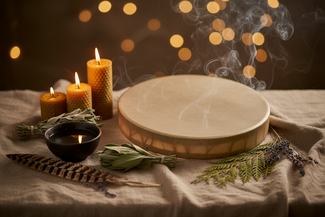
Vous pouvez étaler un tissu, placer une bougie au centre, et rassembler les outils qui soutiennent votre intention, tels que de l'encens, un petit bol d'eau, des cristaux, une plume, un tambour, un journal ou des cartes de tarot.
Prenez quelques respirations lentes. Tenez-vous debout ou asseyez-vous au centre de l'espace choisi. Ce point central est l'endroit où vous rencontrez les directions — entre la Terre en dessous et le Ciel au-dessus. De nombreuses traditions reconnaissent cela comme un lieu d'équilibre, où Pachamama, la Terre vivante et force créatrice féminine, est honorée aux côtés de l'immensité des cieux, des étoiles et du Père Ciel. Ensemble, ils créent un sentiment d'être soutenu à la fois physiquement et énergétiquement.
Certaines personnes aiment purifier l'espace d'abord avec de la fumée, du son ou du parfum. Si vous utilisez de l'encens, de la résine ou des herbes, gardez le processus doux et pratique, surtout dans les petites maisons. À l'extérieur, vous constaterez peut-être que l'air diffuse plus librement le parfum. Le son peut être une bonne alternative si vous êtes sensible à la fumée — un bol chantant, un carillon ou une maraca peuvent changer rapidement l'atmosphère.
Ensuite, tournez-vous vers chaque direction une par une. Parlez à voix haute ou intérieurement. Vous pouvez accueillir les qualités que vous associez à cette direction, demander clarté et protection, ou simplement reconnaître sa présence. Les mots n'ont pas besoin d'être formels. Ce qui compte, c'est la sincérité.
Travailler avec les directions Sud, Ouest, Nord et Est
L'Est est souvent associé à l'aube, aux nouveaux commencements, à l'illumination et à une vision nouvelle. En pratique, c'est un endroit naturel pour commencer. Si vous ouvrez un espace sacré pour un rituel de nouvelle lune, une méditation ou la définition d'intentions, l'Est peut porter l'énergie de l'invitation et de l'éveil. Dans certaines traditions, cette direction est également associée à l'aigle ou au condor — celui qui voit d'une perspective plus élevée, apportant clarté, perspicacité et la capacité de dépasser la vue immédiate pour une vision plus large. Certaines personnes placent de l'encens, une bougie jaune ou blanche, ou une plume ici, selon leur pratique.
Le Sud est fréquemment lié à la vitalité, à la confiance, à la croissance et au feu de la réalisation. Il peut concerner le corps physique, le mouvement et l'expérience d'être pleinement présent dans la vie. Dans certaines traditions, cette direction est associée au serpent — représentant l'instinct, la force vitale et le fait de se débarrasser de ce qui n'est plus nécessaire. Si votre pratique est axée sur la confiance, l'action ou l'énergie créatrice, le Sud peut vous sembler particulièrement favorable. Une bougie rouge ou orange, des huiles essentielles réchauffantes ou des cristaux énergisants peuvent être utilisés ici si cela correspond à votre façon de travailler.
L'Ouest est souvent la direction des sentiments, de l'introspection, des fins, des rêves et des eaux intérieures. Il peut être un endroit puissant vers lequel se tourner lorsque vous traitez des émotions, cherchez des aperçus ou libérez ce qui a fait son temps. Dans certaines lignées, l'Ouest est associé au jaguar — symbole de transformation, de courage et de la capacité de se mouvoir entre la vie, la mort et le renouveau avec une force tranquille. Parce que l'Ouest peut sembler profond et parfois tendre, il est sage de l'approcher avec calme plutôt qu'avec intensité. Un bol d'eau, des tons bleus ou des parfums plus doux peuvent soutenir cet espace.
Le Nord est généralement associé à la sagesse, à l'ancrage, aux ancêtres, à la tranquillité et à la force nourricière de la terre. Il peut aider à ancrer un rituel, surtout si vous vous sentez déraciné. Dans les traditions Q'ero, cette direction est souvent liée au colibri — représentant l'endurance, la résilience et la capacité d d'entreprendre de longs voyages sans avoir besoin de s'accrocher à l'histoire de leur achèvement. Les pierres, le sel et les éléments d'ancrage peuvent tous bien fonctionner ici. Pour beaucoup de gens, le Nord apporte un sentiment d'être soutenu et en sécurité.
À travers de nombreuses traditions, ces quatre directions sont comprises dans un champ plus large — tenues par la Terre en dessous, souvent honorée comme Pachamama, et le Ciel au-dessus, représenté par le soleil, la lune et les étoiles. Ensemble, elles créent un sentiment d'équilibre entre l'ancrage et l'expansion, le physique et l'invisible.
Ces significations ne sont pas universelles. Différentes traditions attribuent des qualités, des animaux et des éléments différents à chaque direction. Si vous travaillez au sein d'une lignée spécifique, il est toujours préférable de suivre cet enseignement plutôt que de mélanger des systèmes sans les comprendre. Ce qui compte le plus, c'est que votre pratique reste respectueuse, intentionnelle et cohérente.

Faut-il inclure le Ciel, la Terre et le Centre ?
De nombreux praticiens le font. Une fois les quatre directions saluées, il est courant de reconnaître également le Haut, le Bas et le Centre — complétant l'espace et apportant un sentiment d'équilibre à la pratique.
Le Ciel peut représenter l'esprit, la guidance supérieure et le champ plus large au-delà du moi personnel — le soleil, la lune et les étoiles qui portent un sens d'ordre et de perspective. La Terre, souvent honorée comme Pachamama, représente la nourriture, l'incarnation et un soutien stable. Le Centre est là où vous vous tenez — le point de rencontre de toutes les directions, où ces forces sont mises en relation au sein de votre propre corps et de votre conscience.
L'inclusion de ces aspects peut aider un rituel à se sentir plus complet sans le rendre compliqué. Cela crée un sentiment d'être tenu entre le terre-à-terre et l'expansif, le physique et l'invisible.
Un simple geste peut suffire. Une main levée vers le Ciel, une main touchant le sol ou la terre, puis les deux mains ramenées vers le cœur crée une manière calme et physique de refermer la carte directionnelle autour de votre corps.
Outils rituels qui soutiennent l'espace sacré
Les outils ne sont pas essentiels, mais ils peuvent vous aider à rester présent. Le bon choix dépend de votre pratique, de votre maison et de votre sensibilité aux odeurs, aux sons et au symbolisme. Si vous construisez une trousse de rituel personnelle, beaucoup de gens commencent par une bougie, de l'encens purificateur, un petit tissu, un cristal pour chaque direction, et peut-être une maraca, un tambour ou un bol chantant pour l'ouverture et la clôture.
Pour une pratique quotidienne plus douce, des roll-on d'huiles essentielles, des brumes d'ambiance, des pierres roulées, des bougies chauffe-plat et un petit jeu d'oracle peuvent suffire. Pour une ambiance plus cérémonielle, vous pourriez ajouter des textiles chamaniques, des bols d'autel, du cacao cérémoniel ou des agencements de cristaux basés sur les directions. Il n'est pas nécessaire de surcharger l'espace. Quelques objets bien choisis sont généralement plus ancrés qu'un arrangement encombré.
Différentes traditions mettent l'accent sur différents outils. Certaines se concentrent sur le son — utilisant des hochets, des tambours ou des flûtes pour appeler les directions et travailler avec les principes organisateurs sous-jacents de l'espace. D'autres travaillent davantage avec la fumée, le parfum et le geste — utilisant de l'encens, des résines, des plumes ou le souffle pour purifier, inviter et reconnaître chaque direction.
Dans les traditions Q'ero des Andes, des offrandes rituelles telles que le despacho (pagos) sont utilisées pour honorer la Pachamama et les forces vives de la nature, souvent accompagnées de sons produits par des hochets, des flûtes ou un tambour. Parallèlement, des outils tels que le Palo Santo et l'Agua de Florida (Eau de Floride) sont largement utilisés pour la purification, la bénédiction et la préparation de l'espace — aidant à nettoyer, élever et inviter des énergies favorables avant ou pendant le rituel.
Les deux approches sont également valides. Vous pourriez vous sentir attiré par l'une, ou naturellement mélanger des éléments au fil du temps. Le rituel peut être énoncé à voix haute ou gardé silencieusement à l'intérieur. Ce qui compte n'est pas la forme qu'il prend, mais la présence que vous y apportez.
Si vous explorez ce qui vous convient, une boutique spirituelle soigneusement sélectionnée peut être utile – surtout lorsque vous pouvez naviguer par intention plutôt que par tâtonnements. Chez Sacred Essence, nous proposons une gamme réfléchie d'outils rituels, d'encens, de bougies, de cristaux, d'instruments de guérison sonore et d'accessoires chamaniques pour soutenir à la fois les pratiques quotidiennes simples et les travaux cérémoniels plus élaborés.
Erreurs courantes et ajustements doux
Une erreur courante est la précipitation. L'espace sacré répond bien au rythme. Si vous parlez à chaque direction tout en vérifiant mentalement votre téléphone ou en pensant à la suite, le rituel peut sembler plat. Même cinq minutes sans distraction peuvent améliorer la qualité de votre expérience.
Une autre erreur est de copier un style cérémoniel qui ne vous semble pas naturel. Si les longues invocations vous paraissent gênantes, utilisez un langage simple. Si la fumigation ne convient pas à votre domicile, utilisez du son, la respiration, la prière ou un vaporisateur d'ambiance doux à la place. La profondeur spirituelle n'est pas mesurée par l'élaboration du décor, mais par votre présence en son sein.
Il est également important de se souvenir que le respect culturel est important. La pratique chamanique est un terme large qui inclut de nombreuses traditions distinctes, certaines indigènes et d'autres contemporaines. Si vous vous sentez attiré par une lignée spécifique, prenez le temps d'apprendre auprès de sources appropriées, de comprendre ce qui est cérémoniel et ce qui est adapté, et de l'aborder avec soin plutôt qu'avec des suppositions.
Enfin, essayez de ne pas trop compliquer le processus. Il est facile de penser que vous avez besoin des bons outils, des bons mots ou de la configuration parfaite. En réalité, la cohérence compte plus que la précision. Une pratique simple et répétée sera souvent plus utile que quelque chose qui n'est fait qu'occasionnellement et qu'il est difficile de reprendre.
L'intégrer à votre pratique quotidienne
Les espaces sacrés les plus significatifs sont généralement ceux qui sont réellement utilisés. Une cérémonie élaborée une fois par an peut être magnifique, mais une simple pratique directionnelle régulièrement revisitée crée souvent un changement plus profond et durable. Vous pourriez ouvrir les directions avant de tenir un journal, tirer une carte après avoir salué l'Est, ou clôturer votre journée de travail en vous tournant vers le Nord et en demandant la stabilité.
Avec le temps, votre corps commence à reconnaître le schéma. Se tourner, faire une pause, parler, écouter — ces petites actions deviennent un seuil. Vous sortez de la course ordinaire et entrez dans un état plus intentionnel.
Si vous débutez, laissez les choses être simples. Allumez une bougie. Trouvez l'Est. Reconnaissez l'espace autour de vous. Parlez comme s'il pouvait vous entendre, et écoutez comme si quelque chose pouvait répondre.
Souvent, c'est dans cette cohérence tranquille que l'espace sacré commence à prendre forme.
Créer un espace qui vous ressemble
L'espace sacré peut sembler étrange au début. Parfois même un peu bizarre ou inconfortable. Que ce soit à la maison ou dans la nature, prendre un moment pour faire une pause, se tourner et reconnaître l'espace qui nous entoure n'est pas quelque chose auquel la plupart d'entre nous sont habitués.
Mais c'est souvent là que le changement commence.
Avec le temps, ces petites pratiques vous permettent de remarquer, de ressentir et de créer quelque chose de nouveau. Non pas quelque chose de parfait ou de fixe, mais quelque chose qui évolue avec vous – un flux et un reflux qui peuvent contenir votre espace, votre place, et tout ce qui s'y manifeste.
Un espace intentionnellement créé peut parfois sembler peu familier parce qu'il est différent du rythme de la vie quotidienne. Il vous demande de ralentir, d'écouter et d'être présent. Et ce faisant, il peut devenir un lieu qui vous soutient doucement — un endroit où les choses peuvent faire surface, s'apaiser, surprendre et être vues d'une manière différente.
Explorez les outils pour l'espace sacré, les essentiels rituels et la pratique quotidienne
La création d'un espace sacré ne nécessite pas tout en même temps. La plupart des gens commencent avec quelques outils simples et développent progressivement une pratique qui leur est personnelle et facile à reprendre.
Découvrez les produits et collections associés
-
Cristaux de Guérison, Pierres Roulées & Ensembles de Pierres Directionnelles Chamaniques
Chacun peut être utilisé individuellement ou combiné pour favoriser une approche simple et ancrée de la création d'un espace sacré à la maison ou dans la nature.
Traditions, Outils & Marques Mis en Avant
-
Sacred Essence – une gamme sélectionnée d'outils rituels, de sprays, de cristaux et d'essentiels spirituels quotidiens
-
Outils d'Inspiration Péruvienne & Q'ero – incluant Palo Santo, les traditions de despacho et les éléments rituels liés à Pachamama
-
Murray & Lanman (Florida Water) – eaux de Cologne nettoyantes traditionnelles utilisées dans la pratique spirituelle
-
Sprays Sacrés Alaskiens & Essences Florales de Brousse – sprays et essences de soutien pour l'équilibre émotionnel et énergétique
Guides Connexes
- Comment Utiliser les Sprays Sacrés pour le Nettoyage Énergétique
- Palo Santo : Usages, Bienfaits et Pratique Rituelle
- Utilisations de l'Eau de Floride
- Comment Nettoyer les Cristaux - Un Guide Complet
- Créer un Espace Calme et Durable à la Maison
L'espace sacré n'a pas besoin d'être parfait pour être significatif. Il suffit d'y revenir.
Visitez-nous ou Explorez en Ligne
Vous êtes toujours les bienvenus à notre boutique de Coniston, au cœur du Lake District, où nous serons ravis de vous guider en personne. Ou explorez en ligne pour découvrir des outils rituels, des essentiels de nettoyage et des articles spirituels pour soutenir votre pratique.
Visitez-nous à Coniston ou explorez en ligne chez Sacred Essence
Vous pouvez également nous suivre sur Instagram et Facebook pour de l'inspiration, des nouveautés et des moyens simples d'apporter le calme dans la vie quotidienne.
Une Dernière Réflexion
L'espace sacré n'est pas quelque chose que l'on crée une fois.
C'est quelque chose auquel on revient — et ce faisant, il commence lentement à vous soutenir.
Une pratique douce, souvent reprise, peut devenir un soutien discret ✨
Sacred Essence 🌈