



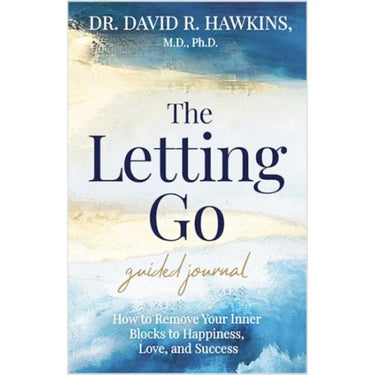
The Letting Go – Journal guidé

Inspiré des enseignements du Dr David R. Hawkins

Le journal guidé « The Letting Go » est un journal de pleine conscience magnifiquement conçu, inspiré du livre classique et best-seller « Letting Go » du psychiatre, enseignant spirituel et chercheur en conscience de renommée mondiale, David R. Hawkins, M.D., Ph.D.

Créé comme un compagnon pratique aux principes du lâcher-prise émotionnel et de la guérison, ce journal guidé vous aide à libérer la négativité, à traiter les émotions et à cultiver une plus grande conscience de soi. Grâce à des invites structurées et des exercices de réflexion, il soutient votre cheminement vers la liberté émotionnelle, la clarté et la paix intérieure.

Si vous recherchez un journal d'anxiété, un journal de positivité, un journal de gratitude ou un cadeau de motivation significatif, ce journal offre un chemin de soutien et structuré vers la croissance et la transformation personnelles.

Détails du produit :

Vous serez guidé à travers un puissant processus de journalisation pour :

  • Cesser de réprimer vos émotions et vos vrais sentiments

  • Libérer les ressentiments

  • Surmonter la résistance

  • Abandonner l'ego

  • Approfondir votre conscience de soi

  • Cultiver la pleine conscience et la gratitude

Format et spécifications :

  • 128 pages

  • Journal broché

  • Comprend des invites guidées, des citations de réflexion et des exercices

  • Conçu pour la guérison émotionnelle et la réflexion quotidienne

À propos de l'auteur

Sir David R. Hawkins, M.D., Ph.D., était un auteur de renommée mondiale, un enseignant spirituel et un chercheur en conscience. Son travail représente la pointe de la recherche sur la conscience et la vérification des réalités spirituelles, y compris les propres réalisations subjectives profondes et la transformation de l'auteur.

Avec une formation scientifique et clinique, le Dr Hawkins était exceptionnellement capable d'articuler des états avancés de conscience spirituelle de manière claire et compréhensible. Ses œuvres publiées et ses conférences enregistrées décrivent de profondes intuitions spirituelles tout en restant ancrées dans une compréhension psychologique et clinique.

Ses enseignements explorent la guérison et le rétablissement émotionnels, la compassion envers soi-même et les autres, la conscience spirituelle et l'acceptation de la vie, de la mort et de la transformation. Son travail continue d'inspirer les lecteurs du monde entier en quête de clarté, de lâcher-prise et de paix intérieure.

A Practical Companion to Letting Go

The journal takes ideas associated with Letting Go and translates them into prompts that can be worked through slowly.

Rather than simply reading about surrender, acceptance or emotional awareness, you are invited to write.

That shift from reading to reflection can make the material feel more personal.

You may find yourself noticing what you avoid, what you keep replaying, what still carries emotional weight or where you are resisting something you cannot control.

What Does “Letting Go” Mean?

Within Hawkins’ framework, letting go is connected with allowing emotions to be acknowledged rather than suppressed or fought against.

In practical journalling terms, that might mean recognising what you feel, naming it more clearly and exploring what sits underneath it.

The process is not about pretending difficult experiences do not matter.

It is about creating a little more space between the experience itself and the story you continue to carry around it.

Mindfulness, Gratitude & Self-Awareness

The journal also incorporates themes of mindfulness and gratitude.

Mindfulness can help bring attention back to what is happening now, while gratitude practices may encourage you to notice supportive or meaningful aspects of daily life.

These ideas fit naturally into reflective journalling, especially when the aim is to become more aware of habits, reactions and emotional patterns.

The journal should not be presented as a treatment for anxiety, depression or trauma, but it may sit comfortably alongside a broader personal wellbeing routine.

Working with Resentment & Resistance

Some prompts focus on resentment, resistance and emotional suppression.

These can be difficult themes, which is why a slower pace may be more useful than trying to complete the journal quickly.

You might spend time with questions such as:

“What am I still holding onto?”

“What am I resisting?”

“What changes when I stop trying to force this situation to be different?”

The purpose is not to reach one perfect answer, but to create space for more honest self-observation.

A Journal for Daily Reflection

The 128-page format makes this easy to use as part of a regular routine.

You may prefer to work through one prompt at a time, write for ten minutes in the evening or return to the journal whenever a particular theme feels relevant.

Because the prompts are structured, it can also suit people who like the idea of journalling but do not always know what to write.

Gratitude Without Forced Positivity

The journal includes gratitude as one of its themes, but gratitude does not have to mean ignoring difficulty.

A balanced practice might involve recognising something supportive or meaningful while still acknowledging grief, frustration or uncertainty.

That makes the journal more useful as a reflective tool than as a simple positivity exercise.

Emotional Healing Language

The original description refers to emotional healing, emotional freedom and releasing negativity.

I would keep those ideas aspirational rather than guaranteed.

A guided journal may support reflection, awareness and a sense of perspective, but it should not be presented as proven to heal trauma, resolve mental-health conditions or produce emotional freedom.

For significant or persistent distress, professional psychological or medical support may be appropriate alongside journalling.

A Simple Way to Begin

Choose one prompt and give yourself a few uninterrupted minutes.

Write without trying to make the response polished.

If a question feels difficult, begin with:

“What am I noticing right now?”

You can return to the same prompt more than once.

The value is often in what changes between one reflection and the next.

Ideal For

The Letting Go Guided Journal may especially appeal to readers interested in mindfulness journals, gratitude journals, self-reflection, spiritual development and the teachings of David R. Hawkins.

It may also make a thoughtful gift for someone who enjoys guided journalling and personal-development books.

Quick FAQs

What is The Letting Go Guided Journal?
It is a 128-page paperback guided journal inspired by the teachings of Dr David R. Hawkins.

Does it contain writing prompts?
Yes. The journal includes guided prompts, reflective quotes and exercises.

Is this the same as the book Letting Go?
No. It is a guided journal inspired by the ideas associated with Letting Go.

What themes does it cover?
Themes include emotional awareness, surrender, resentment, resistance, mindfulness, gratitude and self-reflection.

Can I use it as a gratitude journal?
Yes. Gratitude is one of the themes, although the journal covers much more than gratitude alone.

Is it an anxiety journal?
It may appeal to people looking for reflective journalling around difficult emotions, but it should not be presented as a treatment for anxiety.

How many pages are there?
The supplied product information lists 128 pages.

Is it suitable for daily use?
Yes. The guided format lends itself well to regular reflection.

Please Note

The Letting Go Guided Journal explores spiritual and personal-development ideas associated with surrender, emotional release, consciousness and self-awareness.

These concepts reflect the teachings and framework associated with Dr David R. Hawkins and should not be treated as established medical or psychological treatment.

The journal is intended for personal reflection and spiritual development and should not replace professional medical or psychological care.

Commandes et expédition
Les commandes passées avant 15h00 sont traitées et expédiées le jour même. Nous livrons dans le monde entier.

Informations de suivi
Veuillez suivre votre colis à l'aide des informations de suivi fournies dans votre e-mail de confirmation d'expédition. Le suivi est généralement mis à jour dans les 24 heures suivant l'expédition et se poursuit jusqu'à ce que la livraison soit confirmée.

Droits de douane et taxes
Les droits de douane et taxes de l'UE et internationaux sont à la charge du client et doivent être payés localement, le cas échéant. Pour les clients non britanniques, la taxe britannique est automatiquement supprimée à la caisse une fois la destination d'expédition sélectionnée.

Retards douaniers
Certaines commandes internationales peuvent être retardées en raison de contrôles douaniers, qui échappent à notre contrôle. Les retards peuvent être plus longs pendant les périodes de forte activité.

Retours
Pour les commandes ayant bénéficié de la livraison gratuite, les articles retournés peuvent être soumis aux frais d'expédition initiaux et aux éventuels frais de collecte.

Commandes internationales refusées ou annulées
Les commandes internationales qui sont refusées, retournées puis annulées peuvent être soumises à une surtaxe de 10 %. Les colis peuvent être réexpédiés sur demande, bien que des frais supplémentaires puissent s'appliquer.