
Fire Ceremony Guide – How to Hold a Sacred Fire Ceremony
Fire is one of the most ancient and universal sacred elements. Across every culture and tradition in the world — from the fire ceremonies of the Andean Q’ero to the Vedic homa rituals of India, the Celtic Beltane fires to the sweat lodge ceremonies of Native America — fire has been used as a vehicle for transformation, purification, prayer, and communion with the spirit world.
Fire transforms. It takes what is offered and transmutes it — releasing it from the physical world and carrying it as smoke and light into the realm of spirit. A fire ceremony is an act of conscious release, gratitude, and renewal — one of the most powerful ritual tools available to any practitioner.
This guide covers how to hold a simple, respectful fire ceremony — from setting sacred space and calling in the directions to making offerings, working with instruments, and closing with gratitude. You do not need an outdoor fire or a fire pit. A single candle or tealight, placed with care and held with intention, is everything you need. Browse all ceremony tools →
Is a Fire Ceremony Right for You?
- Want to release something — a pattern, a relationship, a chapter of your life — a fire ceremony is one of the most powerful tools for intentional release; writing what you are letting go and offering it to the flame is a complete practice
- Setting intentions for a new season or life chapter — offer your prayers and intentions to the fire at a new moon, equinox, or solstice; fire activates and carries intention in a way that writing alone does not
- Want to mark a transition with ceremony — moving home, ending a relationship, beginning something new; fire ceremony creates a clear before and after, a threshold you step through with full awareness
- Drawn to Andean, shamanic, or earth-based practice — the fire ceremony is central to Q’ero and many other traditions; see also our Despacho Ceremony guide →
- Want to hold ceremony with others — fire naturally gathers community; a shared ceremony around a fire strengthens collective intention and connection in a way that is hard to replicate; a cluster of candles or tealights works beautifully indoors
- No outdoor space or open fire available — a candle or tealight on your altar is a complete fire ceremony; see the dedicated section below for how to make this a rich and meaningful practice
- Working with the seasonal or lunar calendar — see the seasonal ceremony section below; each turning point of the year has its own quality of fire ceremony
- New to ceremony and not sure where to start — begin with a single candle: light it with intention, speak your prayer aloud, sit with the flame; that is a complete and powerful fire ceremony
What Is a Fire Ceremony?
A fire ceremony is a ritual in which offerings — prayers, intentions, objects, or symbolic representations of what you wish to release or call in — are given to the fire. The fire receives the offering, transforms it, and carries it into the spirit world. In return, the practitioner receives clarity, release, renewal, and connection.
Fire ceremonies can be held for many purposes:
- Release — letting go of old patterns, grief, resentment, fear, or anything that no longer serves
- Intention — offering prayers and intentions for what you wish to call into your life
- Gratitude — giving thanks for blessings received
- Transition — marking a significant life change, the turning of a season, or a new beginning
- Healing — offering prayers for yourself, others, or the earth
- Community — gathering people around a shared fire to strengthen bonds and collective intention
Preparing for Your Fire Ceremony
Choose Your Fire
A fire ceremony can be held around any fire — a garden fire pit, a beach bonfire, a wood-burning stove, or a single candle flame for indoor practice. The size of the fire matters less than the intention you bring to it. A candle flame held with full presence and reverence is as sacred as a roaring bonfire. The spirit of fire does not require scale; it requires sincerity.
For outdoor fires, always follow local fire safety guidelines and ensure you have water nearby. Choose a location that feels right — ideally somewhere you can sit comfortably around the fire for the duration of the ceremony.
Holding Fire Ceremony with a Candle or Tealight
Not everyone has access to an outdoor space, a fire pit, or the freedom to light an open fire — and that is no barrier whatsoever to a meaningful and complete fire ceremony. A pillar candle, a tealight, or even a cluster of small candles on your altar carries exactly the same transformational quality as a bonfire when approached with intention and reverence. Many experienced practitioners prefer candle ceremony for its intimacy and stillness — there is something about the contained, quiet flame that invites a particular quality of presence.
For a candle fire ceremony:
- Choose your candle with care — a pillar candle or a large tealight in a safe, heatproof holder; choose a colour that matches your intention if that resonates (white for clarity and new beginnings, red for passion and courage, black for release and protection, gold or yellow for abundance). Shop Candles & Tealights →
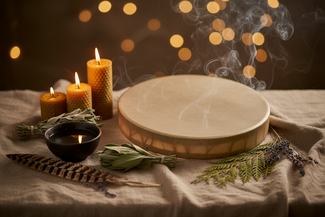
- Set your altar — place the candle at the centre of a small altar cloth; arrange crystals around it, add a stick of incense, and any objects that hold meaning for the ceremony. Shop Altar Cloths →
- Write your offerings on small slips of paper — what you are releasing, what you are calling in, what you are grateful for; for a candle ceremony you hold each slip close to the flame to feel its warmth and speak the prayer aloud, then set it aside rather than burning it directly; alternatively, use a fireproof dish and carefully burn each slip in the flame
- Light with full intention — pause before striking the match; breathe; name your intention for the ceremony aloud; then light the candle as a conscious sacred act, not a casual one
- Sit with the flame — watch it; let it hold your attention completely; the act of gazing softly into a candle flame is itself a meditative and ceremonial practice, recognised across traditions as a direct way to access stillness and inner clarity
- Close with gratitude — do not blow the candle out carelessly; either let it burn down fully in a safe setting, or snuff it deliberately with thanks, acknowledging that the ceremony is complete
A tealight in a beautiful holder, a written prayer, five minutes of silent presence — that is a fire ceremony in its most essential and accessible form. It is enough. It has always been enough. Shop all Candles & Tealights → | Candles Guide →
Gather Your Materials
Prepare everything you need before the ceremony begins:
- Fire-making materials — wood and kindling for an outdoor fire, or a candle and matches for indoor practice
- Offerings — see below for what to offer
- Incense or sacred smoke — for cleansing the space before and after. Palo Santo, white sage, or copal resin are all traditional choices
- Drum and/or rattle — for holding the energy of the ceremony. Shop Drums → | Shop Rattles →
- Crystals — to place around the fire or altar, or hold during the ceremony. Shop Crystals →
- Candles — to mark the four directions, or as the ceremony fire itself. Shop Candles →
- Sacred spray or Florida Water — for personal cleansing before the ceremony. Shop Florida Water → | Shop Sacred Sprays →
- Altar cloth — to create a simple altar near the fire or candle. Shop Altar Cloths →
What to Offer to the Fire
Offerings to the fire can be physical or symbolic. Traditional offerings include:
- Tobacco — the most widely used ceremonial offering across many traditions; a pinch of tobacco offered with a prayer is a simple and powerful act
- Written prayers or intentions — write what you wish to release or call in on paper and offer it to the flames; for a candle ceremony, hold each slip close to the flame as you speak the prayer, then burn carefully in a fireproof dish
- Flowers and herbs — dried flowers, herbs, and botanicals offered with intention
- Copal, frankincense, or other resins — burned on a charcoal disc alongside the ceremony candle. Shop Resin Incense →
- Palo Santo or sage — burned as a cleansing and blessing offering. Shop Palo Santo →
- Despacho — in the Andean tradition, a Despacho is a beautifully assembled bundle of offerings given to the fire as an act of Ayni (sacred reciprocity). See our Despacho Ceremony guide →
- Food offerings — bread, grain, fruit, or other foods placed on the altar as an offering in gratitude
Only offer materials that are safe to burn — natural, untreated materials only. Never offer plastics, synthetic materials, or anything that produces toxic smoke.
Setting Sacred Space
Step 1: Cleanse Yourself
Before the ceremony begins, cleanse your own energy. Pass Palo Santo or sage smoke around your body, or mist yourself with Florida Water or a sacred spray. Take a few deep breaths and arrive fully in the present moment.
Step 2: Cleanse the Space
Walk the perimeter of your fire circle or room with smoke or sacred spray, setting the intention that the space is clear, protected, and sacred. If working with a group, invite everyone to be cleansed before entering the circle.
Step 3: Call in the Four Directions
Face each direction in turn — East, South, West, North — and call in the spirits, elements, and qualities associated with each. Use your rattle or drum to mark each direction as you call it in. Then acknowledge the earth below and the sky above. This creates a sacred container for the ceremony.
Step 4: Light the Fire with Intention
Light the fire or candle consciously — not as a practical act but as a sacred one. Pause before you strike the match. Breathe. As you light it, speak your intention for the ceremony aloud. Invite the spirit of fire to be present and to receive your offerings with grace.
The Ceremony
Holding the Energy with Drum & Rattle
The drum and rattle are the heartbeat of the fire ceremony. Their rhythm holds the energy of the circle, calls in the helping spirits, and supports everyone present in staying present and open. The drummer typically maintains a steady beat throughout the ceremony, with the rattle used to mark transitions, call in the directions, and accompany prayers.
If you are holding ceremony alone, you can drum or rattle as you make your offerings, or play a recorded drumming track. See our Sound Healing at Home guide →
Making Your Offerings
Approach the fire or candle with your offerings. Speak your prayers aloud — what you are releasing, what you are calling in, what you are grateful for. Offer each item to the fire with full presence and intention. Watch as the fire receives and transforms your offering. Trust that what you have given has been received.
Take your time. There is no rush in ceremony. Allow each offering to be fully received before moving to the next.
Sitting with the Fire
After making your offerings, simply sit with the fire. Watch the flames. Listen to the crackling and the drum. With a candle, gaze softly into the flame — allow your eyes to soften, your breathing to slow, your mind to settle into the quality of stillness the flame creates. Allow whatever arises — emotion, insight, memory, vision — to move through you without grasping or pushing away. The fire is a teacher as well as a receiver.
Using Incense in Ceremony
Incense can be burned throughout the ceremony — either on a charcoal disc on a nearby altar, or thrown directly into an open fire. For candle ceremonies, burn incense on a charcoal disc or use incense sticks alongside the ceremony candle. Copal and frankincense are the most traditional ceremonial resins. Palo Santo burned nearby creates a sacred atmosphere and blends beautifully with candle light.
Crystals in Fire Ceremony
Crystals can be placed around the fire circle or altar to hold and amplify the energy of the ceremony. Choose crystals that feel appropriate for your intention:
- Black Tourmaline — protection and grounding for the circle
- Clear Quartz — amplification of intention and clarity
- Obsidian — transformation and truth; a powerful fire ceremony stone
- Citrine — for ceremonies focused on abundance and new beginnings
- Labradorite — for ceremonies involving journeying or spirit contact
Note: Do not place crystals directly in or very close to any open flame — extreme heat can crack or damage them. Arrange them around the candle or fire, not touching it.
Shop Crystals →
Closing the Ceremony
Step 1: Give Thanks
Before closing, take a moment to express genuine gratitude — to the fire, to the spirits of the directions, to the earth and sky, and to anyone who has shared the ceremony with you. Gratitude is the foundation of Ayni — sacred reciprocity — and closes the ceremony in right relationship.
Step 2: Close the Directions
Thank and release each direction in reverse order — North, West, South, East — then the earth below and sky above. Use your rattle or drum to mark each closing.
Step 3: Cleanse After the Ceremony
After the ceremony, cleanse yourself and the space to clear any energies that have been stirred up:
- Pass Palo Santo or sage around yourself and the space
- Mist with Florida Water or a clearing spray
- Ground yourself — eat, drink water, walk barefoot on the earth
- Hold a grounding crystal such as Black Tourmaline or Smoky Quartz
Step 4: Close the Flame with Intention
For an outdoor fire, allow it to die naturally where possible — the fire completes its work in its own time. If you must extinguish it, do so with water and with gratitude. For a candle, either allow it to burn down safely to completion, or snuff it deliberately — never blow it out carelessly. The act of closing the flame is itself part of the ceremony; do it with the same presence you brought to lighting it.
Fire Ceremony for the Seasons
- Spring Equinox — fire of new beginnings; offer what you are releasing from winter and call in your intentions for the growing season
- Beltane (1st May) — the great Celtic fire festival; a fire of abundance, fertility, and the full flowering of life
- Summer Solstice — fire of celebration and gratitude at the height of the light
- Lammas (1st August) — fire of harvest and gratitude for what has grown
- Autumn Equinox — fire of release; offer what you are letting go as the light turns
- Samhain (31st October) — fire of ancestors and the thinning veil; honour those who have passed
- Winter Solstice — fire of hope and renewal at the darkest point of the year; a cluster of candles or tealights is a beautiful and complete way to mark this ceremony indoors
- Full Moon — fire of release; offer what you are letting go at the height of the lunar cycle
See our Nature, Seasons & Living in Rhythm guide → for more on working with the seasonal and lunar calendar.
Frequently Asked Questions
Do I need an outdoor fire to hold a fire ceremony?
No — and this is one of the most important things to understand about fire ceremony. A single candle or tealight, lit with intention and held with reverence, is a complete and powerful fire ceremony. Many practitioners hold all their ceremonies indoors with candles and prefer it — the contained, quiet flame creates an intimacy and stillness that a large fire cannot always match. The fire is a vehicle for intention; its size is irrelevant. What matters is the quality of presence you bring to it.
How do I hold a fire ceremony with just a candle?
Set up a simple altar: an altar cloth, your ceremony candle at the centre, crystals arranged around it, a stick of incense or a Palo Santo stick nearby. Write your prayers or intentions on slips of paper. Cleanse yourself and the space. Sit quietly, breathe, and light the candle with a spoken intention. Offer each prayer by holding the slip close to the flame as you speak it aloud — then set it aside or burn it carefully in a fireproof dish. Sit with the flame in silence. Close with gratitude and snuff the candle deliberately. That is a complete fire ceremony.
What should I write on my offering paper?
Write what is honest. For a release ceremony, name specifically what you are letting go — not in generalities but in detail: the pattern, the story, the feeling, the relationship. For an intention ceremony, write what you are calling in with the same specificity. The act of writing before offering forces clarity; the fire receives what you have made clear.
How often should I hold a fire ceremony?
There is no fixed rule. Many practitioners align their ceremonies with the seasonal and lunar calendar — the eight points of the Celtic Wheel of the Year and the full and new moons provide a natural rhythm of approximately one ceremony every three to six weeks. Others hold ceremony when something specific calls for it — a transition, a release, a prayer. Begin with one ceremony and let the practice tell you how often it wants to be repeated.
What is a Despacho and how does it relate to fire ceremony?
A Despacho is a traditional Andean offering bundle — a beautifully assembled collection of natural materials, foods, flowers, and prayers assembled as an act of Ayni (sacred reciprocity) and given to the fire. It is one of the most complete and powerful ceremonial offerings in the Q’ero tradition. See our full Despacho Ceremony guide →
Can I hold a fire ceremony alone?
Yes — a solo fire ceremony is a complete practice. Light your candle or fire, drum or rattle as you make your offerings, or simply sit in silence. Call in the directions in whatever way feels right to you. The essential elements are the same whether you are alone or in a group: intention, offering, presence, gratitude, and closing. See our Shamanic Journeying Guide → for related solo practice guidance.
Is it safe to burn crystals in the fire?
No — do not place crystals directly in or very close to any open flame or heat source. Extreme heat can crack, shatter, or permanently damage most stones. Arrange crystals around the candle or fire perimeter instead, where they hold and amplify the energy of the ceremony without being exposed to direct heat.
What is the difference between a fire ceremony and a smudging ritual?
Smudging is a cleansing practice — smoke is used to clear and purify a space or energy field. A fire ceremony is a transformational ritual — offerings are given to the fire with specific intention, and the fire acts as a vehicle for release, prayer, and renewal. Smudging often forms part of the preparation for a fire ceremony (cleansing the space and participants before the ceremony begins), but they are distinct practices with different purposes. See our Smudging guide →
Shop Fire Ceremony Essentials
- Candles & Tealights
- Natural Skin Frame Drums
- Remo Buffalo Synthetic Drums
- Rattles, Maracas & Rainsticks
- Palo Santo
- Smudge Sticks & Loose Sage
- Resin Incense & Charcoal Discs
- All Incense
- Sacred Sprays & Room Mists
- Florida Water
- Crystals
- Altar Cloths
- Altar Items & Offerings
- Ritual Tools & Ceremony Items
- Despacho Bundles & Prayer Flags
- Smudging Feathers
Related Guides
- Candles Guide
- Despacho Ceremony Explained
- Shamanic Journeying Guide
- Shamanic Tools Guide
- Sound Healing at Home
- Smudging & Energy Cleansing Guide
- Energy Cleansing Explained
- Incense Guide
- Palo Santo Guide
- Creating a Sacred Space
- Nature, Seasons & Living in Rhythm
- Crystal Guide