

A practical guide to creating a personal altar — choosing meaningful objects, understanding the difference between an altar and a shrine, simple setups for beginners, and examples of different altar traditions from meditation and ancestor altars to seasonal, shamanic, and portable practice spaces.
Browse altar and ritual tools →
What Is a Spiritual Altar?
An altar is a deliberately created space used for reflection, meditation, prayer, ritual, intention, remembrance, or spiritual practice. It can be highly traditional or extremely simple. A shelf with one candle and a meaningful object can be as intentional as a larger ceremonial altar — what makes a space an altar is not what is on it but what it is used for, and the intention brought to it.
An altar is a working space: a physical anchor for practice, a place the mind and body learn to associate with a particular quality of attention. The moment you sit in front of it, something shifts. That is what it is for.
Altar vs Shrine – What’s the Difference?
These words are often used interchangeably, and there is genuine overlap. But a useful distinction is:
An altar is a place of practice. It is where ceremony, meditation, prayer, ritual, or intention work happens. It may hold candles, incense, offerings, crystals, ritual tools, or objects connected with your practice.
A shrine is a place of devotion or remembrance. It is centred around honouring someone or something — an ancestor, a deity, a saint, a teacher, a sacred figure. A shrine may include an altar surface, and an altar may contain devotional objects.
The meaning also varies between religions and traditions, so there is no single universal rule. An ancestor altar might be described as either. A Wiccan altar is a place of practice. A Hindu home shrine is a place of devotion. The important thing is to know what your space is for — that clarity shapes everything else.
Choosing Where to Create Your Altar
Size does not determine power. A dedicated room, a quiet corner, a windowsill, a bedside shelf, or a single surface in a shared home — all are equally valid starting points. What matters is that the space can be used with consistency and that it feels right to you.
A few practical considerations:
- Privacy — not essential, but a space you can sit with undisturbed makes practice easier
- Children and pets — if open flames are part of your practice, make sure candles are placed safely out of reach
- Natural light — a windowsill or surface that catches natural light adds a quality of aliveness to the space; East-facing catches morning light, which has a quality of fresh beginning
- Permanence — a permanently set altar builds energetic resonance over time; a portable altar (see below) works equally well if a permanent space is not available
What Is Your Altar For?
Before choosing objects, decide the purpose. This is the single most important step, and the one most often skipped. Without a clear intention, an altar becomes a collection of beautiful objects rather than a working space.
Common altar intentions include: meditation and stillness, grounding and stability, prayer and devotion, divination practice, seasonal ritual, ancestor remembrance, manifestation and intention work, healing practice, protection, and simply creating a place to pause and return to yourself.
Decide first. Then choose objects that genuinely serve that intention. This prevents the common problem of buying objects first and deciding what the altar means afterwards.
What Can You Put on an Altar?
Candles, crystals, incense, sacred sprays, flowers, water, feathers, shells, photographs, tarot or oracle decks, singing bowls, bells, meaningful jewellery, statues, ritual tools, natural objects — stones, seeds, wood, leaves — and personal keepsakes that carry meaning or memory.
You do not need all of them. One candle, one crystal, and a clear intention is a complete altar. Add only what genuinely belongs.
Simple Altar Setups – For Beginners
These are starting points — copy and adapt as your practice develops.
Simple Meditation Altar
- One candle (white or purple)
- One crystal — Amethyst or Selenite
- Meditation chime, Tingshas or singing bowl
- One small natural object
Keep it uncluttered. The quality of stillness in front of the altar matters more than what is on it.
Grounding Altar
- Smoky Quartz, Black Tourmaline or Obsidian
- Wood, stone or earth element — a piece of bark, a handful of soil, a stone from outside
- One candle (brown, green or black)
- Incense or sacred spray
Cleansing & Protection Altar
- Selenite
- White Sage smudge, resin incense or sacred spray
- One white or black candle
- Small bowl or ritual object
Tarot or Divination Altar
- Your tarot or oracle deck, placed face-up or wrapped in cloth
- Altar cloth
- One candle
- One crystal — Labradorite, Amethyst, or Clear Quartz
- Incense
Ancestor or Remembrance Altar
- Photograph of an ancestor or loved one
- White candle
- Flowers — fresh, chosen with care
- One meaningful personal object connected to the person
- Optional: a small bowl of water or food offering
Keep this respectful and personal. Ancestor practices vary enormously across traditions; let your own connection guide what belongs here.
Seasonal Altar
- Seasonal flowers, leaves, or plant material
- One candle in a seasonal colour
- One natural object gathered from outside
- One crystal or symbolic item
Refresh at each seasonal threshold — Spring Equinox, Beltane, Summer Solstice, Lughnasadh, Autumn Equinox, Samhain, Winter Solstice, Imbolc — to align the altar with the turning of the year.
Examples of Different Types of Spiritual Altar
Meditation altar — focused on stillness and regular daily or weekly practice; typically simple, uncluttered, and consistent
Ancestor altar — centred on remembrance, family history, lineage, and gratitude; holds photographs, personal objects, candles, flowers, and offerings
Seasonal altar — follows the natural cycles of the year, refreshed at solstices, equinoxes, and Celtic fire festivals; holds natural materials appropriate to each season
Pagan or Wiccan altar — may include elemental symbolism, candles, representations of the Goddess and God, an athame, wand, chalice, and pentacle; arrangement and objects vary considerably by tradition
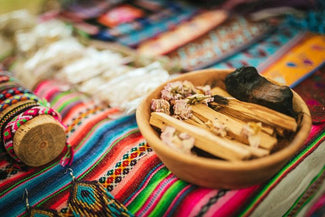
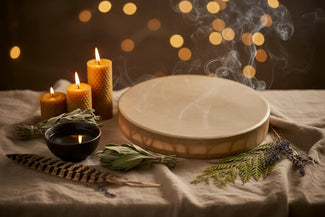
Shamanic altar or mesa — may include a frame drum, rattle, feathers, power stones (khuyas), Florida Water, copal resin, and animal medicine objects; the Q’ero mesa is the shaman’s primary ceremonial tool and spiritual identity. See our Shamanic Tools Guide →
Reiki or healing-space altar — crystals, Reiki symbols, candles, sound instruments, and meaningful objects used alongside professional or personal healing practice
Manifestation or intention altar — objects connected with a specific goal or intention: relevant crystals, a written intention beneath the cloth, candles in the appropriate colour, and symbolic items
Nature altar — stones, leaves, flowers, shells, wood, and other responsibly gathered natural objects; particularly suited to those whose practice is primarily earth-based
Portable or travel altar — a small cloth, one crystal, a card or meaningful image, a candle alternative (battery tealight, or a small tin candle with a lid), and one personal object kept in a pouch or box; as complete and intentional as a permanent altar, simply smaller
The Four Elements on an Altar
Representing all four elements creates a balanced energetic container — a microcosm of the natural world brought into your space. Elemental correspondences vary between traditions; what follows is the most widely shared framework.
- Earth — crystals, stones, salt, soil, seeds, plant matter, wood. Grounds the altar in physical reality; brings stability, patience, and embodied presence
- Water — a small bowl of water, shells, Florida Water, water-associated crystals (Aquamarine, Moonstone, Larimar). Brings flow, emotion, intuition, and purification
- Fire — a candle or oil lamp. Real flame carries transformation, intention, and the quality of light into the space; it is the most active element on the altar
- Air — incense, feathers, wind chimes or bells. Brings thought, communication, the breath of life, and connection to what is unseen
Building Your First Altar – Step by Step
The most important sequence in this guide, and the simplest:
- Choose the space — shelf, windowsill, corner, or surface; any size
- Decide its purpose — what is this altar for? Name it clearly before placing anything
- Clear the area — physically clean it first, then cleanse energetically with smoke, sound, or sacred spray
- Choose one central object — a candle, a crystal, a photograph, or a meaningful object that anchors the intention
- Add only what supports the intention — resist the urge to fill the space; each object should earn its place
- Sit with it — spend a few minutes in front of it before adding anything else; notice what it needs
- Adjust over time — the altar is a living thing; let it evolve with your practice
Keep It Simple
This is worth saying plainly.
A meaningful altar does not need to look impressive. If every available surface has been filled, it can become harder to notice the objects that actually matter.
An altar crowded with beautiful things is still a collection of objects. An altar with three chosen things and a clear intention is a working practice space. Begin with less than you think you need. Add slowly, only when something genuinely calls to be there.
Candles – Choosing by Colour
A single white candle is the most universal choice — white holds all colours and all intentions. For more specific work, choose by colour:
- White — purity, clarity, all intentions
- Purple / Violet — spiritual depth, intuition, connection to the divine
- Blue — peace, communication, healing, truth
- Green — abundance, growth, healing, the natural world
- Pink — love, self-care, compassion, the heart
- Red / Orange — energy, passion, courage, transformation
- Gold / Yellow — clarity, confidence, the sun, the divine masculine
- Black — protection, banishing, deep mystery
- Silver — the moon, intuition, the divine feminine, cycles
Shop Candles → | Candles Guide →
Crystals for Your Altar
- Selenite — self-cleansing, high-vibrational; holds the space clear between uses and amplifies the energy of everything near it. The essential altar crystal
- Clear Quartz — the master amplifier; amplifies intention and the energy of all other stones
- Amethyst — spiritual connection, intuition, protection, depth; the most widely used crystal for meditation and spiritual practice
- Rose Quartz — opens the heart, softens the atmosphere, brings love and compassion to the space
- Black Tourmaline — energetic protection and grounding; placed at the corners it creates a protected field
See our Crystal Guide → and Crystal Combinations Guide → for the full range of crystals by intention.
Incense & Fragrance
Incense purifies the space, carries prayer upward in the rising smoke, and engages the sense of smell to anchor the mind in sacred time. Choose by tradition, intention, or instinct.
- Frankincense — the most traditional altar incense across Western esoteric and Eastern ceremonial traditions; purifies, elevates, and opens. Universally appropriate. Shop Frankincense →
- Copal — the traditional Mesoamerican and Q’ero offering resin; used in ceremony as a vehicle for prayer. Shop Copal →
- Sandalwood — meditative stillness; used across Hindu, Buddhist, and shamanic traditions. Shop Sandalwood →
- White Sage — the primary cleansing tool; burn before ceremony to clear the space. Shop White Sage → | Smudging Guide →
- Palo Santo — warm and uplifting; invites positive energy after cleansing. Shop Palo Santo →
- Nag Champa — the most recognised meditation incense in the world; brings devotion and stillness. Shop Nag Champa →
Incense Guide → | Resin Incense Guide →
Cleansing and Refreshing Your Altar
Physical cleaning comes first — dust the surface, remove anything that has wilted or completed its purpose, wipe down with a clean cloth. Then energetic cleansing: smoke from sage or incense moved through and around the space, a misting of sacred spray into the corners and across the surface, or sound from a singing bowl or Tingshas played directly over the altar. Replace flowers and water offerings before they stale. Replace candles when burned down. Remove objects that no longer feel as though they belong.
Cleanse at minimum once a month, and always after a significant ceremony or a period of difficulty.
Shop Smudge Sticks → | Shop Sacred Sprays → | Shop Singing Bowls →
When Your Altar Changes
Altars are not permanent displays. They evolve as your practice evolves, as your intentions shift, as the season turns, as you move through different phases of life. Some objects will feel complete — their work done — and can be returned to the earth, given away, or simply removed with gratitude. New objects will arrive. The altar that serves you now may look quite different in a year’s time. This is not inconsistency. It is a practice alive and growing.
Respecting Different Traditions
Altar traditions exist across Christianity, Hinduism, Buddhism, Paganism, Wicca, indigenous traditions worldwide, and many other religions and spiritual paths. Their meanings, objects, arrangements, and protocols are not interchangeable.
A personal spiritual altar can draw from what genuinely belongs to your own practice, your own heritage, and your own experience without needing to imitate another culture’s sacred setup. When tools or practices from other traditions genuinely call to you — Palo Santo, copal, mesa cloths, khuyas — approach them with respect for their origins, learn something of the tradition they come from, and work with them with care rather than as aesthetic choices.
Common Altar Mistakes
- Overcrowding — more objects do not mean more power; a cluttered altar is harder to work with than a spare one
- Copying social-media altars — the most photographed altars are designed to look beautiful, not necessarily to function as working practice spaces
- Feeling compelled to buy everything — start with what you have; a meaningful stone from the garden outperforms an expensive crystal placed without intention
- Leaving candles unattended — a practical and serious point; never leave a lit candle in a space you are not in
- Cultural mixing without context — combining sacred objects from multiple traditions without understanding their origins can produce something that serves none of them
- Treating the setup as more important than using it — a beautifully arranged altar that is never sat in front of is decoration; an imperfect altar used daily is a practice
Frequently Asked Questions
How many objects should be on my altar?
As few or as many as genuinely belongs. A single candle and a crystal is a complete altar. What matters is that every object has a reason to be there. If you are unsure whether something belongs, it probably doesn’t — yet.
Does my altar need to face a particular direction?
Not necessarily, but direction adds a layer of intentionality. East is associated with new beginnings and inspiration; North with grounding and ancestral wisdom. If you work with the Four Directions, see our Four Directions guide →
Can I have more than one altar?
Absolutely. Many people have a main practice altar, a smaller bedside altar for sleep and dreamwork, and a seasonal nature altar outdoors. Each holds a different quality and intention.
What is the difference between an altar and a sacred space?
A sacred space is the broader environment — the room, corner, or area set aside for spiritual practice. An altar is the specific arrangement of objects within it. See our Creating a Sacred Space guide →
A Final Thought
Your altar does not need to prove anything about your spirituality.
It only needs to create a place where you can return — to pause, remember, reflect, practise, or reconnect with what matters to you.
Begin simply. Let the space grow as your practice grows.
Shop Altar Essentials
- Altar & Mesa Cloths
- Crystals
- Selenite
- Candles, Tealights & Holders
- Incense & Smudging
- Resin Incense & Charcoal Discs
- Smudge Sticks & Loose Sage
- Palo Santo
- Sacred Sprays & Room Mists
- Florida Water
- Ritual Tools & Altar Items
- Altar Items & Offerings
- Singing Bowls & Tingshas
- Feathers & Dream Catchers
- Koshi & Heola Wind Chimes
- Rattles & World Instruments
- Shamanic Drums
Related Guides
- Creating a Sacred Space – A Complete Guide
- Four Directions: Opening Sacred Space
- Crystal Guide
- Crystal Combinations Guide
- How to Cleanse Crystals
- Candles Guide
- Incense Guide
- Resin Incense & Charcoal Discs Guide
- Smudging & Energy Cleansing Guide
- Sacred Sprays Guide
- Sound Healing at Home
- Shamanic Tools Guide
- Energy Cleansing Explained
- Tarot & Oracle Cards Guide