
How to call the Four Directions and open sacred space ceremonially — the elemental associations of East, South, West and North, the earth beneath and the sky above, the tools used, and a complete practice drawing on Native American and Q’ero Peruvian shamanic traditions.
Before ceremony, before journey, before any practice that asks something significant of us, there is a moment of preparation — a turning towards the world, a calling of what is needed, a deliberate marking of the threshold between ordinary time and sacred time. Opening sacred space is that moment.
The Four Directions — East, South, West, North — are one of the most ancient and universal frameworks in human spiritual practice. They appear in shamanic traditions across the Americas, in Celtic and Druidic practice, in Wiccan and ceremonial magic, in Native American ceremony, and at the heart of the Q’ero Peruvian shamanic tradition — one of the oldest and most intact living shamanic lineages on earth, carried by the indigenous peoples of the high Andes.
In the Q’ero tradition, the directions are not merely points on a compass. Each holds an archetypal quality, a medicine animal, and a principle that organises our inner life and our relationship with the living world. Together they form a complete map of human experience — from the physical and instinctual to the visionary and cosmic. To call them into sacred space is to call all of these qualities into witness and support, and to place your ceremony within a living field that is far larger than yourself.
Opening sacred space can be done alone or in a group, in silence or spoken aloud, facing each direction or from a single position with internal orientation. You may hold a rattle, carry incense or smudge, beat a drum, or work with sacred spray and feathers — or simply your voice and your intention. The practice is complete however you bring it. What matters is presence, sincerity, and the willingness to call.
How to Use This Guide – At a Glance
- You are new to this practice — use the Q’ero Prayer Crib Card below to begin immediately; return to the full direction descriptions to deepen your understanding
- You want to know the order — Q’ero shamanic tradition begins in the South; many Native American traditions begin in the East. Both are valid; follow your lineage or your instinct
- You want to face each direction — traditional and recommended where possible, but not required; the practice works equally well with internal orientation from a fixed position
- You are working alone — silent, whispered, or spoken aloud; intention is primary
- You are working in a group — one person leads the calling while others hold the space; pass the rattle, fan the smoke, spritz each direction together
- You want to add physical tools — see the tools section below; each links to the relevant products
Q’ero Prayer Crib Card – Opening Sacred Space
Hold your rattle, incense, drum, or sacred spray. Face each direction in turn, or hold each in your awareness. Speak from the heart.
To the South:
To the winds of the South, great Sachamama, great Serpent — come, be with us. Combine, wrap your coils of light around us. Show us how to shed our past as the serpent sheds her skin — wholly, completely, with grace. We call on you.
To the West:
To the winds of the West, mother, sister Jaguar — Otorongo of the jungle, the bridge between the worlds. Life, death, and renewal live in you. Join us. Show us your ways — how to transform in an instant, how to dance with you across the rainbow bridge. We call on you.
To the North:
To the winds of the North, Hummingbird — you who undertake the impossible journey without question, with complete knowing. Ancient one, ancestor from the high mountain tops — be with us. Show us your ways, so that we may show others the same. We call on you.
To the East:
To the winds of the East, Eagle, Condor — lift us to new eyes. Fly with us above the mountains so we may see a new perspective, a fuller vision of who we are becoming and what is possible. We call on you.
Pachamama:
Pachamama — Mother Earth, you who hold us, provide for us, and nourish us. To the winged ones and the small ones, to the four-legged and the two-legged — be with us. Hold us and nourish us in this time of ritual and ceremony. We are grateful. We call on you.
Inti Tata:
Inti Tata — Father Sun, Mother Moon, cosmic brothers and sisters of the stars — be with us. Overlight this space, allowing us to be held: as above, so below, in balance and harmony with all creation. We call on you.
Sacred space is open. Begin your practice.
To close: reverse the order — East, North, West, South, then Inti Tata, then Pachamama — with a simple thank you at each: “Thank you — go in peace.” Then: “This space is now closed. We return to ordinary time with gratitude.”
The Four Directions – The Q’ero Way
South – Sachamama – The Serpent – The Literal & Physical World
The South is where Q’ero ceremony begins. Its medicine animal is Sachamama — the great mother serpent of the jungle, she who moves through the physical world with her belly on the earth, sensing everything, present in every moment. The serpent is the master of the literal and physical — of the body, the stories we carry in our flesh, the patterns and wounds that live in our history and our lineage.
The medicine of the South is the medicine of shedding. As the serpent sheds her skin — wholly, completely, without negotiation — so the South asks us to see the stories we hold about ourselves and our past, to acknowledge them fully, and then to let them go. This is not metaphor. It is a practical, physical process of releasing what we have been carrying so that we can move forward unencumbered.
- Medicine animal: Sachamama — the Serpent
- Principle: Shedding — seeing and releasing our stories, patterns, and wounds
- Qualities: Groundedness, embodiment, courage to shed, clarity about what we carry
- Tools & objects: White Sage, Palo Santo, rattle, a red or orange candle, Carnelian, Fire Agate
West – Otorongo – The Jaguar – Life, Death & Transformation
The West is held by Otorongo — the jaguar of the jungle, apex of the food chain, the one who moves between the worlds. The jaguar does not negotiate with fear. It transforms in an instant — from stillness to explosive, decisive action — and in doing so teaches us something essential about the nature of power.
The West is the place of life, death, and renewal. It is the direction where karmic patterns live — not just our personal karma but our karmic inheritance, the threads carried across lifetimes and lineages. This is our power centre: the place where we meet the deepest forces at work in our lives and, like the jaguar, learn to move through them without being consumed. When we call the West, we call the courage to face what needs to change fundamentally — the death that is not an ending but a becoming, the dissolution that precedes a more authentic form.
- Medicine animal: Otorongo — the Jaguar
- Principle: Life, death, and renewal — meeting karmic patterns and transforming through them
- Qualities: Power, courage, transformation, meeting fear, karmic release, depth
- Tools & objects: Florida Water, sacred sprays, a bowl of water, a blue or silver candle, Obsidian, Moonstone, Labradorite
North – Siwarkenti – The Hummingbird – Wisdom & the Ancestors
The North is held by Siwarkenti — the hummingbird, that impossibly tiny bird that undertakes one of the greatest journeys in the natural world. The hummingbird does not pause to calculate whether the journey is possible. It simply goes — with complete knowing, with unwavering will, without needing to understand how. In this, the hummingbird teaches a particular kind of wisdom: not the wisdom of accumulated knowledge, but the wisdom of becoming — a knowing that does not precede the journey but arises through it.
The North is the place of the ancestors — the mountain tops, the high places that hold and guide and advise. It is the direction of those who have walked this path before and whose wisdom is available to us when we learn to listen. When we call the North, we call the willingness to undertake the journey without needing to know the destination, and the support of all those whose journeys have made ours possible.
- Medicine animal: Siwarkenti — the Hummingbird
- Principle: Wisdom through becoming — the journey undertaken in trust, guided by the ancestors
- Qualities: Trust, will, ancestral wisdom, the knowing that comes through experience rather than thought
- Tools & objects: Feathers, incense, bells & wind chimes, a white or silver candle, Amethyst, Clear Quartz, Selenite
East – Apuchin – The Eagle & Condor – Vision & Becoming
The East is held by Apuchin — the eagle and the condor, the great birds that soar above the world and see it whole. Where the serpent moves through the physical world with her belly on the ground, the eagle rises above it and sees from a perspective simply not available at ground level — the pattern beneath the detail, the larger movement beneath the immediate event, the thread of meaning that connects what appears to be separate.
The East is the direction of transformation through vision — the death of who we thought we were so that we may become who we were always meant to be. It is the place of the seer: the one who looks through different eyes, who holds the capacity for genuine transformation rather than mere change. When we call the East, we call the willingness to see clearly and completely, and from that seeing, to be genuinely remade.
- Medicine animal: Apuchin — the Eagle & Condor
- Principle: Transformation through vision — seeing from the seer’s eyes, becoming who we were meant to be
- Qualities: Vision, perspective, transformation, the seer’s sight, becoming
- Tools & objects: A gold or yellow candle, eagle or condor feathers, Labradorite, Lapis Lazuli, Azurite
Pachamama – Mother Earth – She Who Holds and Nourishes All
After the four cardinal directions are called, the Q’ero tradition acknowledges Pachamama — the living earth herself. Not a direction in the geographical sense, but the presence that underlies and holds all the others. Pachamama is the mother of all life: she who feeds the four-legged and the two-legged, who provides for the winged ones and the small ones, who holds every living creature in her body and sustains the conditions that make life possible. She is not a concept or a symbol. She is the ground beneath your feet, alive and aware and generous beyond measure.
To acknowledge Pachamama is to remember that every ceremony takes place within her body and with her blessing — an act of gratitude and reciprocity, the foundational principle of Andean spiritual life: ayni, right relationship, giving and receiving in balance.
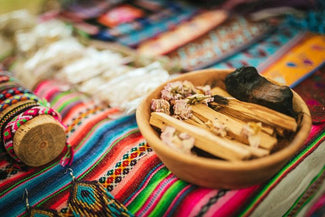
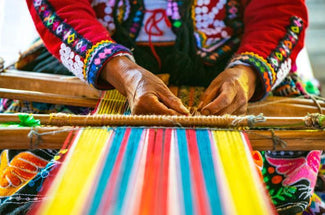
- Tools & objects: Stones and crystals placed on the earth, flowers, seeds, offerings of food or drink, mesa cloth
Inti Tata – Father Sun, Mother Moon – Cosmic Brothers & Sisters
The final acknowledgement is to Inti Tata — Father Sun — and to Mother Moon, the stars, and the cosmic brothers and sisters of the universe. Where Pachamama grounds the ceremony in the earth, Inti Tata opens it to the sky: the light of the sun that makes all growth possible, the feminine wisdom of the moon that governs cycles and tides, the vast community of consciousness that extends far beyond the earth into the cosmos.
This is the masculine that overlights the space — not in the sense of dominance, but of the light that enables and allows. As above, so below: Father Sky and Mother Earth together form the complete container within which all ceremony, all life, all becoming takes place, held in balance with all creation.
- Tools & objects: A gold candle for the sun, a silver for the moon, Clear Quartz, Selenite, Celestite
The Order of Opening – Two Traditions
| Step | Q’ero Peruvian Shamanic | Native American (many traditions) |
|---|---|---|
| 1 | South (Serpent) | East |
| 2 | West (Jaguar) | South |
| 3 | North (Hummingbird) | West |
| 4 | East (Eagle & Condor) | North |
| 5 | Pachamama (Mother Earth) | Above / Below (varies) |
| 6 | Inti Tata (Father Sky / Cosmos) | — |
Neither sequence is more correct than the other. If you work within a specific lineage, follow its guidance. If not, choose the sequence that resonates and use it consistently — repetition builds the energetic pattern over time.
Working With Tools
Opening the directions can be done with voice and intention alone. Adding physical tools deepens the sensory and energetic quality of the practice and gives everyone in a group a way to participate physically, not just as observers.
- White Sage — carry the smoke to each direction as you call it, cleansing that quadrant of the space and offering the smoke as prayer
- Palo Santo — widely used in Q’ero and South American practice; warmer and sweeter than sage, used to invite positive energy and bless each direction
- Incense — sticks, cones, or resin on charcoal; carried to each direction as an offering of fragrance and prayer
- Feathers — used to direct and fan smoke, to cleanse each direction, and to carry prayers; sacred tools associated with the winged ones who carry messages between worlds
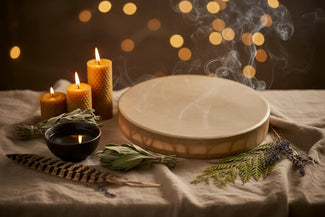
- Rattles — shaken at each direction to break up stagnant energy and call the directions awake; a fundamental shamanic tool across both traditions
- Shamanic drum — a steady beat or short rhythm at each direction before the calling; the drum is the heartbeat of ceremony
- Bells & tingshas — rung at each direction to cleanse with sound and mark each calling with precision
- Sacred sprays & spritzing water — misted at each direction to cleanse and bless; Florida Water is traditional in Q’ero and Latin American practice
Frequently Asked Questions
Do I have to face each direction physically?
No — facing the direction is traditional and adds a grounding quality to the practice, but it is not required. The opening works equally well from a fixed position with your attention and intention oriented to each direction in turn.
Can I do this silently?
Yes. Silent or softly spoken, the practice is equally valid. Speaking aloud is more powerful — the voice is itself a ceremonial tool — but if circumstances require quiet, work silently with full concentration and clear intent.
Which order should I use?
If you work within a specific lineage — Q’ero, Native American, Wiccan, Druidic — follow its guidance. If not, begin with South (the Q’ero starting point) or East (the most widely shared alternative) and use the same order consistently. Repetition builds the energetic pattern of the opening over time.
Do I need to close the space every time?
Yes — if you open, close. Opening sacred space creates a defined energetic container; not closing it leaves it incomplete. The closing takes no more than a minute or two but is an important act of completion, gratitude, and energetic hygiene.
Can I adapt the words?
Absolutely — and over time you should. The words offered here are a starting point. What matters is genuine intention and felt connection to each direction and its medicine. Let your language evolve with your practice.
Shop Ceremonial Tools
- Ritual Tools & Altar Items
- Shamanic Drums
- Rattles & World Instruments
- Incense & Smudging
- Smudge Sticks & Loose Sage
- Palo Santo
- Candles, Tealights & Holders
- Crystals
- Feathers & Dream Catchers
- Singing Bowls & Tingshas
- Koshi & Heola Wind Chimes
- Sacred Sprays & Room Mists
- Florida Water
- Altar & Mesa Cloths
Related Guides
- Creating a Sacred Space – A Complete Guide
- How to Create an Altar
- Shamanic Journeying Guide
- Fire Ceremony Guide
- Shamanic Tools Guide
- Despacho Ceremony Explained
- Energy Cleansing Explained
- Smudging & Energy Cleansing Guide
- Sound Healing at Home