
Shamanic Journeying Guide – How to Journey, Types of Journey & Setting Sacred Space
Shamanic journeying is one of the oldest spiritual practices in the world — a method of entering an altered state of consciousness to access guidance, healing, and wisdom from the spirit world. Used by shamans and practitioners across every culture and continent for tens of thousands of years, journeying remains one of the most powerful and accessible tools in the shamanic toolkit.
This guide covers everything you need to begin — from understanding the different types of journey to setting sacred space, choosing your instruments, and cleansing before, during, and after your practice.
What Is a Shamanic Journey?
A shamanic journey is a deliberate shift in consciousness — induced primarily through rhythmic sound, most commonly the drum — that allows the practitioner to move between ordinary reality and non-ordinary reality. In non-ordinary reality, the journeyer can meet and work with helping spirits, power animals, and ancestral guides to receive healing, insight, and guidance.
Unlike meditation, which typically involves quieting the mind, journeying is an active, intentional practice with a specific destination and purpose. The journeyer sets a clear intention, enters the journey state, and returns with information or healing to bring back into ordinary life.
Types of Shamanic Journey
The Lower World Journey
The Lower World is the realm of nature spirits, power animals, and ancestral wisdom. It is reached by visualising a descent — through a cave, a tree root, a body of water, or any opening in the earth. The Lower World is not a dark or negative place; it is a rich, living realm of natural power and ancient wisdom. This is typically the first journey a beginner undertakes, and the most common destination for meeting a power animal.
Best for: Meeting your power animal, connecting with nature spirits, grounding, ancestral healing
The Upper World Journey
The Upper World is the realm of teachers, guides, and higher wisdom. It is reached by visualising an ascent — through clouds, up a mountain, along a beam of light, or through the branches of a great tree. The Upper World tends to feel lighter, more ethereal, and more abstract than the Lower World.
Best for: Receiving guidance and teaching, connecting with spirit guides and ancestors, clarity on life direction
The Middle World Journey
The Middle World is the spirit dimension of ordinary reality — the energetic layer that underlies the physical world we inhabit. Middle World journeys are used for tracking lost objects, communicating with the spirits of places, and working with the energies of the natural world around us. This is more advanced territory and generally not recommended for beginners.
Best for: Tracking, place healing, working with the spirits of land and nature
Extraction Journeys
An extraction journey is undertaken to identify and remove intrusive energies — energies that do not belong in a person's energy field and are causing disruption or illness. This is healing work and is typically undertaken by experienced practitioners on behalf of others.
Soul Retrieval Journeys
Soul retrieval is one of the most profound forms of shamanic healing — the recovery of soul parts that have been lost through trauma, shock, or significant life events. This is advanced work, usually undertaken by trained shamanic practitioners.
Setting Sacred Space Before Your Journey
Preparing your space before a journey is not optional — it is an essential part of the practice. Sacred space creates a container of protection and intention that supports the journey and honours the spirits you are working with.
Step 1: Cleanse Your Space
Begin by physically tidying the space. Then cleanse energetically using smoke, sound, or sacred spray:
- Smoke cleansing — burn white sage or palo santo and move through the space, paying particular attention to corners. Alternatively burn copal or frankincense resin on a charcoal disc — both are traditional ceremonial cleansers.
- Sound cleansing — strike a singing bowl or tingsha bells in each corner of the room, or shake your rattle around the perimeter of the space.
- Sacred spray — mist a room clearing spray or Florida Water around the space and around yourself.
Step 2: Call in the Four Directions
Many shamanic traditions open ceremony by calling in the four directions — East, South, West, and North — along with the elements, the earth below, and the sky above. This creates a sacred container and invites the support of the directions and their associated spirits. Use your rattle or drum to mark each direction as you call it in.
Step 3: Set Your Intention
Before entering the journey, state your intention clearly — aloud or in your mind. Be specific. "I journey to the Lower World to meet my power animal" is a clear intention. "I journey to find out what I need to know" is too vague. Write your intention down if it helps to anchor it.
Step 4: Create Your Altar
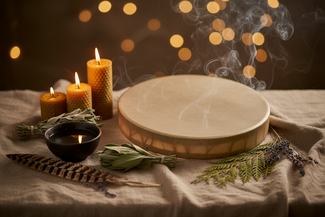
Arrange a simple altar with objects that feel meaningful — crystals, candles, feathers, sacred images, or anything that represents your intention and the spirits you are working with. Light a candle to mark the opening of sacred space.
Step 5: Choose Your Crystals
Crystals can be placed on the altar, held during the journey, or placed on the body. Crystals that support journeying include:
- Labradorite — the stone of the shamanic practitioner; supports access to non-ordinary reality and protects the energy field during journeying
- Black Tourmaline — grounding and protective; anchors you in your body and shields against unwanted energies
- Amethyst — deepens altered states and supports spiritual connection
- Obsidian — a powerful shamanic stone for truth, protection, and shadow work
- Selenite — connects to higher guidance and keeps the energy of the space clear
- Chumpi stones — Andean shamanic healing stones used in ceremony and energy work
Shop Crystals → | Shop Chumpi & Shamanic Healing Stones →
Instruments for Shamanic Journeying
The Shamanic Drum
The drum is the primary vehicle for shamanic journeying — often called the "horse" of the shaman. Its steady, monotonous beat (typically 4–7 beats per second) induces a theta brainwave state that allows the journeyer to enter non-ordinary reality. You can journey to live drumming, drum for yourself, or use a recorded drumming track.
A typical journey drumbeat is steady and unvarying for the duration of the journey, followed by a callback beat — a rapid, louder sequence that signals it is time to return — and then a slower closing beat to bring you fully back.
The Rattle
The rattle is the second most important shamanic instrument. It is used to open and close sacred space, call in the directions, cleanse the energy field, and accompany the drum during ceremony. Rattles are also used during the journey itself — shaking the rattle can help maintain the altered state and signal to helping spirits that you are present and working.
Different rattles carry different energies. Gourd rattles are earthy and grounding; seed rattles are lighter and more calling in nature; rawhide rattles are powerful and penetrating.
Other Instruments
Other instruments used in shamanic practice and ceremony include:
- Singing bowls — for space clearing, opening ceremony, and sound healing after the journey. Shop Singing Bowls →
- Tingsha bells — for marking transitions, calling in spirits, and clearing energy. Shop Tingshas →
- Flutes & ocarinas — used in many traditions to call in spirits and open ceremony. Shop World Instruments →
- Rainsticks — used to call in rain, water energy, and cleansing. Shop Rainsticks →
How to Do a Shamanic Journey – Step by Step
1. Prepare Your Space
Cleanse, set your altar, call in the directions, and light your candle and incense. Dim the lights or use an eye mask — darkness supports the journey state.
2. Lie Down or Sit Comfortably
Most journeyers lie on their back with an eye mask or cloth over their eyes. Some prefer to sit. Make sure you are warm and comfortable — the journey can last 10–30 minutes.
3. State Your Intention
Speak your intention aloud three times. This anchors it in the space and signals to your helping spirits that you are ready to work.
4. Begin the Drumbeat
Start your drumming track or begin drumming yourself. Allow the beat to carry you. Visualise your entry point — a cave, a tree root, a pool of water — and begin to move through it.
5. Journey
Follow your intention. Move through the landscape of non-ordinary reality with curiosity and openness. Notice what you see, hear, feel, and sense. Meet whatever comes with respect and gratitude.
6. Hear the Callback
When the callback beat sounds, thank any spirits you have met, say your farewells, and begin to return the way you came. Move back through your entry point and into your body.
7. Ground Yourself
When the closing beat ends, take a few deep breaths. Feel the weight of your body on the floor. Wiggle your fingers and toes. Eat or drink something — food and water are excellent grounding tools after a journey.
8. Record Your Journey
Write down everything you experienced as soon as possible. Journey experiences can fade quickly, like dreams. A journey journal is an invaluable tool for tracking patterns, insights, and the development of your relationship with your helping spirits.
Cleansing During the Journey
If you feel heavy, stuck, or encounter difficult energy during a journey, you can use your rattle to clear your energy field — shake it around your body with the intention of clearing. You can also call on your power animal or helping spirits to assist with any clearing that is needed.
Cleansing After the Journey
Closing ceremony and post-journey cleansing are as important as the opening. After returning from the journey:
- Close the directions — thank and release each direction in reverse order (North, West, South, East), then the earth below and sky above
- Smoke cleanse — pass palo santo or sage around yourself and the space to clear any energies that may have been stirred up
- Sound cleanse — strike your singing bowl or shake your rattle through the space
- Sacred spray — mist Florida Water or a clearing spray around yourself and the room
- Ground — eat, drink water, walk outside, or hold a grounding crystal such as Black Tourmaline or Smoky Quartz
- Extinguish your candle — close the sacred space with intention and gratitude
Honouring the Spirits
In many traditions, offerings are made to the spirits as an act of gratitude and reciprocity — the Andean principle of Ayni (sacred reciprocity) teaches that what we receive, we must also give. Offerings might include tobacco, flowers, food, water, or a Despacho ceremony. Even a simple moment of heartfelt gratitude is a meaningful offering.
Tips for Beginners
- Start with the Lower World and the intention of meeting your power animal — this is the traditional starting point
- Use a recorded drumming track if you don't yet have a drum — many are available online
- Don't worry if your first journeys feel unclear or dreamlike — this is normal; the practice deepens with time
- Always journey with a clear intention — vague journeys produce vague results
- Keep a journey journal from the very beginning
- Treat everything you encounter with respect, even if it seems strange or challenging
- Ground thoroughly after every journey
Shop Shamanic Journeying Tools
- Natural Skin Frame Drums
- Remo Buffalo Synthetic Drums
- Drum Bags & Accessories
- Maracas, Rattles & Rainsticks
- All World Instruments
- Singing Bowls & Tingshas
- Smudge Sticks & Loose Sage
- Palo Santo
- Resin Incense & Charcoal Discs
- Sacred Sprays & Room Mists
- Florida Water
- Crystals
- Chumpi & Shamanic Healing Stones
- Candles & Tealights
- Altar Items & Offerings
- Smudging Feathers
- Medicine Pouches
Related Guides
- Shamanic Tools Guide
- Shamanic Drums Explained
- Despacho Ceremony Explained
- Smudging & Energy Cleansing Guide
- Energy Cleansing Explained
- Creating a Sacred Space
- Sound Healing at Home
- Incense Guide
- Palo Santo Guide
- Sacred Sprays Guide
- Crystal Guide
- Nature, Seasons & Living in Rhythm
Related Blog Posts
- Shamanic Journeying for Beginners
- Shamanism and Shamanic Altars and Tools: A Comprehensive Guide
- What is a Shaman Drum? Considerations for Choosing the Right One
- Difference Between Rattles, Maracas, Gourd Shakers & Rainsticks
- Florida Water: Uses, Meaning and Rituals
- How to Create Sacred Space With The Four Directions