What Is African Turquoise?
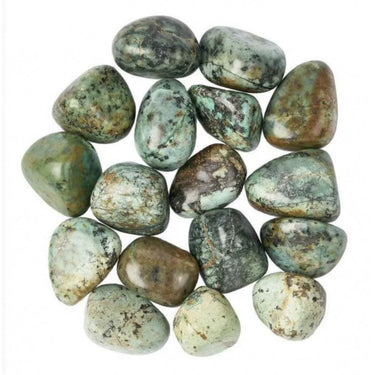
African Turquoise is the trade name commonly given to a teal-green jasper-type stone that resembles natural turquoise in colour and pattern.
It is not true turquoise.
Its appearance may include green, blue-green, teal and earthy tones, often with dark brown or black matrix lines running through the stone.
These markings give African Turquoise a distinctive organic appearance, with no two tumblestones looking exactly alike.
Within the crystal world, the stone has become particularly well known for its symbolic association with change, growth and personal evolution.
African Turquoise Meaning
The meaning of African Turquoise centres strongly on growth, transformation and new beginnings.
Within contemporary crystal traditions, it is often chosen during periods of change, personal development or transition.
Its symbolism is less about sudden dramatic transformation and more about gradually moving into a new phase with greater awareness and openness.
This makes African Turquoise especially suited to reflective practices centred on change, intention and personal direction.
The Stone of Evolution
African Turquoise is often called the Stone of Evolution.
This name reflects its contemporary metaphysical association with personal growth, renewal and moving forward into new possibilities.
It is often chosen when someone feels ready to change direction, begin something new or develop a different way of thinking about a situation.
The stone does not create change by itself, but it can serve as a meaningful physical reminder of progress, adaptability and purposeful movement.
Growth, Renewal & New Beginnings
African Turquoise is closely linked with symbolism around renewal.
Its green and blue colouring naturally evokes growth, nature and fresh perspective, while its darker matrix gives each piece a grounded, earthy quality.
This combination makes it especially appealing during periods of transition.
Some people use African Turquoise when setting intentions for a new chapter, starting a project, changing routines or reflecting on the direction they want to take next.
Creativity & Clearer Perspective
African Turquoise is also associated symbolically with creativity and perspective.
Within crystal practice, it may be chosen when looking for new ideas, alternative approaches or a different way to view an existing situation.
Its varied colour and patterning reinforce this symbolism, giving each stone a sense of movement and individuality.
It can be used during journalling, brainstorming, meditation or creative work as a reminder to remain open to change and possibility.
African Turquoise & the Third Eye Chakra
African Turquoise is commonly associated with the Third Eye Chakra.
Within contemporary chakra practice, the Third Eye represents perception, intuition, insight and perspective.
Its blue-green tones fit naturally within this symbolism.
A tumblestone may be held during meditation, placed nearby during reflective practice or included within a Third Eye crystal grid.
Its role is symbolic rather than a claim that the stone creates heightened intuition or psychic ability.
African Turquoise & the Heart Chakra
Some crystal traditions also connect African Turquoise with the Heart Chakra.
The Heart Chakra symbolically represents compassion, openness, balance and emotional connection.
Its green colouring contributes naturally to this association.
For some people, this gives African Turquoise a useful balance between insight and emotional awareness, making it suitable for reflective practices centred on both perspective and personal growth.
Astrology, Zodiac & Birth Sign Associations
African Turquoise is commonly associated with Sagittarius and Pisces in contemporary crystal astrology.
For Sagittarius, the connection centres on exploration, growth, freedom and moving towards new experiences.
These themes align closely with the Stone of Evolution symbolism.
For Pisces, African Turquoise is often associated with intuition, sensitivity, imagination and spiritual reflection.
Its blue-green colouring and Third Eye association also fit naturally with Pisces symbolism.
These correspondences vary between crystal traditions and should be understood as modern symbolic associations rather than fixed astrological rules.
African Turquoise is not generally recognised as a traditional calendar birthstone.
African Turquoise & the Earth Element
African Turquoise is most closely associated with the Earth element.
Earth symbolises growth, stability, grounding, patience and connection with the natural world.
These themes complement African Turquoise particularly well because its symbolism centres on steady development rather than sudden change.
Its natural-looking matrix patterns and green tones further strengthen this Earth correspondence.
Within elemental crystal practice, African Turquoise may be used in Earth-focused grids or altar work centred on growth, transition and practical progress.
African Turquoise Healing Crystal
African Turquoise is frequently described as a healing crystal within contemporary metaphysical and wellbeing traditions.
Its strongest symbolic themes include growth, transformation, creativity, emotional balance and spiritual development.
These associations belong to spiritual and reflective practice rather than established medical treatment.
The stone can therefore be used during meditation, chakra work, intention setting, crystal grids or simply enjoyed for its distinctive natural appearance.
Meditation & Everyday Use
Its 2–3cm size makes this African Turquoise tumblestone practical for everyday crystal use.
It can be carried in a pouch, held during meditation, placed beside a journal or incorporated into a crystal grid.
Its size also makes it suitable for altar use or as a symbolic stone during periods of transition or personal change.
Because each piece has different colour and matrix patterning, it also works beautifully as a small collectible stone.
Natural African Turquoise Character
Every African Turquoise tumblestone is individual.
Some pieces may be predominantly green or teal, while others contain stronger blue tones, earthy brown areas or darker matrix markings.
Patterning, shape and polish will also vary from stone to stone.
These natural differences are part of the character of the material and are not considered faults.
Care
African Turquoise should be handled with normal care.
Clean gently with a soft damp cloth and dry afterwards.
Avoid harsh chemical cleaners, abrasive surfaces and hard impacts that could affect the polished finish.
Store separately from rougher or harder minerals where practical.
Quick FAQs
What is African Turquoise traditionally used for?
Within crystal practice, African Turquoise is associated with growth, transformation, renewal, creativity and new beginnings.
What is the meaning of African Turquoise?
Its strongest symbolic meanings centre on personal evolution, positive change, growth and fresh direction.
Why is African Turquoise called the Stone of Evolution?
The name reflects its contemporary association with personal growth, renewal and moving into new phases of life.
Is African Turquoise real turquoise?
No. African Turquoise is not true turquoise. It is commonly sold as a jasper-type material within the crystal trade.
What chakra is African Turquoise associated with?
It is most commonly associated with the Third Eye Chakra and is also linked with the Heart Chakra in some traditions.
What zodiac signs are associated with African Turquoise?
Sagittarius and Pisces are commonly linked with African Turquoise in contemporary crystal astrology.
Is African Turquoise a birthstone?
No. It is not generally recognised as a traditional calendar birthstone.
What element is African Turquoise associated with?
Earth is its closest elemental correspondence because of its links with growth, grounding, stability and natural renewal.
How large is the tumblestone?
Approximately 2–3cm.
How much does each stone weigh?
Up to approximately 35g.
Will every stone look the same?
No. Colour, matrix patterning, shape and polish naturally vary between pieces.
NB
As this item is made from African Turquoise and individually polished, variations in colour, matrix patterning, markings, shape, size and finish are to be expected.
These natural differences give each tumblestone its own individual character and are not considered faults.
Please Note / Disclaimer
African Turquoise is a trade name and is not true turquoise.
Crystal meanings, chakra associations, zodiac correspondences, elemental associations and references to healing, growth, transformation or spiritual development describe traditional and contemporary metaphysical beliefs.
Astrological and elemental crystal correspondences can vary between different spiritual and metaphysical traditions.
African Turquoise should not be used to diagnose, treat or manage stress, anxiety or any other medical or psychological condition.
Small object. Not suitable for children. Keep out of reach of children and pets.




 Pierre roulée de guérison en turquoise africaine de 2 à 3 cm – Croissance et transformation
£2.48
/
Pierre roulée de guérison en turquoise africaine de 2 à 3 cm – Croissance et transformation
£2.48
/