


Tara Verte (Chittamani Tara) est une manifestation féminine de l'énergie éclairée et de l'activité compatissante, profondément vénérée dans le bouddhisme tibétain. Parmi les 21 formes de Tara, les deux plus importantes sont Tara Blanche et Tara Verte — symbolisant la longévité et la compassion active.

Tara Verte est souvent représentée avec sept yeux — sur son visage, ses paumes et ses plantes de pieds — représentant sa conscience de la souffrance de tous les êtres. Elle est gracieusement assise en posture du lotus, sa main gauche tenant la tige d'un lotus bleu (utpala), symbolisant la pureté et la sagesse qui fleurit immaculée hors de la boue de l'illusion mondaine.

Dans les communautés bouddhistes, les 21 Louanges de Tara sont régulièrement chantées pour apaiser les obstacles et les peurs. Les dévots croient que réciter le mantra de Tara Verte apporte protection, courage et paix intérieure :

Om Tare Tuttare Ture Svaha (prononcé "Soham")

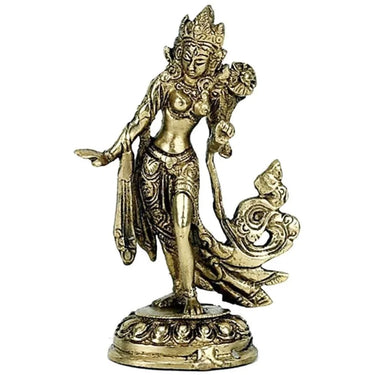
Cette statue de danse de Tara Verte artisanale capture l'essence de l'énergie dynamique de Tara — à la fois équilibrée et fluide, rayonnante et sereine. La finition en métal doré antique évoque une beauté intemporelle, en faisant à la fois un symbole sacré et une pièce décorative gracieuse.

Compacte et profondément significative, elle est parfaite pour les autels, les espaces de méditation ou la décoration intérieure sacrée, invitant les bénédictions de la compassion et de la protection dans n'importe quel cadre.

Détails du produit :

  • Design : Tara Verte en posture de danse, tenant un lotus bleu symbolisant la pureté et l'illumination

  • Taille : Env. H 13 cm × L 10 cm × P 6 cm

  • Matériau : Métal doré artisanal avec finition antique

  • Couleur : Ton or antique avec des détails complexes

  • Utilisation : Convient pour les autels intérieurs, les espaces rituels, les coins de méditation ou comme souvenir de dévotion

  • Symbolisme : Représente la compassion, l'intrépidité et la libération des obstacles

  • Origine : Inde

The Sacred Presence of Green Tara

Among the many forms of Tara, Green Tara is especially associated with active compassion.

Rather than remaining distant or withdrawn, she represents enlightened energy that responds swiftly to suffering. Her presence is traditionally invoked in times of fear, uncertainty and difficulty, making her an especially meaningful figure for meditation, prayer and personal devotional practice.

In this dancing form, Tara appears light, graceful and alive with movement. The posture suggests that compassion is not passive: it moves, acts and reaches outward where help is needed.

Her serene expression balances this movement with inner stillness, creating a figure that feels both radiant and composed.

What Does the Blue Lotus Symbolise?

The blue lotus, or utpala, is associated with wisdom, purity and spiritual awakening.

Like a lotus rising clean from muddy water, it reflects the possibility of clarity and compassion emerging through the challenges of worldly life.

In images of Green Tara, the lotus is often shown beside her as a sign of awakened understanding and the unfolding of enlightened qualities.

Green Tara and the 21 Taras

Green Tara is closely connected with the wider tradition of the 21 Taras, whose praises are recited across Tibetan Buddhist communities.

The Twenty-One Praises of Tara honour Tara in multiple forms, each expressing a different quality of enlightened activity. These practices may be used to cultivate courage, remove obstacles, calm fear and deepen compassionate awareness.

White Tara and Green Tara are among the best-known forms. White Tara is commonly associated with longevity and healing, while Green Tara is linked with swift compassion, protection and fearless action.

The Green Tara Mantra

A mantra traditionally associated with Green Tara is:

Om Tare Tuttare Ture Svaha

A common pronunciation guide is:

Om Tah-ray Too-tah-ray Too-ray Swah-hah

Within Buddhist practice, the mantra is recited as a devotional and meditative support. It may be used to steady the mind, invoke Tara’s compassionate qualities and cultivate courage in the face of difficulty.

Its meaning and use belong to a living spiritual tradition, and practitioners may wish to learn the pronunciation and practice from a qualified teacher.

For Altars and Meditation Spaces

At approximately 13cm high, this statue is compact enough for a personal altar while still carrying a strong visual presence.

It may be placed on:

a home shrine, meditation shelf, ritual table, sacred corner, yoga-space display or devotional cabinet.

The antique gold finish pairs naturally with candles, flowers, incense holders, prayer beads, offering bowls and rich altar fabrics.

Choose a clean, respectful position where the figure can be seen clearly and handled with care.

Handcrafted Antique-Gold Finish

The statue is made from metal and finished in an antique gold tone that highlights the flowing posture, lotus stem and intricate surface detail.

The aged appearance is intended to feel warm and traditional rather than bright or highly polished.

Because the piece is handcrafted, minor differences in tone, texture and detail may occur. These subtle variations form part of its individual character.

A Meaningful Spiritual Gift

Green Tara is widely associated with compassion, reassurance and the courageous removal of obstacles.

This makes the statue a thoughtful gift for someone beginning a meditation practice, creating a home altar, marking a spiritual milestone or seeking a devotional symbol of guidance and inner strength.

It may also be chosen simply for its graceful artistry and the sense of calm it brings to a sacred or contemplative space.

Care and Respectful Display

Dust gently with a soft, dry cloth or brush.

Avoid abrasive cleaners, harsh chemicals and prolonged damp, as these may affect the antique finish.

Keep indoors on a stable surface and handle with care, especially around the lotus and finer decorative details.

As a sacred image within Buddhist tradition, many people prefer to display Tara in a clean, elevated and respectful position.

Perfect For

Home altars, Tibetan Buddhist-inspired spaces, meditation rooms, ritual settings, yoga studios, sacred shelves, devotional collections and meaningful spiritual gifts.

Quick FAQs

Who is Green Tara?
Green Tara is a revered female Buddha figure in Tibetan Buddhism, associated with active compassion, protection and liberation from fear.

What does Chittamani Tara mean?
Chittamani Tara refers to a particular Green Tara tradition and practice centred on her enlightened, wish-fulfilling compassionate activity.

What is the statue made from?
Handcrafted metal with an antique gold finish.

What size is it?
Approx. H: 13cm × W: 10cm × D: 6cm.

What does the blue lotus represent?
Purity, wisdom and spiritual awakening.

What is the Green Tara mantra?
Om Tare Tuttare Ture Svaha.

Is this suitable for an altar?
Yes. Its compact size makes it especially suitable for personal shrines, meditation shelves and ritual spaces.

Is every statue identical?
No. Slight differences in finish and detail may occur because the piece is handcrafted.

Commandes et expédition
Les commandes passées avant 15h00 sont traitées et expédiées le jour même. Nous livrons dans le monde entier.

Informations de suivi
Veuillez suivre votre colis à l'aide des informations de suivi fournies dans votre e-mail de confirmation d'expédition. Le suivi est généralement mis à jour dans les 24 heures suivant l'expédition et se poursuit jusqu'à ce que la livraison soit confirmée.

Droits de douane et taxes
Les droits de douane et taxes de l'UE et internationaux sont à la charge du client et doivent être payés localement, le cas échéant. Pour les clients non britanniques, la taxe britannique est automatiquement supprimée à la caisse une fois la destination d'expédition sélectionnée.

Retards douaniers
Certaines commandes internationales peuvent être retardées en raison de contrôles douaniers, qui échappent à notre contrôle. Les retards peuvent être plus longs pendant les périodes de forte activité.

Retours
Pour les commandes ayant bénéficié de la livraison gratuite, les articles retournés peuvent être soumis aux frais d'expédition initiaux et aux éventuels frais de collecte.

Commandes internationales refusées ou annulées
Les commandes internationales qui sont refusées, retournées puis annulées peuvent être soumises à une surtaxe de 10 %. Les colis peuvent être réexpédiés sur demande, bien que des frais supplémentaires puissent s'appliquer.