
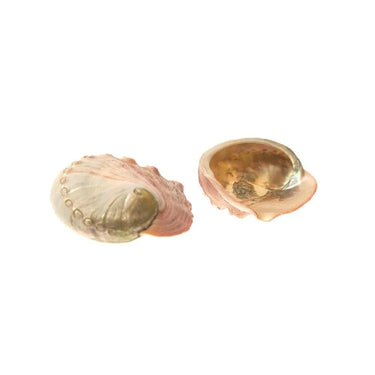
Coquille d'Ormeau de Fumigation 4" – Coquille Rituelle Rose Mama Cocha
Coquille de Fumigation en Ormeau • Mama Cocha « Mère des Eaux » • Récipient Rituel Sacré

Cette coquille de fumigation en ormeau rose (3-4") est un magnifique récipient rituel naturel traditionnellement utilisé pour les cérémonies de fumigation, la combustion d'encens, les offrandes d'autel et les pratiques de purification spirituelle.

Dans la cosmologie andine, la coquille représente Mama Cocha (Mama Qucha) — la Mère des Eaux, des océans et des mers. Elle incarne l' énergie féminine divine de l'eau, symbolisant la purification, la guérison émotionnelle, l'intuition et la force vitale de l'océan.

La coquille sert de support cérémoniel pour les herbes de fumigation, l'encens ou les offrandes sacrées, et est souvent placée sur les autels pour représenter l' élément de l'eau. Certains praticiens ajoutent également une petite quantité d'eau à la coquille pendant la cérémonie pour compléter la représentation élémentaire.

Chaque coquille présente une nacre irisée époustouflante avec des tons roses, rouges et océaniques, façonnée naturellement par la mer. Il n'y a pas deux coquilles identiques.

Détails du produit :

  • Vendu : Individuellement
  • Design : Coquille rituelle naturelle d'ormeau utilisée comme coupelle de fumigation ou récipient cérémoniel
  • Matériau : Coquille d'ormeau naturelle avec intérieur en nacre irisée
  • Taille approximative : 3,5–4,5 pouces (±10 % de variation naturelle)
  • Couleur : Tons irisés roses, rouges et arc-en-ciel à l'intérieur de la coquille
  • Finition : Intérieur de coquille naturel avec texture de nacre organique
  • Signification : Mama Cocha – Mère des Eaux • Féminin Divin • Purification • Équilibre Émotionnel
  • Utilisations : Coquille de fumigation, porte-encens, récipient d'eau pour autel, offrandes cérémonielles
  • Origine : Coquille océanique naturelle provenant de sources durables

Note : Chaque coquille varie naturellement en forme, en tonalités de couleur et en marques formées par l'océan.

Mama Cocha • Mother of the Waters

Mama Cocha, also written Mama Qucha, is associated with the sea and waters within Andean religious traditions.

Her name is commonly translated as Mother Sea or Mother of the Waters, and she is associated with the life-giving importance of water, particularly oceans and other bodies of water.

Within a contemporary spiritual altar, an Abalone shell may therefore be used symbolically to honour:

  • water and the ocean
  • gratitude for natural resources
  • flow and change
  • nourishment and life
  • reflection and emotional awareness
  • reciprocity with the natural world

Andean traditions are diverse, so this symbolism should not be treated as one universal interpretation or ritual prescription.

Water Element, Altar & Ritual Use

The shell works particularly well as a water-element vessel within holistic and spiritual spaces.

It can be placed on an altar alongside other elemental symbols or used to hold:

  • a small amount of water
  • flowers or petals
  • crystals
  • herbs
  • symbolic offerings
  • small keepsakes or prayer objects

Its natural ocean origin makes water symbolism particularly intuitive, although the meaning given to it remains personal to the practitioner.

Smoke Cleansing & Smudging

Abalone shells are also widely sold as smudging shells and may be used to catch ash from smouldering herbs or incense.

The word smudging, however, has specific ceremonial meanings within a number of Indigenous North American traditions. For general personal spiritual practice, smoke cleansing is often the more appropriate term unless referring to a specific tradition in its proper cultural context.

Materials used in personal smoke-cleansing practices can include herbs, woods or incense chosen according to the practitioner’s own tradition.

Rather than assuming that all plants or ceremonies are interchangeable, it is worth considering their cultural background and how they have been sourced.

The Four Elements in Contemporary Practice

Some modern spiritual practitioners use an Abalone shell as part of a symbolic four-element arrangement:

  • Shell or water – Water
  • Herbs or plant material – Earth
  • Smoke – Air
  • Flame – Fire

This is a contemporary ritual interpretation rather than a universal rule across Indigenous or Andean traditions.

It can nevertheless provide a simple framework for a personal altar, meditation or intention-setting practice.

A Simple Water & Intention Ritual

For a flame-free practice, place a small amount of clean water inside the shell and set it on a stable altar surface.

Spend a moment considering what water represents to you — perhaps flow, renewal, adaptability or gratitude.

You might reflect on:

“What am I ready to allow to move more freely?”

“What would greater balance look like here?”

When finished, return the water respectfully to the earth where appropriate, rather than leaving it standing in the shell indefinitely.

Using the Shell for Offerings

The shell can also be used as a small ceremonial offering vessel.

Flowers, petals, crystals or other symbolic items may be placed inside according to your personal practice.

If incorporating Andean-inspired concepts such as ayni — reciprocity or right relationship — the emphasis can be placed not only on asking for something, but also on gratitude and acknowledging what has already been received.

This helps distinguish an offering from simply treating ritual as a way to obtain a desired result.

Heat & Fire Safety

Natural Abalone shell is not indestructible or fully heat-proof.

Direct flame, hot charcoal or intense concentrated heat may cause natural shell to crack, scorch or become dangerously hot.

For safer smoke-cleansing use:

  • place a layer of clean sand or ash inside first
  • avoid placing hot charcoal directly against the shell
  • keep flames brief and allow herbs to smoulder rather than burn strongly
  • place the shell on a stable, heat-resistant surface
  • keep it away from fabrics, dried flowers and other flammable altar materials
  • ensure good ventilation
  • never leave burning material unattended
  • allow the shell to cool completely before handling

If burning resins on charcoal, use a purpose-made heat-resistant incense burner rather than relying on the shell alone.

Care & Cleaning

For ordinary cleaning, wipe gently with a soft damp cloth and dry thoroughly.

Avoid abrasive cleaners, harsh chemicals and prolonged soaking, which may affect the natural surface and nacre.

Natural shell can chip if dropped, so handle the edges carefully.

Quick FAQs

What size is the Abalone shell?
Approximately 3.5–4.5 inches, with natural variation between individual shells.

Will mine look exactly like the photograph?
No. Each natural shell differs in shape, depth, colour, markings and iridescence.

What is Mama Cocha?
Mama Cocha, or Mama Qucha, is associated with the sea and waters within Andean religious traditions and is commonly translated as Mother Sea or Mother of the Waters.

Can I use the shell on an altar?
Yes. It can represent water or hold crystals, petals, herbs and other small offerings.

Can I put water in it?
Yes, a small amount can be used temporarily for symbolic water-element practice. Empty and dry the shell afterwards.

Can I burn herbs directly inside it?
Use caution. Natural shell can become very hot or crack. A protective bed of sand or ash is recommended, and intense heat or hot charcoal should not be placed directly against the shell.

What is the difference between smudging and smoke cleansing?
Smudging can refer to specific ceremonial practices within Indigenous North American traditions. Smoke cleansing is a broader term for personal practices involving aromatic smoke.

Is the shell sustainably sourced?
The supplied information does not provide certification or sourcing evidence for this particular stock, so sustainability should not be claimed unless separately verified.

Disclaimer

Spiritual, holistic and ceremonial meanings described here are symbolic and culturally contextual. References to purification, protection, emotional balance or energetic cleansing should not be interpreted as guaranteed therapeutic or supernatural effects.

Practices connected with Andean or Indigenous traditions should be approached with respect for the living communities and cultural contexts from which they originate.

Commandes et expédition
Les commandes passées avant 15h00 sont traitées et expédiées le jour même. Nous livrons dans le monde entier.

Informations de suivi
Veuillez suivre votre colis à l'aide des informations de suivi fournies dans votre e-mail de confirmation d'expédition. Le suivi est généralement mis à jour dans les 24 heures suivant l'expédition et se poursuit jusqu'à ce que la livraison soit confirmée.

Droits de douane et taxes
Les droits de douane et taxes de l'UE et internationaux sont à la charge du client et doivent être payés localement, le cas échéant. Pour les clients non britanniques, la taxe britannique est automatiquement supprimée à la caisse une fois la destination d'expédition sélectionnée.

Retards douaniers
Certaines commandes internationales peuvent être retardées en raison de contrôles douaniers, qui échappent à notre contrôle. Les retards peuvent être plus longs pendant les périodes de forte activité.

Retours
Pour les commandes ayant bénéficié de la livraison gratuite, les articles retournés peuvent être soumis aux frais d'expédition initiaux et aux éventuels frais de collecte.

Commandes internationales refusées ou annulées
Les commandes internationales qui sont refusées, retournées puis annulées peuvent être soumises à une surtaxe de 10 %. Les colis peuvent être réexpédiés sur demande, bien que des frais supplémentaires puissent s'appliquer.