


Parfum. Se marie bien avec le vétiver, le jasmin, le mimosa, le galbanum, la bergamote, la cannelle, la rose, le benjoin, la tubéreuse et l'amyris.

Traditionnellement, en aromathérapie, l'ylang-ylang est surtout utilisé pour son effet psychologique, aidant à surmonter les sentiments négatifs, les peurs et les insécurités, en particulier chez les femmes en ce qui concerne leur sexualité. Il peut être utilisé contre la frigidité et l'impuissance ou simplement comme huile de massage ou de bain aphrodisiaque érotique. Il ralentit le rythme cardiaque et peut calmer les palpitations et réduire l'hypertension artérielle. Il peut aider à lutter contre l'insomnie, en particulier lorsque celle-ci est due à l'anxiété. En aromathérapie, il peut être utilisé pour les soins de la peau sur tous les types de peau, mais il aide également à soulager les peaux irritées et grasses. Il est également utilisé dans les produits de soins capillaires.

L'ylang-ylang magique est utilisé pour les charmes d'amour et les parfums pour attirer le sexe opposé (généralement les femmes). Il dissipe la peur et l'appréhension et peut aider à gagner un sentiment de confiance en soi. C'est une huile profondément sensuelle et érotique et c'est une huile idéale pour les rituels tantriques et la magie sexuelle. Elle peut également être utilisée pour dissiper les émotions négatives telles que la jalousie, la frustration, la colère et l'insécurité qui empêchent de passer à autre chose. Parfum Un parfum intensément capiteux, floral, doux, légèrement balsamique

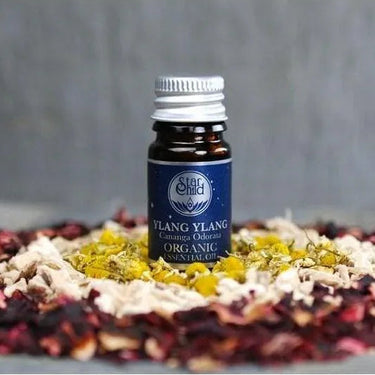
Ylang Ylang Essential Oil • Cananga odorata, Sensual Fragrance & Love Symbolism

Ylang Ylang has long been valued for the fragrance of its flowers throughout parts of Southeast Asia and later became an important material in international perfumery.

Its cultural story is strongest when kept close to what the flower genuinely offers: an unusually rich perfume and longstanding associations with beauty, intimacy and celebration.

Flowers, Fragrance & Tradition

Ylang Ylang comes from the flowers of Cananga odorata, a tropical tree associated with Southeast Asia and now cultivated in other tropical regions.

The supplied Star Child oil comes from Madagascar.

Historical preparations have included fragrant flowers and flower-infused oils, while modern essential oil is produced as a concentrated aromatic material.

The exact cultural traditions surrounding Ylang Ylang vary by region, so it is better not to turn them into one universal story.

Wedding & Love Symbolism

Ylang Ylang flowers are often associated with wedding and romantic fragrance traditions in parts of Southeast Asia.

That history makes love and sensuality natural themes for contemporary ritual use.

The oil can accompany personal fragrance, relationship ritual or a deliberately romantic atmosphere.

It should not be described as guaranteeing attraction, increasing sexual function or changing another person’s desire.

Sensuality Without the Aphrodisiac Claim

There is no need to call Ylang Ylang a guaranteed aphrodisiac for it to feel sensual.

Its scent already does that work.

The heavy floral sweetness and warmth make it a natural choice for intimate perfumes and massage blends where appropriate.

Sensuality is a fragrance experience and personal association, not a medical treatment for impotence, frigidity or sexual dysfunction.

Love Magic & Attraction Rituals

In contemporary magical practice, Ylang Ylang may be used in love-oriented perfume, charms or ritual blends.

A more respectful and useful approach is to centre such work on:

affection,

mutual attraction,

confidence,

connection,

and consensual intimacy.

It should not be presented as a way to compel another person's feelings.

Tantra & Sacred Intimacy

The original material connects Ylang Ylang with Tantra and sex magic.

Tantra is not simply a synonym for erotic ritual. It refers to diverse South Asian religious and spiritual traditions with complex philosophies and practices.

Ylang Ylang can certainly be used in a modern intimacy or sacred-sensuality ritual, but that should be described as Tantric-inspired contemporary practice, not as a claim that the oil itself has a traditional Tantric role or awakens sexual energy.

Meditation & Evening Atmosphere

Because Ylang Ylang is rich rather than sharp, it suits quieter aromatic settings particularly well.

A small amount in a diffuser can create a warm floral atmosphere for reflection, bathing or evening ritual.

That does not mean it treats anxiety, insomnia or emotional distress.

Its role is aromatic.

A Simple Love & Appreciation Ritual

Use Ylang Ylang sparingly according to the product directions.

As the fragrance develops, consider:

What do I appreciate but rarely express?

or

How can affection be shown more clearly?

The fragrance marks the intention without promising an emotional outcome.

Quick FAQs

What does Ylang Ylang Essential Oil smell like?
Intensely floral, sweet, warm and slightly balsamic.

What is the botanical name?
Cananga odorata.

Where does this oil come from?
Madagascar, according to the supplied product information.

Is it organic?
Yes. The supplied product information identifies it as organic.

How much is included?
5ml.

What oils blend well with Ylang Ylang?
Vetivert, Jasmine, Rose, Bergamot, Benzoin, Tuberose, Amyris, Mimosa, Galbanum and Cinnamon.

Is Ylang Ylang an aphrodisiac?
It has a longstanding association with sensual fragrance, but sexual effects should not be guaranteed.

Can it help insomnia or anxiety?
Those are therapeutic claims and should not be presented as established effects of this product.

Can it be applied directly to the skin?
No. Essential oils should be appropriately diluted before topical use.

Care & Safety

For external aromatic use only.

Do not ingest.

Do not apply undiluted to the skin.

Dilute appropriately in a suitable carrier oil before topical use.

Patch test diluted preparations before wider application.

Avoid contact with eyes, mucous membranes and broken or irritated skin.

Use sparingly. Ylang Ylang has a powerful fragrance, and excessive exposure may cause headache or nausea in some people.

Keep out of reach of children and pets.

Use diffusers in a well-ventilated space.

If pregnant, breastfeeding, taking medication or managing a medical condition, follow the current product label and seek appropriate professional guidance before topical use.

Store tightly closed in a cool, dark place away from direct sunlight and excessive heat.

Please Note

Traditional claims relating to high blood pressure, heart rate, palpitations, insomnia, anxiety, impotence, frigidity, skin disorders or emotional conditions should not be treated as established benefits of this Ylang Ylang Essential Oil.

References to love, sensuality, attraction, confidence or ritual intimacy describe fragrance character and contemporary symbolic use.

They are not guarantees of therapeutic, emotional, sexual or supernatural effects.

Commandes et expédition
Les commandes passées avant 15h00 sont traitées et expédiées le jour même. Nous livrons dans le monde entier.

Informations de suivi
Veuillez suivre votre colis à l'aide des informations de suivi fournies dans votre e-mail de confirmation d'expédition. Le suivi est généralement mis à jour dans les 24 heures suivant l'expédition et se poursuit jusqu'à ce que la livraison soit confirmée.

Droits de douane et taxes
Les droits de douane et taxes de l'UE et internationaux sont à la charge du client et doivent être payés localement, le cas échéant. Pour les clients non britanniques, la taxe britannique est automatiquement supprimée à la caisse une fois la destination d'expédition sélectionnée.

Retards douaniers
Certaines commandes internationales peuvent être retardées en raison de contrôles douaniers, qui échappent à notre contrôle. Les retards peuvent être plus longs pendant les périodes de forte activité.

Retours
Pour les commandes ayant bénéficié de la livraison gratuite, les articles retournés peuvent être soumis aux frais d'expédition initiaux et aux éventuels frais de collecte.

Commandes internationales refusées ou annulées
Les commandes internationales qui sont refusées, retournées puis annulées peuvent être soumises à une surtaxe de 10 %. Les colis peuvent être réexpédiés sur demande, bien que des frais supplémentaires puissent s'appliquer.