Mestana Mesa Cloths, Personal Altars & Andean Weaving Tradition
What Is a Mestana?
A mestana is a ceremonial textile used within some Andean spiritual traditions as the outer cloth of a personal mesa or medicine bundle.
When opened, it can define the altar space.
When folded, it gathers the contents back into one portable bundle.
That makes the cloth both practical and symbolic.
It does not simply sit beneath the altar.
It helps form the altar.
Building a Personal Mesa
A personal mesa is usually developed over time.
It may begin with one or two significant objects and gradually grow as new relationships, journeys and experiences become important.
A mesa may hold:
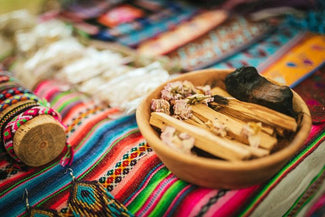
- khuyas or sacred stones
- objects connected with mountains or rivers
- offerings
- inherited pieces
- gifts from teachers
- personal ritual objects
- symbolic items
- objects connected with prayer or ceremony
The collection becomes personal precisely because it is not fixed.
It changes as the person carrying it changes.
Outer Mestana & Inner Unkuna or Wachala
The mestana usually forms the outer layer of the medicine bundle.
Within it, a smaller unkuna or wachala may be used to hold more intimate or particularly significant objects.
In contemporary Andean ceremonial teachings, these layers are often understood through the relationship between inner and outer worlds.
The outer cloth may reflect the visible world of body, family, community and landscape.
The inner cloth may hold memory, intention, prayer and the more private dimensions of spiritual life.
Wrapped together, they become one structure.
Holding the Worlds Together
When the inner cloth and its contents are placed within the outer mestana, the complete bundle can be tied closed.
A mesa tie or decorative beaded tie may gather:
the outer cloth • inner cloth • khuyas • offerings • personal objects
into one contained whole.
Within some teachings, this is spoken of as holding the worlds together.
The phrase reflects the physical act of wrapping as well as the symbolic bringing together of different aspects of life and practice.
What Are Khuyas?
Khuyas are sacred or personally significant stones and objects used within some Andean ceremonial traditions.
A khuya may be associated with:
- a mountain
- a river
- a teacher
- an ancestor
- a journey
- an important place
- a ceremony
- a period of personal transformation
Their meaning often comes from relationship rather than appearance.
A simple stone can become important because of where it was found, who gave it or what happened around it.
Earth-Toned Colour & Character
This cloth has a quieter visual language than many rainbow-rich Andean textiles.
Greys, black, moss green and brown dominate the weave, with orange appearing as a brighter accent.
The overall effect is earthy, grounded and substantial.
The colours evoke:
stone • soil • moss • mountain shadow • fire
without needing to force one fixed symbolic interpretation onto every shade.
Colour in Andean Weaving
Colour can carry regional, familial, ceremonial and aesthetic meaning within Andean textile traditions.
Some cloths are exceptionally bright.
Others are intentionally restrained.
Different weaving families may favour different combinations, proportions or arrangements.
For that reason, no single colour should be treated as having one universal meaning.
The significance lies in context, lineage and the relationship between the colours as much as in the colours themselves.
Hand-Spun Sheep's Wool & Alpaca
This M89-Q cloth combines sheep's wool and alpaca.
The sheep's wool gives the textile body and structure.
Alpaca adds softness and flexibility.
Together, the fibres produce a cloth with enough substance to wrap stones and ritual objects while remaining workable as a personal mesa.
Because the yarn is hand-spun, small variations in thickness and texture are natural.
Natural Dyes
The cloth is described as naturally dyed.
Natural dyeing creates depth and subtle variation rather than absolute uniformity.
One batch may be slightly warmer, darker or more muted than another.
That is one reason colour variation should be expected and embraced as part of the handmade textile.
Two Halves & Complementarity
Some Andean ceremonial cloths are woven in two sections that are then joined together.
Within contemporary interpretation, this construction may be associated with ideas of complementarity:
left and right • inner and outer • feminine and masculine • receiving and giving
These relationships can be meaningful within Andean thought, but they should not be treated as one fixed symbolic code for every textile.
The important idea is relationship: two parts becoming one cloth.
A Cloth of Birth, Protection & Becoming
Textiles have accompanied Andean life through many important transitions.
They have been used for wrapping, carrying, protecting and receiving.
In some communities, woven cloths have also played a role around childbirth and the wrapping or receiving of newborn children.
That gives cloth a powerful relationship with birth, protection and transformation.
Within contemporary mesa practice, that same imagery can resonate with the idea of birthing a new stage of oneself, carrying what is important forward while allowing the personal altar to evolve.
Specific traditions vary between communities and should not be treated as one universal Andean custom.
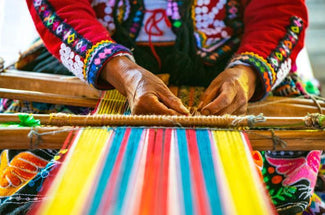
Q'ero Weaving & Living Tradition
The Q'ero are an Indigenous Andean people associated with the highlands of the Cusco region and with distinctive ceremonial and textile traditions.
Their weaving is part of a living cultural practice rather than an isolated decorative style.
Textiles may reflect relationships with:
family • mountain • land • ceremony • community • inherited knowledge
In contemporary spiritual writing, the Q'ero are sometimes described poetically as Rainbow Children.
Such terms are best understood as symbolic or spiritual descriptions rather than formal titles universally used by every Q'ero community.
Weaving as Story
A handwoven textile can carry story without writing it down.
A colour may recall place.
A repeated form may belong to a family tradition.
A pattern may echo landscape, animals or ceremonial relationships.
The meaning may be obvious to one person and hidden from another.
That is part of what makes Andean textiles so compelling.
They are not simply patterned objects.
They are made within a world of relationship.
Personal Altars & Medicine Bundles
A mestana can be used to create a temporary or portable sacred space.
When opened, stones and sacred objects can be arranged upon it during:
prayer • meditation • ceremony • offerings • reflection • personal spiritual practice
When the work is complete, the contents are gathered and wrapped again.
The same cloth becomes both altar and bundle.
Opening & Closing the Mesa
The act of opening and wrapping a mesa can become part of the practice itself.
The inner cloth may be opened first.
Khuyas and personal objects are arranged.
The outer mestana forms the larger boundary around them.
When complete, everything is gathered back together and tied.
Over time, these repeated movements become familiar.
The cloth acquires folds, softness and memory through use.
A Newly Woven Cloth
This M89-Q is described as newly handwoven.
It has not been presented as carrying another person's ceremonial history.
That makes it especially suitable for someone beginning a personal mesa or wanting a fresh outer cloth for an existing medicine bundle.
Its story begins with its new keeper.
Fair Trade & Direct Sourcing
The supplied information describes these textiles as sourced directly through Q'ero families and communities rather than conventional commercial factories.
Fair exchange helps support the continuation of weaving traditions and community life in the Andes.
The value of the cloth therefore lies not only in the finished textile, but in the skill, time and inherited knowledge behind its making.
Cleaning & Care
Because this cloth contains wool, alpaca and natural dyes, cleaning should be light and gentle.
Suitable care includes:
- specialist gentle dry cleaning where appropriate
- careful hand washing in cool to slightly warm water
- mild wool-safe or natural soap
- minimal agitation
- gentle rinsing
- drying flat
Avoid:
- hot water
- bleach
- harsh detergents
- abrasive stain removers
- vigorous rubbing
- wringing
- machine washing
- tumble drying
Natural dyes may soften or move under aggressive cleaning.
If wax is present, avoid scraping or applying strong direct heat. Gentle specialist textile care is preferable.
Steam & Pressing
If the cloth needs freshening, use only gentle warmth and avoid direct high heat.
Steam should be used carefully, keeping in mind that both natural fibres and natural dyes can be sensitive.
Storage
Store the cloth completely dry.
If used as a medicine bundle, keep the wrapped mesa protected from damp, excessive heat and prolonged direct sunlight.
Natural-fibre textiles benefit from occasional checking if stored for long periods.
Quick FAQs
What is a mestana?
A ceremonial Andean textile commonly used as the outer cloth of a personal mesa or medicine bundle.
What is this cloth made from?
A hand-spun mixture of sheep's wool and alpaca.
What colours does this version contain?
Greys, black, moss green, brown and a small splash of orange.
Will the colours always be identical?
No. Natural dyes and hand weaving mean tone and colour balance can vary by approximately 10% from batch to batch.
Is the exact size fixed?
No. Handmade construction means dimensions can vary by approximately 10%.
What is a mesa?
A portable personal altar containing khuyas, sacred stones and other meaningful objects.
What is an unkuna or wachala?
A smaller inner ceremonial cloth that may sit inside the outer mestana.
What are khuyas?
Sacred or personally meaningful stones and objects used within some Andean ceremonial traditions.
How is the bundle closed?
The inner and outer cloths are wrapped together and may be secured with a mesa tie or decorative beaded tie.
Is this cloth newly woven?
Yes. The supplied information describes this M89-Q as newly handwoven.
Are natural dyes used?
Yes, according to the supplied product information.
Can it be used as an altar cloth?
Yes. It may be opened as a personal altar and wrapped again as a medicine bundle.
Were cloths used around childbirth?
Woven textiles have been used for wrapping and receiving infants in some Andean communities. Specific customs vary.
How should it be cleaned?
Very gently, using specialist dry cleaning or light hand washing in cool to slightly warm water with mild soap.
Can it be machine washed?
No. Machine washing and abrasive cleaning may damage both the fibres and natural dyes.
Please Note
This textile belongs to a living Andean weaving and ceremonial tradition.
Descriptions of mesas, khuyas, inner and outer cloths, Q'ero identity, duality, birth symbolism and ceremonial use reflect broad and contemporary understandings of Andean practice. Meanings and teachings vary between communities, individual weavers and ceremonial lineages.
Its significance lies not only in what has been woven into the cloth, but in what may eventually be gathered inside it — stones, memories, places, relationships and personal meaning held together over time.




 Textile Mestana Sacrée de Qero Paqo (M89-Q) - Textile Sacré des Andes
£180.00
/
Textile Mestana Sacrée de Qero Paqo (M89-Q) - Textile Sacré des Andes
£180.00
/