


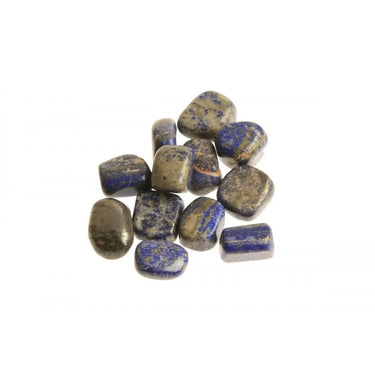
Pierre roulée de Lapis Lazuli 2-3cm - Communication curative, avec un lien avec la mer et les océans.

Le Lapis Lazuli, traditionnellement une pierre de royauté. C'est une excellente pierre de méditation. Agit avec le troisième œil aidant à ouvrir la vision. Agissant avec le chakra de la gorge qui est lié à la créativité, il aide à équilibrer et à restaurer.

On dit que le lapis stimule l'illumination et améliore le travail onirique, les capacités psychiques et le pouvoir spirituel. Ce serait une pierre de cristal de guérison puissante pour la manifestation !

Les propriétés spirituelles et psychiques du lapis sont censées aider à créer et à maintenir une connexion entre les plans physique et céleste, créant une forte connexion spirituelle. Cela peut être lié à sa propriété d'aider au contact avec les esprits gardiens. La conscience intuitive et psychique sont des énergies que le Lapis Lazuli améliore et apporte.

Le Lapis Lazuli est excellent pour la méditation. Il peut aider à ouvrir le troisième œil et à équilibrer le chakra de la gorge.

  • Prix à l'unité
  • Design et apparence : Le Lapis Lazuli est un magnifique minéral bleu, sa couleur bleu profond et ses paillettes dorées le rendent visuellement attrayant et spirituellement significatif.
  • Signification : Le Lapis Lazuli est souvent utilisé dans les bijoux, la méditation et les pratiques de guérison énergétique.
  • Matériau : Le Lapis Lazuli est une pierre précieuse naturelle composée de plusieurs minéraux. Ses principaux composants sont : Lazurite : La lazurite est le minéral principal responsable de la couleur bleue vibrante du Lapis Lazuli. Elle représente généralement la majeure partie de la composition de la gemme et lui donne sa teinte bleu foncé distinctive. Pyrite : Le Lapis Lazuli contient souvent de la pyrite sous forme de paillettes et de veines dorées ou laiton. La pyrite ajoute un éclat métallique et de la brillance à la pierre. Calcite : Certains spécimens de Lapis Lazuli contiennent des veines ou des taches de calcite blanche. La calcite est un minéral de carbonate de calcium et contribue à l'apparence générale de la pierre. Sodalite : Occasionnellement, le Lapis Lazuli peut contenir de petites quantités de sodalite, un autre minéral bleu. Cela peut influencer la nuance de bleu de la pierre et son apparence générale.
  • Composition chimique : La lazurite est le minéral dominant dans le Lapis Lazuli et est responsable de sa couleur bleue intense. Sa formule chimique est généralement écrite comme (Na,Ca)8(AlSiO4)6(S,SO4,Cl)1-2.
  • Taille approximative : 2-3cm (Veuillez prévoir + ou - 5% sur la taille, le poids et la variation de couleur)
  • Poids approximatif : Jusqu'à 25g par pièce
  • Utilisations : Vérité, Pouvoir intérieur, Organisation - Pierre de communication, Excellente pierre de manifestation ! Pierre de chance, pierre de communication, Utilisée dans les grilles de cristaux, les pratiques de guérison, les thérapies par les cristaux par les cristallothérapeutes, utilisée dans le chamanisme pour la divination et pour la récupération d'âme
  • Origine : Inde

NB : Veuillez noter qu'en tant que produit naturel, la couleur et les marques peuvent varier de + ou - 10%. Les cristaux et les pierres sont extraits des profondeurs de la terre, des veines et des fils naturels se produisent. Pour tout changement distinctif, nous modifierons l'image en conséquence.

Communication, Truth & Self-Expression

Lapis Lazuli is commonly linked with the throat chakra and is often used in symbolic work around communication and authentic expression.

It may be chosen when reflecting on:

  • speaking honestly
  • expressing thoughts more clearly
  • listening with greater care
  • finding the confidence to use one’s voice
  • writing or creative expression
  • approaching difficult conversations with calm

The stone does not guarantee better communication, but it can serve as a physical reminder to speak with integrity and listen with patience.

Writers, teachers, speakers and creative practitioners may also enjoy keeping Lapis nearby while working with language, ideas or personal expression.

Clarity, Intuition & the Third Eye

Lapis Lazuli is also associated with the third-eye chakra, a symbolic centre connected with intuition, insight and inner awareness.

During meditation, it may be used as a focus when seeking:

  • greater self-understanding
  • clearer thought
  • intuitive reflection
  • awareness of recurring patterns
  • spiritual perspective
  • calm observation before action

Its deep blue colour often supports a quiet, inward mood, making it well suited to meditation, dream journalling and contemplative practice.

Rather than being used to force visions or answers, Lapis is best approached as a stone of patient observation and thoughtful awareness.

A Stone of Royalty & Ancient History

Lapis Lazuli has a long and significant history across the ancient world.

It was highly valued in ancient Egypt, where it was used in jewellery, amulets, decorative objects and ceremonial settings. Its blue colour was associated with the heavens, divinity and royal status.

Lapis was also prized in Mesopotamia and across ancient trade routes, travelling long distances from major sources in Central Asia. Historically, finely ground Lapis was used to create ultramarine pigment, one of the most valuable blue pigments in art.

Its enduring symbolic associations include:

  • wisdom
  • nobility
  • truth
  • divine connection
  • protection
  • inner authority

These meanings vary across cultures and should be understood as historical and symbolic rather than universal.

Connection with Sea & Sky

Lapis Lazuli is not traditionally known specifically as an ocean stone, but its deep blue colouring naturally evokes both sea and sky.

For this reason, some modern practitioners use it in symbolic work connected with:

  • emotional depth
  • calm reflection
  • the movement of intuition
  • stillness beneath surface activity
  • connection with water imagery
  • expansive thought

It may be placed beside shells, water bowls or ocean-themed altar objects where its colour supports the intended symbolism.

This sea connection is interpretive and personal rather than a fixed historical property of the stone.

Meditation & Reflective Practice

Lapis Lazuli is widely chosen for meditation because of its quiet, inward character.

To use it, hold the stone gently in one hand or place it in front of you.

Take several slow breaths and bring one question to mind.

You may ask:

“What truth needs to be spoken clearly?”

or:

“What am I ready to understand more deeply?”

Sit with the question without forcing an answer. Notice what thoughts, feelings or images arise.

The stone can also be placed beside a journal to support reflective writing or used as a marker at the beginning of a meditation session.

Writing, Journalling & Creative Work

Because of its association with communication and inner truth, Lapis Lazuli is often used in practices involving writing.

It may be kept beside:

  • a journal
  • a notebook
  • a desk
  • a writing altar
  • creative tools
  • cards or divination materials

Some practitioners also use Lapis during automatic or stream-of-consciousness writing. In this context, it acts as a symbolic focus for openness and honesty rather than guaranteeing spiritual messages.

A simple prompt might be:

“What would I say if I trusted my own voice?”

Manifestation & Intention Work

Lapis Lazuli is sometimes described as a manifestation stone, especially for goals involving truth, communication, knowledge or spiritual development.

It may be used when setting intentions around:

  • speaking with confidence
  • expressing a creative idea
  • developing a spiritual practice
  • improving organisation
  • strengthening personal integrity
  • making a thoughtful decision

For a simple intention practice, hold the stone while naming one quality you wish to develop.

Keep the intention realistic and connected with practical action. The stone can serve as a reminder, but it does not replace effort, planning or responsibility.

Crystal Grids, Altars & Symbolic Protection

Lapis Lazuli may be placed in crystal grids or on personal altars where themes of wisdom, truth, insight or communication are central.

It may be paired with:

  • clear quartz for focus
  • sodalite for communication
  • amethyst for contemplation
  • smoky quartz for grounding
  • rose quartz for compassionate expression

Some people also use Lapis symbolically in protection work, particularly where the intention is to maintain clear boundaries, discernment and confidence.

Such uses belong to spiritual and personal belief systems and should not be treated as guaranteed outcomes.

Zodiac & Birthstone Associations

Lapis Lazuli is often associated in modern crystal traditions with:

  • Sagittarius, through themes of truth, wisdom and exploration
  • Taurus, through steadiness and thoughtful expression
  • Virgo, through clarity, organisation and communication

It is also sometimes offered as an alternative September birthstone.

These associations vary between crystal guides and astrological traditions, so they are best treated as symbolic correspondences rather than fixed rules.

A Simple Lapis Lazuli Clarity Ritual

Place the stone on a clean cloth or hold it in your hand.

Take three slow breaths.

Bring to mind one situation where you need greater clarity or more honest communication.

Repeat:

“May I see clearly, speak truthfully and listen with wisdom.”

Sit quietly for several minutes.

When finished, write down one practical step you can take.

Natural Variation & Appearance

Each Lapis Lazuli tumblestone is unique.

The stone may range from deep navy to brighter royal blue and may include:

  • golden pyrite flecks
  • white calcite patches
  • pale veining
  • darker mineral areas
  • softer blue sections

Please allow approximately ±10% natural variation in colour and markings, along with reasonable differences in size, shape and weight.

Some pieces may show more pyrite, while others may contain more calcite. These differences reflect the natural structure of the stone and are not considered faults.

Quick FAQs

What is Lapis Lazuli associated with?

It is commonly associated with communication, truth, wisdom, intuition, meditation and spiritual insight.

Which chakras is Lapis Lazuli linked with?

It is most often connected with the throat and third-eye chakras.

Is Lapis Lazuli a mineral?

Lapis Lazuli is technically a rock made from several minerals, including lazurite, pyrite and calcite.

Does every stone contain golden flecks?

No. Some pieces show visible pyrite, while others may have very little or none.

Is Lapis Lazuli connected with the sea?

Its sea association is mainly symbolic and based on its deep blue colour. Historically, it is more strongly connected with royalty, wisdom, the heavens and spiritual insight.

Can it be used for meditation?

Yes. Its deep colour and traditional associations make it a popular stone for meditation, journalling and reflective practice.

Is each stone the same?

No. Colour, shape, mineral pattern and markings will vary naturally.

Is this listing for one stone?

Yes. Each tumblestone is priced and sold individually.

Care & Safety

Lapis Lazuli is softer than many common crystals and should be handled with care.

Avoid soaking it in water, exposing it to salt, or using harsh chemical cleaners. These can damage the surface or affect softer mineral components such as calcite.

Wipe gently with a soft, dry cloth.

Keep away from babies, young children and pets. Small stones can present a choking risk.

Do not place the stone in drinking water or use it to prepare crystal elixirs.

Disclaimer

Crystal meanings are based on traditional, cultural and modern metaphysical beliefs. This stone is intended for personal reflection, meditation, decoration and spiritual practice. It is not intended to diagnose, treat, cure or prevent any medical or psychological condition, and no spiritual or therapeutic outcome is guaranteed.

Commandes et expédition
Les commandes passées avant 15h00 sont traitées et expédiées le jour même. Nous livrons dans le monde entier.

Informations de suivi
Veuillez suivre votre colis à l'aide des informations de suivi fournies dans votre e-mail de confirmation d'expédition. Le suivi est généralement mis à jour dans les 24 heures suivant l'expédition et se poursuit jusqu'à ce que la livraison soit confirmée.

Droits de douane et taxes
Les droits de douane et taxes de l'UE et internationaux sont à la charge du client et doivent être payés localement, le cas échéant. Pour les clients non britanniques, la taxe britannique est automatiquement supprimée à la caisse une fois la destination d'expédition sélectionnée.

Retards douaniers
Certaines commandes internationales peuvent être retardées en raison de contrôles douaniers, qui échappent à notre contrôle. Les retards peuvent être plus longs pendant les périodes de forte activité.

Retours
Pour les commandes ayant bénéficié de la livraison gratuite, les articles retournés peuvent être soumis aux frais d'expédition initiaux et aux éventuels frais de collecte.

Commandes internationales refusées ou annulées
Les commandes internationales qui sont refusées, retournées puis annulées peuvent être soumises à une surtaxe de 10 %. Les colis peuvent être réexpédiés sur demande, bien que des frais supplémentaires puissent s'appliquer.