What Are Mala Beads?
A mala is a traditional string of prayer or meditation beads used particularly within Hindu and Buddhist practices. Malas are commonly used to keep count while repeating a mantra, prayer or sacred phrase, allowing the practitioner to concentrate on the recitation rather than the number of repetitions.
Although prayer beads also occur in other religions, a mala has its own history and traditions and should not simply be treated as another name for a Christian rosary or Islamic prayer beads.
Malas may be made from seeds, wood, bone, gemstones or other materials depending on the tradition and intended practice. Gemstone malas such as this design also have a strong place within modern yoga, meditation and contemporary crystal practice.
Why Do Mala Beads Have 108 Beads?
108 beads are one of the best-known traditional mala formats.
The number 108 carries significance across several strands of Hindu, Buddhist and yogic thought, although its meaning is not limited to one single explanation. Different traditions connect it with sacred texts, cosmology, mantra practice, mathematical symbolism and spiritual completeness.
For meditation, a 108-bead mala also provides a practical way to complete a full cycle of 108 mantra repetitions.
This Lotus mala therefore follows a recognisable full-length mala format rather than the smaller 21- or 27-bead wrist malas sometimes used for abbreviated practice.
Rose Quartz Meaning
Rose Quartz is a pale pink variety of quartz long associated in contemporary crystal practice with love, compassion and emotional gentleness.
It is commonly connected with the Heart Chakra and used symbolically when focusing on:
- self-compassion
- loving relationships
- forgiveness
- emotional openness
- peaceful reflection
Its soft colour gives this mala a warm and nurturing visual character alongside the cooler tones of Amazonite.
These meanings belong to spiritual and metaphysical traditions rather than established medical effects.
Amazonite Meaning
Amazonite is a blue-green variety of microcline feldspar prized for its calming colour and distinctive natural patterning.
Within modern crystal traditions it is associated with:
- calm and balance
- truthful communication
- personal expression
- courage
- emotional steadiness
Amazonite is most commonly linked with the Heart and Throat Chakras, making it a popular symbolic stone for meditation centred on compassionate communication and speaking with clarity.
Rhodonite Meaning
Rhodonite is typically recognised by its pink to rose-red colouring, often accompanied by darker mineral veining.
Contemporary crystal traditions associate Rhodonite with:
- compassion
- forgiveness
- emotional grounding
- patience
- self-reflection
- restoring balance after conflict
It is frequently linked with the Heart Chakra.
Rather than describing Rhodonite as literally clearing emotional wounds, it is more accurate to regard it as a symbolic focus for practices involving forgiveness, emotional awareness and compassionate intention.
Rose Quartz, Amazonite & Rhodonite Together
The combination creates a particularly harmonious meditation mala for anyone drawn to themes of love, communication and emotional balance.
Rose Quartz brings the symbolism of compassion and affection; Amazonite is traditionally associated with honest expression and calm; Rhodonite adds themes of grounding, forgiveness and emotional resilience.
Used together, the stones can provide a meaningful focus for meditation or intention-setting without implying that the gemstones themselves produce guaranteed emotional or therapeutic effects.
The Meaning of the Lotus Amulet
The Lotus flower carries deep spiritual symbolism in several Asian religious and philosophical traditions, particularly Hinduism and Buddhism.
Because the lotus grows from muddy water and rises to flower above the surface, it has become associated with ideas including:
- purity
- spiritual awakening
- transformation
- perseverance
- enlightenment
Its precise meaning varies between traditions, so it is better understood as a rich sacred symbol rather than a single universal emblem.
On this mala, the Lotus amulet complements the gemstone beads with a visual reminder of growth, reflection and spiritual practice.
How to Use 108 Mala Beads
For mantra meditation or japa, hold the mala comfortably in one hand and move from one bead to the next with each repetition of your chosen mantra or prayer.
Continue around the strand until you have completed the full sequence of 108 beads.
Different traditions have their own customs regarding which hand and fingers are used and how the end or guru bead is approached. If you practise within a particular Hindu or Buddhist lineage, it is best to follow the method taught within that tradition.
For more general mindfulness practice, the beads can also be moved one at a time while breathing slowly, repeating an affirmation or simply returning attention to the present moment.
Wearing a Mala Necklace
At approximately 108 beads, this is a traditional full-length mala format and may also be worn as a gemstone mala necklace when appropriate to your personal practice.
If wearing sacred or devotional jewellery, some practitioners prefer to follow the customs of their own tradition regarding handling and use. Others wear contemporary gemstone malas primarily as reminders of an intention, meditation practice or spiritual value.
Avoid repeatedly stretching, pulling or twisting the strand, particularly when taking it on and off.
Chakra Associations
In contemporary chakra practice, the stones in this mala are most commonly associated with:
- Rose Quartz — Heart Chakra
- Amazonite — Heart & Throat Chakras
- Rhodonite — Heart Chakra
This makes the mala particularly suited to symbolic practices centred on compassion, communication, forgiveness and emotional balance.
Chakra associations are spiritual and metaphysical traditions and should not be interpreted as medical or physiological claims.
Cleansing & Intention Setting
If crystal cleansing forms part of your practice, gentle methods are preferable for a mixed-stone mala.
You may choose to:
- place it in soft moonlight
- pass it through incense smoke where appropriate
- use a singing bowl, bell or other sound practice
- hold the mala quietly while setting a personal intention
These are symbolic spiritual practices rather than physical cleaning methods and are not required to maintain the gemstones.
There is no need to “recharge” a mala for it to function as meditation beads.
Care
Store the mala in a soft pouch or mala bag when not in use to protect the beads, cord and Lotus amulet from knocks and tangling.
Avoid:
- soaking it in water
- wearing it while bathing or swimming
- perfumes, oils and household chemicals
- prolonged strong sunlight
- pulling or stretching the strand
- dropping it onto hard surfaces
If physical cleaning is needed, gently wipe the beads with a soft, dry cloth.
A mala pouch can be useful for practical protection and respectful storage, but it is not necessary to preserve a measurable “spiritual charge”.
Disclaimer
Crystal meanings, chakra associations and energetic descriptions are drawn from traditional and contemporary spiritual practices. They are provided for cultural and spiritual interest and should not be considered medical or therapeutic claims.
Natural gemstones vary in colour, markings and appearance, making every mala subtly individual.


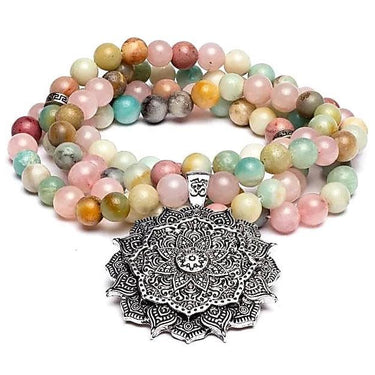


 Mala Lotus Amulette – Quartz Rose, Amazonite & Rhodonite (108 Perles)
£26.00
/
Mala Lotus Amulette – Quartz Rose, Amazonite & Rhodonite (108 Perles)
£26.00
/