



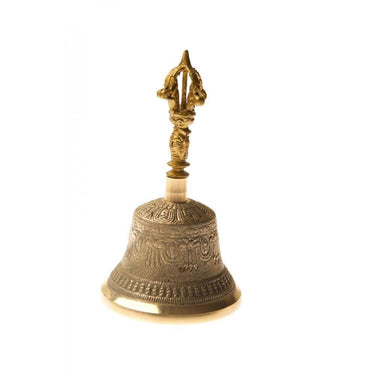
Cloche de Temple Om Dorje Tibétain

La cloche de temple tibétaine Om Dorje est une cloche cérémonielle traditionnelle utilisée dans les rituels bouddhistes tibétains, la méditation et les pratiques de temple. Portant les symboles sacrés « Om » et « Dorje », elle représente l'union de la sagesse et de la compassion – deux aspects fondamentaux de l'illumination dans le bouddhisme tibétain.

La cloche (Ghanta) est généralement associée au Dorje (Vajra), symbolisant l'équilibre entre la perspicacité spirituelle et l'action habile. Lorsqu'elle est sonnée pendant une cérémonie ou une méditation, elle produit un son clair et résonnant qui est censé purifier l'espace et concentrer l'esprit.

Détails du produit :

  • Taille approximative : H : 15–16 cm × 9 cm

  • Poids approximatif : Jusqu'à 400 g

  • Design : Cloche authentique fabriquée au Tibet avec une poignée à visser ; sonorité magnifiquement équilibrée et fabrication détaillée.

  • Origine : Tibet

  • Utilisation : Pour les rituels bouddhistes, les cérémonies, la méditation ou comme objet d'autel spirituel.

Note :
La couleur et la taille peuvent varier légèrement d'un lot à l'autre, y compris de subtiles différences de ton doré entre la poignée et la base — un résultat naturel de son origine artisanale.

What Is a Tibetan Buddhist Ritual Bell?

In Tibetan Vajrayana Buddhist practice, the ritual bell is commonly known as a ghanta.

It is often held together with a vajra or dorje, forming an important ritual pairing.

Broadly speaking, the bell is associated with wisdom or insight, while the vajra represents method, skilful means and compassionate activity. Their use together symbolises the inseparability of these complementary qualities on the Buddhist path.

Specific interpretations and ritual uses vary between traditions, lineages and ceremonies.

Om & Dorje / Vajra Symbolism

Om is a sacred syllable used across several Indian and Himalayan religious traditions, including forms of Buddhism and Hinduism.

Its precise meaning depends on context, so it is better understood as a sacred ritual sound rather than reduced to one fixed translation such as “the vibration of the universe”.

Dorje is the Tibetan word corresponding to Sanskrit vajra.

The vajra is associated with qualities such as:

  • indestructibility
  • firmness of awakened awareness
  • skilful means
  • spiritual method
  • the thunderbolt and diamond as symbolic imagery

When a bell and vajra are used together in Tibetan Buddhist ritual, their symbolism is traditionally complementary rather than interchangeable.

Clear Resonant Meditation Bell Tone

The bell is designed to create a distinct ringing tone with lingering resonance.

Depending on how firmly it is struck or moved, the sound may be used to:

  • mark transitions in meditation
  • begin or close ritual practice
  • punctuate mantra or prayer
  • gather attention
  • introduce a sound cue within group practice

The exact pitch and sustain may vary slightly between individual handmade bells.

Buddhist Ritual & Ceremonial Use

In formal Tibetan Buddhist practice, ritual bells may be used according to specific teachings, gestures and liturgical traditions.

For general personal use, the bell can also be incorporated respectfully into meditation or sacred-space practice without claiming to reproduce a particular lineage ritual.

It may be used beside:

  • a vajra / dorje
  • incense
  • offering bowls
  • prayer beads
  • statues or thangka imagery
  • other altar objects

Where the buyer is following a specific Buddhist lineage, traditional instructions from an authorised teacher should take precedence over general retail guidance.

Meditation, Yoga & Sacred Sound

Outside formal Buddhist ritual, hand bells are also used more broadly in meditation, mindfulness, yoga and contemporary sound practice.

A single clear ring can provide a simple audible marker for:

  • beginning practice
  • returning attention to the present
  • changing stages within a session
  • closing meditation

These are contemporary practical applications rather than claims of therapeutic effect.

Handmade Finish & Colour Variation

The supplier describes this bell as traditionally made with a screw-in handle and detailed finish.

Small differences may occur in:

  • surface colour
  • gold tone
  • detailing
  • dimensions
  • handle alignment
  • bell resonance

These variations are consistent with individually finished production.

Care & Respect

Keep the bell clean and dry when not in use.

Wipe gently with a soft dry cloth and avoid abrasive cleaners that may affect the finish.

If the handle is screw-fitted, check periodically that it remains secure without overtightening.

When used as a ritual object, store it respectfully on an altar, shelf or dedicated practice space.

Quick FAQs

What is a Tibetan Om Dorje bell used for?
It can be used for Buddhist ritual, meditation, ceremony, mantra practice, altar use and sacred sound.

What size is the bell?
The main supplied specification is approximately 14–16cm high × 9cm wide and up to around 400g.

What is a ghanta?
Ghanta is a Sanskrit term for a ritual bell. In Tibetan Vajrayana practice, the bell is often used together with a vajra or dorje.

What does the bell represent in Buddhism?
The bell is commonly associated with wisdom or insight, while the accompanying vajra represents method or skilful means.

What does Dorje mean?
Dorje is the Tibetan equivalent of the Sanskrit vajra, a ritual symbol associated with indestructibility, spiritual method and awakened qualities.

What does Om mean?
Om is a sacred syllable used in several Dharmic traditions. Its meaning depends on religious and ritual context and cannot be reduced to one universal definition.

Does it produce a clear ringing tone?
Yes. The supplier describes it as having a balanced, resonant bell tone, although individual tone may vary slightly.

Is it suitable for meditation?
Yes. It can be used to mark the beginning, transition or end of a meditation session.

Is it made in Tibet?
The supplier describes it as Tibetan-made. Unless separate provenance documentation is available, I would present this as a supplier-provided origin claim.

Can it be displayed on an altar?
Yes. It is suitable for functional ritual use or respectful altar and shrine display.

Disclaimer

Buddhist and Tibetan symbolism is described for cultural and informational context. Ritual meanings and practices vary between Buddhist schools and lineages, and general product descriptions should not replace lineage-specific instruction.

Commandes et expédition
Les commandes passées avant 15h00 sont traitées et expédiées le jour même. Nous livrons dans le monde entier.

Informations de suivi
Veuillez suivre votre colis à l'aide des informations de suivi fournies dans votre e-mail de confirmation d'expédition. Le suivi est généralement mis à jour dans les 24 heures suivant l'expédition et se poursuit jusqu'à ce que la livraison soit confirmée.

Droits de douane et taxes
Les droits de douane et taxes de l'UE et internationaux sont à la charge du client et doivent être payés localement, le cas échéant. Pour les clients non britanniques, la taxe britannique est automatiquement supprimée à la caisse une fois la destination d'expédition sélectionnée.

Retards douaniers
Certaines commandes internationales peuvent être retardées en raison de contrôles douaniers, qui échappent à notre contrôle. Les retards peuvent être plus longs pendant les périodes de forte activité.

Retours
Pour les commandes ayant bénéficié de la livraison gratuite, les articles retournés peuvent être soumis aux frais d'expédition initiaux et aux éventuels frais de collecte.

Commandes internationales refusées ou annulées
Les commandes internationales qui sont refusées, retournées puis annulées peuvent être soumises à une surtaxe de 10 %. Les colis peuvent être réexpédiés sur demande, bien que des frais supplémentaires puissent s'appliquer.