

A practical guide to mindfulness, breath, walking, mantra, sound and other meditation styles to help you find a practice that suits you.

A silent mind is not the entry requirement for meditation. In fact, trying to force one is often why people decide they are ‘bad’ at it. The question behind types of meditation - which practice is right for you? is less about finding the most spiritual method and more about finding a practice you can return to honestly, whether you have two quiet minutes before work or a longer ritual at your altar.
Meditation is an umbrella term for many ways of training attention, settling the nervous system, observing inner experience or connecting with a sense of meaning. Some practices are still and quiet; others use movement, breath, mantra, sound or visual focus. The best place to begin is not with what looks impressive, but with what meets you where you are.
Types of meditation: which practice suits your intention?
Your current need can be a useful guide. If your thoughts are racing, a meditation with an anchor - such as sound, breath or a repeated phrase - may feel more approachable than open silence. If you are feeling disconnected from your body, walking or body scan meditation may be more helpful than sitting cross-legged. If you want to deepen a spiritual or ritual practice, visualisation, mantra or candle meditation can bring greater intention to the space.
There is no need to choose one style forever. Many experienced practitioners move between methods according to the season, their energy and what life is asking of them. A five-minute grounding practice on a difficult morning and a longer sound meditation at the weekend can both be meaningful.
Which meditation might suit you?
If you are unsure where to begin, start with what you find difficult rather than what you think meditation should look like.
- Busy, racing thoughts → Breath or sound meditation
- Restless and dislike sitting → Walking meditation
- Feeling disconnected from your body → Body scan
- Harsh self-talk or emotional tension → Loving-kindness
- Want rhythm or devotional practice → Mantra or japa
- Imaginative or spiritually focused → Visualisation or candle meditation
- Silence feels difficult → Sound meditation

Mindfulness meditation for noticing without fixing
Mindfulness meditation involves paying attention to present experience: the breath, body sensations, sounds, thoughts or emotions. The point is not to empty the mind. It is to notice when attention has wandered and gently return, again and again, without turning that moment of distraction into a judgement.
This is often a good starting point for beginners because it needs very little equipment or belief. Sit comfortably, feel the contact of your feet with the floor or your body with the chair, then notice the natural rhythm of breathing for a few minutes. When thoughts appear, acknowledge them and return to the chosen point of focus.
Mindfulness can feel frustrating for people who expect instant calm. Sometimes it reveals just how busy or tired we are. That is not failure; it is useful information. Keep sessions short at first, particularly if sitting still brings up difficult feelings.
Breath meditation for a simple, portable anchor
Breath-focused meditation gives the mind one clear place to rest. You might follow the sensation of air at the nostrils, notice the rise and fall of the abdomen, or count each exhale up to ten before beginning again.
It is especially practical when you need a pause in ordinary life: before a meeting, after a busy school run, or while waiting for the kettle to boil. There is no need to manipulate the breath. For some people, deliberate breathwork is supportive; for others, particularly when anxious, it can feel too intense. Natural breathing is enough.
If you like a little structure, try three minutes of simply noticing each out-breath. A meditation chime at the beginning and end can help mark out the practice, especially in a home where the day has few quiet boundaries.
Body scan meditation for grounding and rest
A body scan moves attention gradually through the body, often from the feet upwards or from the crown of the head down. You are not trying to make every area relax. You are noticing temperature, tension, heaviness, tingling, numbness or ease as they are.
This type of meditation is often chosen for winding down in the evening or reconnecting after too much time in the head. Lie down if that is comfortable, though sitting may be better if you are likely to fall asleep. A folded blanket, supportive cushion or eye pillow can make the practice feel less like another task to get through.
For those who find internal focus uncomfortable, try a shorter scan or keep one hand resting on the heart or abdomen. Meditation should be invitational, not something endured.
Create a Simple Meditation Space
You don't need much to begin. Explore meditation cushions, candles, crystals and simple tools for creating a quieter place to pause at home.
Explore Ritual - Meditation - Wellbeing

Walking meditation for people who do not want to sit still
Walking meditation brings awareness to steady, unhurried movement. Notice the heel lifting, the foot moving forwards and the sole meeting the ground. You can practise indoors, in a garden or along a familiar, safe path.
This is a valuable reminder that meditation does not have to look like stillness. A quiet walk beside Coniston Water, for example, can become a practice when you soften the urge to rush, attend to the ground beneath you and let the sounds of water and birds arrive without needing to interpret them.
Walking meditation suits restless energy, afternoon slumps and people who feel more present when the body is involved. Leave your phone away if possible. The aim is not to capture the walk, but to be in it.
Loving-kindness meditation for a softer inner voice
Loving-kindness, also known as metta meditation, uses phrases of goodwill directed first towards yourself and then towards others. Traditional wording varies, but simple phrases might include: ‘May I be safe. May I be peaceful. May I meet this day with kindness.’ You can then offer the same wishes to someone you love, someone neutral and, when it feels appropriate, someone you find difficult.
This is not about pretending every relationship is easy or bypassing healthy boundaries. It can be a gentle way to work with harsh self-talk, loneliness or resentment without demanding that you feel differently immediately. If directing kindness towards yourself feels too raw, begin with a beloved animal, a trusted friend or a place in nature.
Mantra and japa meditation for rhythm and devotion
Mantra meditation centres on the quiet repetition of a word, sound or sacred phrase. In some traditions, mantras are received and practised within a particular lineage, so it is worth approaching traditional forms respectfully. A simple personally meaningful word, such as ‘peace’, ‘steady’ or ‘here’, can also provide a rhythm for attention.
Japa meditation uses mala beads to count repetitions, traditionally 108. Moving bead by bead gives the hands a role and can be wonderfully grounding for people who find an unstructured practice elusive. The repetition may support focus, devotional intention or a transition into ritual.
Choose words that feel sincere rather than impressive. A phrase that you can repeat on an ordinary Tuesday is often more useful than one that remains only an aspiration.
Explore Mala & Meditation Beads
Discover malas and gemstone beads for mantra, japa, meditation and personal spiritual practice.
Shop Malas & Meditation Jewellery

Visualisation and candle meditation for intention
Visualisation uses the mind’s eye. You may picture roots extending from your feet into the earth, a calm room filled with gentle light, or yourself meeting a situation with clarity and steadiness. Many practitioners use visualisation alongside Reiki, chakra work, energy cleansing or ritual, though experiences differ greatly from person to person.
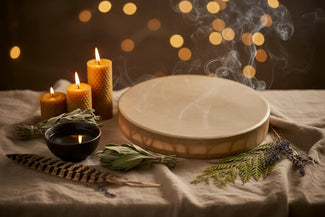
Candle meditation is a related visual practice in which you rest your gaze softly on a flame, then close the eyes and observe any lingering image. Use a stable holder, keep the candle attended and choose a calm place away from pets, children and draughts. The flame does not need to represent anything elaborate. It can simply signal that this small piece of time is set apart.
Visual practices can be powerful for imaginative people, but they are not a test of whether you can ‘see’ clearly. If images do not come easily, work with felt sense, colour, warmth or a simple intention instead.
Sound meditation for an easier route into focus
Sound can give busy minds something gentle to follow. A singing bowl, meditation chime, drum, recorded nature sound or even the hum of a fan can become the object of attention. Listen to the beginning, middle and fading edge of each sound. Notice what is present in the silence after it.
Singing bowls and chimes are often chosen to open or close meditation, support a therapy room, or create a sense of ritual at home. Their value is not in making a space perfect. It is in offering a clear cue: for the next few minutes, you are here.
Volume matters. Sound meditation should feel spacious, not overwhelming, particularly if you are sensitive to noise, have tinnitus or are practising after an overstimulating day.
Explore Sound for Meditation
Discover singing bowls, meditation chimes, bells and other sound instruments for creating a simple focus before, during or after meditation.
- Explore Sound Healing & Meditation Instruments
- Koshi & Heola - Wind Chimes, Meditation Bells & Yoga Chimes
Meditation can change with the season — and with you
Your practice does not have to stay the same throughout the year or even throughout the week.
You may want walking meditation and time outdoors during brighter months, then find yourself drawn towards candlelight, sound or a quieter seated practice as autumn and winter arrive. On a busy morning, three minutes with the breath may be enough. At the weekend, you may want a singing bowl, incense and twenty minutes at your altar.
Spiritual practice becomes much easier to sustain when it is allowed to respond to real life.
That reinforces something the draft already touches beautifully — experienced practitioners can move between practices according to their energy, season and circumstances.
How to choose a meditation practice you will continue
Start with the obstacle, not the ideal. If you cannot sit comfortably, choose walking meditation. If silence feels too wide, try sound, breath counting or a mantra. If you long for a more sacred atmosphere, light a candle, use a favourite sacred spray or place one meaningful crystal nearby - perhaps a grounding stone such as smoky quartz or black tourmaline, traditionally associated with steadiness and protection.
Then make the practice small enough to keep. Five minutes, three times a week, has more power than an ambitious forty-minute routine that quietly disappears. Try one method for seven to ten sessions before deciding whether it suits you. Notice not only whether you feel calm afterwards, but whether you are willing to begin again.
Meditation can complement wellbeing and spiritual practice, but it is not a replacement for medical care or professional mental health support. If a practice consistently heightens distress, dissociation or difficult memories, stop and seek appropriate guidance. A grounded practice respects your limits.
You do not need a perfect cushion, a silent house or a particular identity to meditate. Begin with the method that feels least like a performance and most like a genuine return to yourself. Over time, that quiet willingness to return may become the practice that matters most.

Explore Further with Sacred Essence
Shop Meditation & Spiritual Practice
Explore Meditation Tools, Singing Bowls & Chimes, Malas & Meditation Jewellery, Crystals & Tumblestones, and Candles & Incense for creating a practice that feels natural to you.
Explore Sacred Essence Guides
Continue with our Meditation Guide, Sound Healing Guide and guides to creating a calm, intentional sacred space at home. All Guides
Continue Reading
Discover more from the Sacred Essence Blogs: All Blogs.

A Final Thought
There is no prize for choosing the most difficult form of meditation.
The practice that matters is the one you can return to — sometimes in silence, sometimes walking, sometimes following a breath, a mantra or the fading note of a singing bowl. ✨
Start where you are. Let the practice change when you do.
Sacred Essence 🌈