

Learn how to start reading tarot cards with simple, beginner-friendly guidance
Tarot cards for beginners can feel oddly intimidating at first. You open a deck, meet 78 illustrated cards filled with symbols, and suddenly wonder whether you need years of study, a special gift, or perfect intuition before you can begin. You do not. Tarot is a practice, and like any personal practice, it becomes clearer through regular use, the right tools and a little patience.

For many people, tarot starts as part of a wider wellbeing routine. It may sit alongside journalling, meditation, candle rituals, crystal work or simply a few quiet minutes before the day begins. That is often the most helpful way to approach it - not as a test of psychic ability, but as a reflective system that supports self-awareness, perspective and intention.
What tarot cards for beginners actually are
A standard tarot deck has 78 cards divided into the Major Arcana and the Minor Arcana. The Major Arcana contains 22 cards such as The Fool, The Lovers and The Star. These are often linked with bigger themes, life lessons and turning points. The Minor Arcana has 56 cards across four suits, usually Cups, Pentacles, Swords and Wands, and these tend to speak more directly to everyday situations, feelings, work, relationships and choices.
If that sounds like a lot, it is - at first. But beginners do not need to memorise every card before doing a reading. In practice, you build familiarity over time. You begin to notice that Cups often speak to emotions, Pentacles to the material world, Swords to thought and communication, and Wands to energy, action and desire. Those broad foundations make the deck much easier to work with.
Tarot is not really about getting every meaning exactly right. It is about learning how card imagery, traditional symbolism and your own response work together. Some readers use tarot in a spiritual way, while others use it more psychologically. Most people settle somewhere in between.
Choosing tarot cards for beginners
The best beginner deck is usually the one you feel comfortable picking up often. That matters more than trying to buy the most advanced or impressive option. If the artwork feels inaccessible, overly dense or simply not to your taste, the deck may end up sitting on a shelf rather than becoming part of your practice.
Many beginners start with a Rider-Waite-Smith based deck because so much tarot teaching refers back to its imagery and structure. That can make learning easier, especially if you plan to use guidebooks, journals or online card references alongside your readings. A modern deck inspired by that tradition can also work well if you prefer softer colours, gentler artwork or more contemporary design.
There is a trade-off here. Highly artistic or niche decks can be beautiful and deeply resonant, but some are harder to read if the symbolism departs too far from classic tarot imagery. If you are buying your first deck, clarity is often more useful than complexity.
Card size matters too. Oversized decks can look lovely but be awkward to shuffle. A sturdy guidebook is helpful, especially if you like structure. Some people also like to keep a tarot cloth, storage box or pouch nearby so the deck feels cared for and easy to return to after each reading.
How to start reading without overthinking it
A simple rhythm works best in the beginning. Sit somewhere calm, shuffle the deck and ask a clear question. Then pull one card. That is enough.
Beginners often assume they should jump straight into larger spreads, but one-card readings are one of the best ways to learn. A single card gives you space to notice imagery, colour, posture, symbols and your own reaction before reaching for a guidebook. You are training your attention as much as learning meanings.
Questions also shape the reading. Tarot tends to work better with open, reflective prompts than with rigid yes or no demands. Instead of asking, “Will this definitely happen?” try “What energy surrounds this situation?” or “What do I need to understand before I move forward?” That slight shift usually leads to more useful insight.
If you feel blank when a card appears, start small. What is happening in the image? Does the card feel active or still? Heavy or hopeful? Is there tension, rest, movement, uncertainty? These first impressions often lead you towards the message more naturally than memorised keywords alone.
Learning card meanings in a way that sticks
Trying to study all 78 cards at once is where many beginners lose confidence. A steadier method is to learn through repetition. Pull a daily card and keep a notebook beside you. Write down the card name, a few visual details, the traditional meaning from your guidebook and how that theme showed up during the day.
Over time, the cards stop being abstract definitions and become lived references. The Hermit may start to mean healthy solitude rather than loneliness. The Tower may become a reminder that disruption is not always destruction. The Two of Pentacles may show up whenever life feels a little too full and asks for better balance.
This is where tarot becomes personal. Traditional meanings matter because they give structure, but your own relationship with the cards matters too. That does not mean ignoring the established system whenever you like. It means allowing symbolism and lived experience to meet.
Reversed cards are another common question. Some readers use them, some do not. For beginners, there is no harm in keeping all cards upright until the basics feel secure. Reversals can add nuance, but they also add another layer of interpretation. If you already feel overwhelmed, simpler is better.
A few beginner spreads that genuinely help
Once one-card pulls feel familiar, you can expand gently. A three-card spread is often enough for most situations. You might read the cards as past, present and future, or as situation, challenge and guidance. Both structures are easy to remember and broad enough for everyday questions.
For emotional check-ins, try mind, body and spirit. For decision-making, try option one, option two and what you most need to know. The best spread is not the most elaborate one. It is the one that gives clear space for reflection without turning the reading into a puzzle.
Bigger spreads can be useful later, especially for experienced readers who enjoy layered interpretation, but beginners often get more value from fewer cards. With tarot, depth does not always come from quantity.
Creating a simple tarot ritual at home
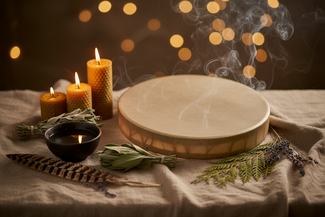
Tarot does not need ceremony to be valid, but a little ritual can help you focus. You might light a candle, burn incense, hold a favourite crystal or take a few slow breaths before shuffling. These small actions mark the moment as intentional and separate it from the rush of the day.
A home practice can be very straightforward. Keep your deck somewhere clean and accessible. Read at the same time each morning or evening if routine helps you. If you already work with meditation accessories, altar pieces or energy-cleansing tools, tarot can sit naturally within that space.
That said, avoid turning preparation into pressure. You do not need the perfect moon phase, the perfect table or a deeply mystical atmosphere every time you read. Sometimes a five-minute card pull at the kitchen table is exactly enough.
Common worries beginners have
One of the most common worries is getting it wrong. In reality, tarot is rarely about passing or failing. Sometimes a reading feels immediately clear. Sometimes it only makes sense later. Sometimes the card you pull seems off, until you realise it was naming the part of the situation you were avoiding.
Another worry is whether you should let others touch your deck. This is entirely personal. Some readers do not mind at all. Others prefer to keep their deck private. The same goes for cleansing. You may like to use incense, sound, moonlight or visualisation, or you may simply reorder and shuffle the cards. What matters is choosing a method that feels respectful and sustainable for you.
People also ask whether tarot predicts the future. It can highlight patterns, possibilities and likely energies, but it is not a fixed script. Human choice still matters. For many beginners, tarot is most helpful when used for clarity and guidance rather than certainty.
Building confidence with the right tools
The easiest way to stay consistent is to keep your practice approachable. A clear tarot deck, a supportive guidebook and a journal are enough to begin. If you enjoy a more sensory ritual, you might add candles, incense, crystals or a dedicated cloth to create a calm reading space. Sacred Essence offers tarot, ritual and wellbeing essentials in a way that makes it easy to build that practice gradually, rather than feeling you need everything at once.
It is worth allowing your tarot toolkit to grow with your experience. Beginners usually do well with one reliable deck and one source of guidance. Later, you may want oracle cards, pendulums, altar tools or seasonal ritual items to support deeper reflection. There is no rush.
The kindest way to learn tarot is to let it be a conversation rather than a performance. Pick up the cards often, ask honest questions, and trust that understanding comes through use. A simple daily pull, done with presence, will teach you far more than waiting for the perfect moment to begin.
Related Collections
If you are starting your journey with tarot, these collections are a good place to explore:
-
Tarot & Oracle Cards – beginner-friendly decks, classic Rider-Waite styles and modern interpretations
-
Tarot & Spiritual Books – guides to help you build confidence and understanding
-
Dowsing Pendulums – for guidance and connection
-
Crystal Collections – to support reflection, grounding and intention
-
Incense Sticks & Smudge – to help create a calm, focused reading space
Explore Tarot & Oracle Cards
(Tarot Collection)
Visit Us or Shop Online
If you would like to see and feel the cards in person, we’d love to welcome you to our shop in the Lake District.
Visit our Coniston, Lake District shop – explore our products in a relaxing space
Or take your time exploring online:
Shop online – explore, get advice, and enjoy a friendly, relaxed space
A Final Thought
The kindest way to learn tarot is to let it be a conversation rather than a performance.
Pick up the cards often, ask honest questions, and allow your understanding to grow naturally over time.
A simple daily pull, done with presence, will teach you far more than waiting for the perfect moment to begin.
Explore, experiment and enjoy — manifesting a bigger dream ✨
Sacred Essence 🌈