

A beginner’s introduction to Palo Santo, personal ritual and choosing thoughtfully

If you have ever picked up a piece of fragrant wood in a spiritual shop and wondered what Palo Santo is, you are not alone. Many people recognise its scent before they understand the different ways it is used. Warm, woody and slightly citrus-like, it can become a familiar part of a quiet pause, a meditation practice or a moment of intention setting.
Palo Santo means “holy wood” in Spanish. The aromatic wood discussed here is Bursera graveolens. It is different from a manufactured incense stick, even though both may be sold under the name Palo Santo. Understanding that distinction is a useful first step when choosing.
Explore our Palo Santo collection for wood and aromatic products, or read our Palo Santo guide for a broader reference. This article offers a simple starting point, with links to more detailed guidance where you need it.
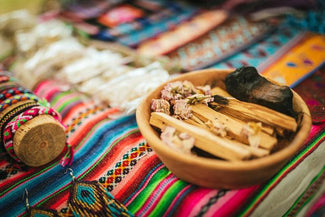
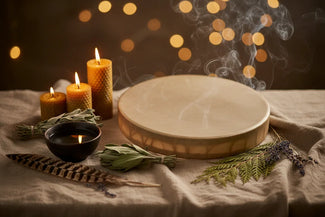
The photographs illustrate ritual atmosphere, not recommended burning arrangements. Keep lit or smouldering wood separate from unused wood, dried herbs and other flammable materials, in a suitable fireproof holder.
In this article: What Palo Santo is · Personal ritual · Using the wood · Choosing thoughtfully · Sage and incense · Precautions · Explore further
What is Palo Santo?
At its simplest, Palo Santo is an aromatic wood used for its fragrance and spiritual associations. Our natural Palo Santo wood stick listing describes the material, fragrance and supplied sourcing information, helping distinguish solid wood from coated joss sticks or fragrance products.
Palo Santo is associated with different South American spiritual traditions. These are living practices with different communities, teachers and ways of working, rather than one universal ceremony. A contemporary home ritual should be approached respectfully, without assuming it reproduces a particular traditional practice.
The scent is a large part of its appeal. People often describe woody, sweet, citrus-like or resinous notes, although individual pieces vary. A lighter aroma or a stick that stops smouldering quickly is not, by itself, evidence of poor quality or imitation.
Why do people use Palo Santo?
For many practitioners, Palo Santo is not simply a room fragrance. It can mark the beginning of meditation, prayer, journalling or a card reading, creating a familiar transition from everyday tasks into a more intentional moment.
Some people use it symbolically for space clearing or when reflecting on what they wish to release and welcome. Others simply appreciate its aroma. These experiences are personal and connected with spiritual belief, rather than guaranteed effects. Palo Santo is not a medical treatment or a substitute for professional support.
You might begin by choosing one clear intention: making time to rest, meeting the day with patience or pausing before a decision. The meaning comes from your attention and practical choices, not from producing a large amount of smoke.
If you are building a place for reflection, our Creating a Sacred Space guide explores how a small, personal corner can support an everyday practice. No smoke or fragrance is required for that space to be meaningful.

How Palo Santo wood is used
Natural Palo Santo wood behaves differently from manufactured incense sticks or cones. Follow the instructions supplied with your particular product rather than relying on a fixed lighting time.
Prepare first. Choose a ventilated space and a suitable fireproof dish on a stable, heat-resistant surface. Keep it away from curtains, paper, dried flowers and other flammable materials, with a suitable means of extinguishing the wood nearby.
A purpose-made option is the Palo Santo White Ceramic Dish 12.5cm. Check the fit of your wood and follow the holder’s directions. A holder designed for wood or cones should not automatically be treated as suitable for charcoal.
Light and extinguish the flame. Hold the wood securely at the unlit end, away from your face, hair and clothing. Light the opposite tip over the dish according to the product instructions, then gently put out the flame before beginning your ritual. If a flame returns, extinguish it before continuing.
Keep the practice brief. Keep the smouldering tip over the fireproof dish, avoid inhaling smoke directly and stay with it throughout. There is no need to carry lit wood around your body or close to furnishings. Natural wood may stop smouldering on its own; you do not need to keep relighting it or aim for continuous smoke.
Extinguish fully. Use the method recommended with the product, then leave the wood and holder on a fireproof, heat-resistant surface until completely cool. The absence of visible smoke does not prove that the tip is extinguished. Check that no heat or glowing embers remain before storage.
For a fuller walkthrough, read Palo Santo: Uses, Benefits and How To Use It.
How to choose Palo Santo thoughtfully
Questions about sourcing deserve more than a reassuring label. Look for the stated species, origin and harvesting information for the particular product, and ask the supplier if anything is unclear. Words such as “natural”, “wild harvested” or “authentic” are not a guarantee on their own.
If wood is described as naturally fallen or aged, look for information supporting that description rather than assuming all Palo Santo is gathered in the same way. Different products and batches may have different sourcing details.
Fragrance strength, visible grain, colour and burn behaviour can vary naturally. They are not reliable tests of identity, provenance or sustainability. Clear product information is a better starting point than promises based on appearance alone.
You can explore our Palo Santo - About brand collection, then check the individual listing for the format and supplied details. Our Palo Santo origins, sourcing and formats article explores these questions in more depth.

Palo Santo compared with sage and incense
Palo Santo and white sage are often grouped together, but their materials, fragrances and cultural associations are not interchangeable. People commonly describe sage as herbaceous and Palo Santo as woody and citrus-like, though scent is subjective and products vary.
Neither should be assumed to be gentler on the airways simply because its fragrance seems softer. Both produce smoke when burned.
Manufactured incense sticks offer another format, often combining aromatic materials, oils and binders. They should not be mistaken for a piece of natural Palo Santo wood. Resin incense also produces smoke and may require charcoal, bringing additional heat and handling precautions.
For a closer comparison, read our Sage vs Palo Santo guide. Choose according to the product’s ingredients, instructions and suitability for your surroundings, not the idea that one tool is essential to spiritual practice.
A few important precautions
Never leave lit or smouldering wood unattended, including when it is resting in a dish. Keep hot wood, holders and matches away from children and pets, and do not expose them to the smoke. Extinguish everything fully before leaving the room or going to sleep.
Ventilate the space, avoid inhaling smoke directly and stop if smoke or fragrance becomes uncomfortable. Ventilation does not remove every risk. If smoke affects your breathing, or you have asthma or another respiratory condition, avoid exposure and seek advice from a qualified healthcare professional about your circumstances.
Sprays and essential oils are not automatically suitable alternatives for fragrance-sensitive people, and resin incense is not smoke-free. A spoken intention, journalling, a quiet pause or a familiar sound can mark the beginning of a ritual without smoke or fragrance.
If you choose an essential oil, follow its label and your diffuser’s instructions. Do not ingest it or apply it undiluted to skin. Different aromatic formats need their own precautions.
Explore collections and related reading
Start with the Palo Santo department or the Palo Santo - About brand collection. You can also explore White Sage and Crystals, choosing only the tools that suit your own practice.
Related guides
Continue reading our blogs
Visit Us or Explore Online
You are always welcome to visit our shop in Coniston, in the heart of the Lake District, where we are happy to guide you in person. Explore our incense, sprays, crystals and ritual tools, or browse online at your own pace.
We have customer parking, and we’re close to Coniston Water, so you can pop in, browse, relax and unwind.
Visit us in Coniston or explore Sacred Essence online.
You can also follow along on Instagram and Facebook for inspiration, new arrivals and updates from our Coniston shop.
A Final Thought
Discovering Palo Santo does not mean you need to follow an elaborate routine or gather every tool at once. Sometimes the most useful beginning is simply to learn what you are choosing, consider where it comes from and decide whether it belongs in your own practice.
If its fragrance appeals to you and it suits your surroundings, let it accompany a brief, thoughtful moment. If smoke or scent is not right for you, the invitation to pause remains. Your attention, intention and care are what make that moment personal.
“A meaningful practice begins not with having all the right tools, but with making a little room to be present.”
Sacred Essence 🌈