Mestana Mesa Cloths, Medicine Bundles & Andean Weaving Tradition
What Is a Mestana Mesa Cloth?
A mestana is a ceremonial textile used within some Andean spiritual traditions as the outer wrapping or foundation of a personal mesa.
It is practical and symbolic at the same time.
When opened, the cloth creates a defined altar space. When folded, it gathers that altar back into a portable bundle.
The cloth is therefore not simply something placed beneath the altar.
It becomes part of the altar itself.
Building a Personal Mesa
A personal mesa does not need to begin fully formed.
It may start with very little — perhaps one meaningful stone, a smaller inner cloth and one object connected with a person, place or teaching.
From there, the bundle can grow naturally.
Some objects are chosen deliberately. Others arrive through travel, ceremony, family, landscape or personal experience.
Over time, the mesa may hold:
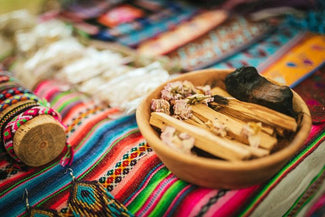
- khuyas or medicine stones
- stones from significant places
- inherited pieces
- gifts from teachers
- ritual objects
- offerings
- personal symbols
- objects connected with prayer or ceremony
The result is deeply individual.
A personal mesa becomes something lived with rather than simply assembled.
The Outer Mestana & Inner Unkuna or Wachala
The larger mestana commonly forms the outer cloth of the bundle.
Within it, a smaller textile such as an unkuna or wachala may be used to hold more intimate or particularly significant objects.
This layered structure can carry powerful symbolism.
The outer cloth may be understood as the world we move through visibly — body, family, community, landscape and everyday life.
The inner cloth can represent what is held closer — memory, intention, personal experience, prayer and the quieter interior world.
Wrapped together, they bring these different dimensions into relationship.
The inner world is held within the outer, while the outer protects what is carried within.
Holding the Worlds Together
Once the inner and outer cloths are folded around the contents of the mesa, the bundle may be secured with a mesa tie or beaded tie.
Within some contemporary Andean teachings, this act is spoken of as holding the worlds together.
The phrase fits the physical object beautifully.
The tie gathers:
the outer cloth • inner cloth • khuyas • altar stones • offerings • personal history
into one contained form.
The tie is therefore more than a closure.
It marks the point where many separate pieces become one medicine bundle.
What Are Khuyas?
Khuyas are sacred or personally significant stones and objects used within some Andean ceremonial traditions.
A khuya may be connected with:
- a mountain
- a river
- an ancestor
- a teacher
- a journey
- a sacred place
- a ceremony
- a personal turning point
Their significance often comes from relationship rather than appearance.
A simple stone may become deeply meaningful because of where it was found, who gave it or what happened around it.
The mestana gives these objects a place to be carried together.
A More Intimate Ceremonial Cloth
This type of mestana is smaller than many of the larger Andean carrying and household textiles.
That more intimate scale makes it particularly practical for a personal altar or medicine bundle.
It is large enough to hold a developing collection of stones and sacred objects while remaining easy to fold, wrap, carry and store.
Its size gives it a personal quality.
This is a cloth intended to be handled repeatedly, opened carefully and wrapped again with intention.
A Cloth of Birth, Holding & Becoming
Woven cloth has accompanied Andean life through many important transitions.
Textiles have been used to carry, wrap, protect and receive.
In some communities, woven cloths have also been associated with childbirth and the wrapping or receiving of newborn children.
That gives cloth a powerful relationship with arrival, protection and becoming.
There is something deeply resonant in the idea that woven textiles may hold a new child, food, offerings, sacred stones or the contents of a personal mesa.
The cloth becomes a container for what is precious.
Within contemporary spiritual practice, this can also give the mesa a symbolic relationship with renewal — holding what is being born, changed or carried forward in a person's life.
Specific traditions vary between communities and should not be understood as one universal Andean custom.
Fine Alpaca & Sheep Wool
This mestana is woven predominantly from fine alpaca yarn combined with sheep wool.
The alpaca gives the cloth softness, smoothness and a more flexible drape.
The sheep wool gives it body and structure.
Together they create a textile that feels substantial without becoming coarse or rigid.
That tactile quality matters.
A working mesa may be opened, folded, wrapped and tied many times. Over time, the feel of the cloth becomes part of the relationship with the bundle.
Chinchero & the Living Weaving Tradition
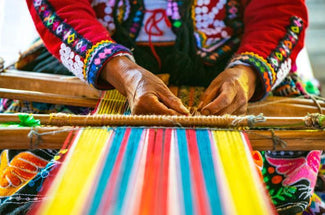
Chinchero, in the Cusco region of Peru, is renowned for its weaving traditions.
Here, textile making is far more than decoration.
Colour, pattern, fibre, repetition and structure can express relationships with:
family • community • landscape • agriculture • animals • mountains • inherited knowledge
A woven cloth may speak of place without words.
A colour relationship may be familiar within one community. A repeated geometric rhythm may belong to a family or regional weaving tradition.
Not every motif has one fixed meaning, and Andean textiles should not be reduced to a simple chart of symbols.
Part of their richness lies in the fact that meaning can be layered, inherited and lived.
Q'ero, Sun & Rainbow Traditions
The Q'ero are an Indigenous Andean people associated with the highlands of the Cusco region and with distinctive ceremonial and textile traditions.
In contemporary spiritual writing, they are sometimes described poetically as Children of the Sun or Rainbow Children.
These expressions evoke the strong relationship between Andean cosmology, colour, landscape and sacred geography.
The sun, mountains, rain, rainbow, earth and sky all occupy powerful places within Andean symbolic worlds.
Brightly woven cloths can seem to carry some of that same intensity.
These poetic descriptions are best understood as spiritual or symbolic language rather than formal titles universally used by every Q'ero community.
Colour, Tone & Meaning
Colour is deeply present in Andean weaving.
Some textiles are vibrant and bright. Others use more restrained, earthy or regionally specific palettes.
Reds, blues, greens, yellows and rainbow-like combinations may carry aesthetic, familial, regional or ceremonial associations.
Colour choices can reflect:
- community
- family tradition
- ceremonial context
- natural dye materials
- regional style
- individual weaving practice
For this reason, variation is expected.
Two cloths from the same broad design family may differ noticeably in shade, intensity or balance.
Those differences are part of the life of handmade weaving.
Natural Dyes
This cloth is described as traditionally plant dyed.
Natural dyeing creates depth and variation rather than absolute uniformity.
One batch may lean slightly warmer or cooler than another. Reds can deepen, blues can vary in intensity, and small shifts in tone can appear across the weave.
Natural colours may also soften gradually with age and use.
That change becomes part of the story of the cloth.
Weaving as Story
In Andean traditions, weaving can hold memory.
A pattern may relate to landscape.
A colour may recall place.
A repeated form may belong to family or community.
The textile is therefore not simply patterned fabric.
It exists within a tradition where weaving, identity, landscape and lived experience are closely connected.
This is one of the reasons a mestana feels so natural as the foundation of a personal altar.
It is already a cloth made through relationship.
Landscape, Spirit & the Andean World
The high Andes are not merely a backdrop to Andean spiritual traditions.
Mountains, earth, weather and place can be understood as living relationships.
Sacred mountains may be referred to as apus, powerful presences connected with particular landscapes and communities. Mountains such as Ausangate hold profound cultural importance within parts of the Cusco region.
A personal mesa may contain stones or objects connected with particular mountains, rivers or journeys.
In this way, the medicine bundle can become a portable relationship with place.
A stone is no longer simply a stone.
It may carry the memory of where it was gathered and what that place came to mean.
Andean cosmology is also often described through relationships between Hanan Pacha, Kay Pacha and Uku Pacha — upper, present and inner or below worlds.
These ideas are complex and vary between communities and teachings, but they echo one of the central themes of the mesa itself: different worlds held in relationship rather than isolation.
Pachamama, Reciprocity & Relationship
Pachamama is often translated as Mother Earth, although the concept is broader than that simple English phrase.
It can include earth, place, time, fertility and reciprocal relationship.
Reciprocity is an important theme within many Andean traditions — the understanding that relationship involves giving as well as receiving.
A personal mesa may contain offerings, stones or objects connected with gratitude and place.
The cloth becomes a place where those relationships can be gathered and remembered.
Wrapping the Mesa
When the altar work is complete, the objects are gathered carefully.
The smaller inner cloth may first be folded around the more intimate contents.
That bundle is then placed within the larger mestana.
The outer cloth is folded around everything and secured using a mesa tie or decorative beaded tie.
The repeated rhythm of opening and closing can gradually become part of the practice itself.
Nothing is rushed.
The altar is opened when needed and gathered back together when complete.
Opening the Mesa as an Altar
When opened, the mestana creates the physical boundary of the altar.
The contents may be arranged upon it during:
prayer • meditation • ceremony • offerings • reflection • personal spiritual work
The arrangement does not need to remain fixed forever.
New objects may enter.
Others may eventually leave.
The mesa changes as the person carrying it changes.
Mesa Ties & Beaded Ties
A mesa tie keeps the wrapped bundle secure.
It may be woven, braided, textile or beaded.
A decorative Inti Santana-style beaded tie can add another layer of colour and symbolism while serving the practical purpose of holding the bundle together.
Visually and symbolically, the tie completes the wrapping.
Fresh from the Loom
This cloth is new and unused in ceremony.
It has not previously held another person's sacred objects or developed another person's ceremonial history.
For someone beginning a personal mesa, that can be particularly meaningful.
The textile starts its working life with its new keeper.
Over time, folds, softening, marks and associations may become part of its individual story.
Handmade Variation
Each cloth is individually handwoven and naturally unique.
Please allow approximately 10% variation in dimensions and colour from batch to batch.
Natural differences may include:
- colour depth
- shade
- pattern balance
- weave tension
- yarn thickness
- edge alignment
- overall proportions
These variations are characteristic of handmade textiles and natural dyes.
Ethical & Cultural Appreciation
Andean ceremonial textiles come from living Indigenous cultures.
Their value lies not only in visual beauty but in the weaving knowledge, labour, continuity and cultural history behind their making.
Using a mestana personally does not itself confer initiation into Q'ero, Chinchero or another Andean ceremonial lineage.
A personal altar can hold profound individual meaning while still respecting the distinction between contemporary personal practice and teachings belonging to particular communities and lineages.
Cleaning & Care
Because this cloth contains alpaca and wool and uses natural dyes, cleaning should always be light and gentle.
If cleaning is genuinely required, suitable approaches include specialist gentle dry cleaning or careful hand washing in cool to slightly warm water.
Use only a mild wool-safe or natural soap.
Avoid hot water, bleach, strong detergents, abrasive stain removers and vigorous rubbing.
Do not wring the cloth.
Natural dyes can move or soften under aggressive cleaning, so minimal intervention is safest.
After washing, gently reshape the textile and dry it flat away from strong heat and prolonged direct sunlight.
Caring for Natural Dyes
Natural dyes are part of the character of the cloth.
Avoid:
- long soaking
- abrasive brushing
- harsh chemical cleaning
- tumble drying
- excessive heat
Gradual softening or subtle fading over years of use can become part of the textile's story.
Storage
Store the cloth completely dry.
If it is being used as a medicine bundle, keep the wrapped mesa somewhere protected from damp, excessive heat and prolonged direct sunlight.
Natural-fibre textiles also benefit from occasional checking when stored for long periods.
Quick FAQs
What is a mestana?
A ceremonial Andean textile commonly used as the outer cloth of a personal mesa or medicine bundle.
What is a mesa?
A portable personal altar containing sacred stones, khuyas and other meaningful objects gathered through spiritual practice.
Is the exact size fixed?
No. Each textile is handmade. Please allow approximately 10% variation in size from batch to batch.
Will the colours always be identical?
No. Natural dyes and handmade production mean colour balance and tone can vary by approximately 10% between batches.
What is an unkuna or wachala?
A smaller inner ceremonial cloth that may sit inside the outer mestana and hold more intimate or particularly significant objects.
What do the inner and outer cloths represent?
Within some contemporary Andean teachings, they can symbolise the relationship between inner and outer worlds.
What are khuyas?
Sacred or personally meaningful stones and objects used within some Andean ceremonial traditions.
How is a mesa closed?
The inner and outer cloths are wrapped around their contents and may be secured with a mesa tie or decorative beaded tie.
What goes inside a personal mesa?
Khuyas, altar stones, ritual objects, offerings, inherited pieces and other objects that acquire personal or spiritual significance over time.
Is this cloth new?
Yes. It is fresh from the loom and has not previously been used in ceremony.
What is it made from?
Predominantly fine alpaca yarn blended with sheep wool.
Why does it feel softer than some traditional cloths?
The high alpaca content gives it a smoother handle and more flexible drape.
Are natural dyes used?
Yes, according to the supplied product information.
Do the colours and patterns have meaning?
They may carry familial, regional, cultural or ceremonial associations, but meanings vary between communities and individual textiles.
Were woven cloths traditionally associated with childbirth?
Textiles have been used for wrapping, carrying and receiving infants in some Andean communities. Specific traditions vary.
How should the cloth be cleaned?
Very gently, using specialist dry cleaning or light hand washing in cool to slightly warm water with mild soap.
Can it be machine washed?
No. Machine washing and abrasive cleaning can damage the natural fibres and dyes.
Please Note
This textile belongs to a living Andean weaving and ceremonial tradition.
Descriptions of mesas, khuyas, inner and outer cloths, Q'ero identity, apus, Pachamama, colour symbolism and cosmology reflect broad and contemporary understandings of Andean practice. Meanings and teachings vary between Q'ero, Chinchero and other communities and between individual lineages.
Its significance lies not only in the weaving itself, but in what may eventually be wrapped within it — stones, memories, landscapes, relationships and personal meaning gathered over time.


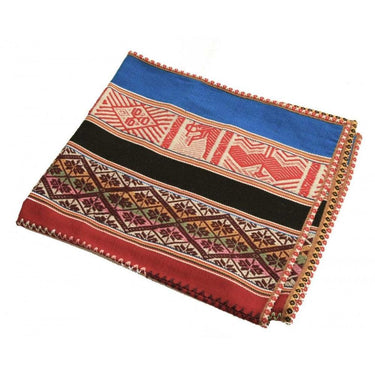


 Chinchero Mestana Mesa Cloth M55-C - Red/Blue - Shamanic Altar & Ceremonial Cloth
£180.00
/
Chinchero Mestana Mesa Cloth M55-C - Red/Blue - Shamanic Altar & Ceremonial Cloth
£180.00
/