Mestana Mesa Cloths, Personal Altars & Q'ero Weaving Tradition
What Is a Mestana Mesa Cloth?
A mestana is a ceremonial textile used within some Andean spiritual traditions to form the outer cloth of a personal mesa or medicine bundle.
Opened out, it becomes an altar surface.
Wrapped closed, it gathers the altar and its contents into a portable form.
This is what gives the cloth its unusual intimacy.
It does not merely decorate a sacred space.
It helps create and contain it.
Building a Personal Mesa
A personal mesa may begin with only a few objects.
A stone from an important place.
A gift from a teacher.
Something inherited.
An object connected with a ceremony or transition.
Over time, other pieces may be added because of their relationship with:
- mountains
- rivers
- ancestors
- teachers
- ceremonies
- journeys
- significant places
- periods of personal change
The mesa gradually becomes a record of relationship.
The cloth is what allows those relationships to be gathered into one form.
Outer Mestana & Inner Unkuna or Wachala
The larger mestana commonly forms the outer layer of the bundle.
Inside it, a smaller unkuna or wachala can be used to hold especially personal or significant objects.
Within contemporary Andean ceremonial teaching, these two layers are often contemplated as expressions of the outer and inner worlds.
The outer cloth can reflect the visible life of body, family, community, land and daily experience.
The inner cloth may hold prayer, intention, memory and the more private dimensions of personal practice.
One is held within the other.
The inner world is carried by the outer world.
Holding the Worlds Together
When the contents are gathered, the inner cloth can be placed inside the larger mestana and the complete bundle wrapped closed.
A mesa tie or decorative beaded tie may then hold together:
outer cloth • inner cloth • khuyas • offerings • sacred objects • personal memories
Within some contemporary teachings, the tie is spoken of as holding the worlds together.
The phrase works on two levels.
Physically, it keeps the medicine bundle closed.
Symbolically, it gathers many relationships into one contained whole.
What Are Khuyas?
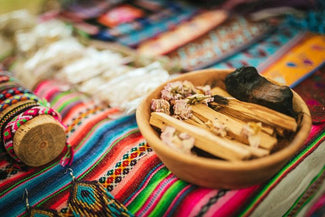
Khuyas are sacred or personally significant stones and objects used within some Andean ceremonial traditions.
A khuya may carry meaning because it is connected with:
- a mountain
- a river
- an ancestor
- a teacher
- a particular ceremony
- a journey
- a place
- a period of transformation
Their importance does not necessarily come from rarity or monetary value.
It comes from relationship.
A stone that appears ordinary to another person may become one of the most significant objects in a mesa because of where it came from and what it carries in memory.
Colour in Q'ero Textiles
Colour is one of the most immediately striking aspects of many Q'ero textiles.
The palette can be bold, layered and highly individual.
Different weaving families may use colour in different proportions and arrangements, with meaning shaped by family tradition, place, available dye materials and ceremonial context.
For that reason, colours should not be reduced to one universal symbolic chart.
Their relationship within the complete textile matters.
Red-Pink Tones
The red and pink areas give M77-Q much of its warmth and visual identity.
Rather than appearing as one flat shade, natural dyeing and hand weaving create changes of depth across the surface.
Some areas may appear richer and deeper.
Others may soften towards pink or fuchsia.
Those transitions give the cloth life.
Black, Purple, Green & Yellow
The darker black areas create structure around the warmer colours.
Purple introduces further depth, while green and yellow bring contrasting points of brightness.
The black sections in this particular textile show small dotted areas and shading variations consistent with its handmade dyeing.
These are part of the piece's appearance and should not be understood as manufacturing defects.
Two Halves & Complementarity
Many Andean ceremonial cloths are woven as two sections that are subsequently joined.
Within contemporary interpretation, this construction may resonate with ideas of complementarity:
inner and outer • left and right • feminine and masculine • receiving and giving
The important idea is not that one side opposes the other.
It is that two parts are brought into relationship and become one cloth.
The precise symbolism varies between families, communities and individual textiles.
A Cloth of Birth, Holding & Becoming
Textiles have long been used throughout the Andes for wrapping, carrying, protecting and receiving.
In some Andean communities, woven cloths have also played roles around childbirth and the wrapping or receiving of newborn children.
This gives the textile a powerful association with birth, protection and becoming.
Within contemporary mesa practice, that symbolism can become personal.
Objects connected with difficult transitions, new beginnings or important changes may gradually find their way into the bundle.
The cloth becomes a place where what has been lived and what is still emerging can be held together.
Specific childbirth and ceremonial traditions vary between communities and should not be treated as universal.
Sheep's Wool & Alpaca
This M77-Q combines hand-spun sheep's wool with alpaca.
Sheep's wool gives the cloth body and a more substantial feel.
Alpaca contributes softness and flexibility.
Together, they create a textile well suited to being folded repeatedly around stones and irregular objects.
Hand-spun yarn naturally varies in thickness, producing small changes in texture across the surface.
These are part of the making process.
Natural Dyes & Individual Shading
The textile is described as naturally dyed.
Natural dyeing rarely creates the absolute uniformity associated with industrial colouring.
Tone may deepen or soften across the same band of yarn.
This is particularly noticeable within some of the darker sections of M77-Q, where dotted and shaded areas are visible.
Rather than removing that variation, it forms part of the visual history of the textile.
New, with Character Already Present
This cloth is described as new, but it is not visually pristine in the sense of a factory-made textile.
Some areas have naturally aged-looking markings and variations created through the hand-dyeing and weaving process.
That gives M77-Q a sense of age and texture even before it begins its life as a personal mesa.
The distinction matters: these characteristics should not automatically be read as evidence of previous ceremonial use.
Q'ero & the Living Andean Tradition
The Q'ero are an Indigenous Andean people associated with the highlands of the Cusco region and with distinctive weaving and ceremonial traditions.
Their textiles belong to a living cultural world in which fibre, colour, family, landscape and ceremony remain closely connected.
A cloth may hold relationships with:
land • mountain • family • community • memory • ceremony
rather than simply serving as decoration.
In contemporary spiritual literature, the Q'ero are sometimes described poetically as Rainbow Children.
Such language is best understood as a contemporary symbolic description rather than a formal title universally used within every Q'ero community.
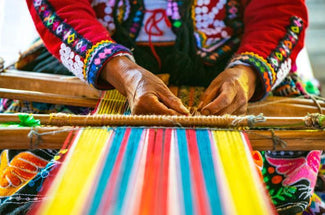
Weaving as Story
A textile can tell a story without words.
A change in colour may recall a particular landscape.
A repeated motif may belong to family or local weaving practice.
A joined seam may carry the visual language of complementarity.
A variation in dye may reveal something of the materials and process used to create the cloth.
Hand weaving records movement.
The textile becomes evidence of the hands that made it.
Landscape, Mountains & Apus
The high Andean landscape is inseparable from many of the traditions surrounding these textiles.
Mountains may be understood within Andean spiritual traditions as apus, sacred presences related to particular places and communities.
For someone building a personal mesa, stones or objects connected with meaningful landscapes may eventually become part of the bundle.
A stone may recall a mountain.
Another may carry the memory of a river.
The cloth becomes a place where geography and personal story meet.
Personal Altars & Medicine Bundles
A mestana may be opened as a portable sacred space.
Khuyas and other meaningful objects can be arranged upon it during:
prayer • meditation • ceremony • offerings • reflection • personal spiritual practice
When the work is complete, the same cloth gathers those objects together again.
The altar becomes the bundle.
The bundle becomes the altar.
Opening & Closing the Mesa
The act of opening and wrapping the mesa can gradually become part of the practice itself.
The outer cloth unfolds.
The inner cloth is opened.
Khuyas and personal objects are arranged.
At the end, everything is gathered and wrapped once more.
Over time, the movements become familiar.
The folds settle into the cloth.
The fibre softens.
The textile begins to carry the physical memory of being used.
Mesa Ties & Beaded Ties
A mesa tie may be used to keep the completed medicine bundle securely closed.
It can be woven, braided, textile or decorative and beaded.
Its practical role is simple, but within the structure of the mesa it also becomes the element that gathers everything together.
The tie completes the bundle.
Direct Sourcing & Fair Exchange
The supplied information describes these textiles as purchased through individuals and weaving families rather than factory production.
Fair exchange can help support livelihoods, weaving knowledge and the continuation of community life within ancestral landscapes.
The value of a cloth therefore lies not only in the object itself but also in the labour, skill and cultural continuity behind its making.
Cleaning & Care
This wool-rich natural-fibre textile should be cleaned very gently.
Suitable care includes:
- careful hand washing in cool to slightly warm water
- a mild natural or wool-safe soap
- minimal agitation
- gentle rinsing
- drying flat
- specialist gentle textile cleaning when appropriate
Avoid:
- hot water
- bleach
- strong detergent
- abrasive stain removers
- vigorous scrubbing
- wringing
- machine washing
- tumble drying
Natural dyes may shift or soften if treated aggressively.
Wax & Ceremonial Marks
If wax comes into contact with the textile, avoid scraping heavily or applying strong direct heat.
Gentle specialist treatment is preferable.
Marks that develop through genuine future use may eventually become part of the cloth's own story, but there is no need to artificially distress or age it.
Steam & Pressing
If the cloth needs freshening, only very gentle steam or low warmth should be considered.
Avoid high heat and direct aggressive pressing.
Natural fibres and dyes respond best to minimal intervention.
Storage
Store the cloth completely dry and protected from persistent damp.
Avoid prolonged direct sunlight, which may gradually soften natural colours.
If the cloth is stored as a wrapped mesa for long periods, occasionally open and check the natural fibres.
Quick FAQs
What is a mestana?
A ceremonial Andean textile commonly used as the outer cloth of a personal mesa or medicine bundle.
What colours are in M77-Q?
Red-pinks with black, purple, green and yellow.
What is the cloth made from?
A hand-spun blend of sheep's wool and alpaca.
What are the dotted areas in the black colour?
They are described as natural shading and dye variation within the handmade textile rather than manufacturing faults.
Is this an old ceremonial cloth?
It is described as new, although it has some naturally aged-looking and dye-related markings.
Is the exact size fixed?
No. Handmade production means size can vary. Please allow approximately 10% variation between individual textiles.
Will the colour match the photograph exactly?
No. Natural dyeing and hand weaving create individual changes in shade, tone and colour balance.
What is a mesa?
A portable personal altar containing khuyas, meaningful stones and other sacred or personally significant objects.
What is an unkuna or wachala?
A smaller inner cloth that may be placed inside the outer mestana.
What are khuyas?
Sacred or personally meaningful stones and objects used within some Andean ceremonial traditions.
What do the inner and outer cloths represent?
Within some contemporary teachings, they can represent the relationship between inner and outer worlds.
How is the mesa bundle closed?
It may be wrapped and secured using a woven or decorative beaded mesa tie.
Can it be used as an altar cloth?
Yes. It may be opened as a personal altar and wrapped again around the objects of a medicine bundle.
Were woven cloths used around childbirth?
Textiles have been used for wrapping, carrying and receiving newborn children in some Andean communities. Particular customs differ by community.
How should I clean it?
Very gently with cool to slightly warm water and mild wool-safe soap, or with appropriate specialist textile cleaning.
Can it be machine washed?
No. Machine washing may damage the fibres, weave and natural dyes.
Please Note
This textile belongs within a living Q'ero and wider Andean weaving and ceremonial context.
Descriptions of mesas, khuyas, inner and outer worlds, complementarity, apus, birth symbolism and ceremonial use reflect broad and contemporary understandings. Meanings and practices vary between families, communities and individual ceremonial lineages.
Natural dye variations, including the dotted shading visible within darker areas of this particular cloth, are part of its individual handmade character.
Its significance lies not only in what has already been woven into it, but in what may eventually be wrapped within it — stones, landscapes, memories, relationships and personal meaning gathered together over time.


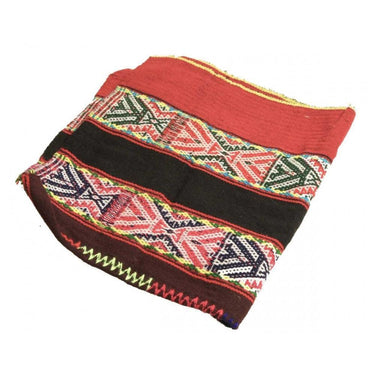


 Sacred Mestana Mesa Cloth M77-Q - Shamanic Altar & Ceremonial Cloth
£170.00
/
Sacred Mestana Mesa Cloth M77-Q - Shamanic Altar & Ceremonial Cloth
£170.00
/