Native American Style Eagle Feather • Smudging, Prayer & Ceremony
A single feather gives a gentle and precise way to guide aromatic smoke.
Rather than blowing directly onto burning herbs or incense, the feather can be moved slowly through the air, encouraging the smoke to travel around a person, object, altar or ritual space.
Its movement is soft and intentional, which is why feathers have become meaningful tools within many forms of ceremonial, prayer-based and spiritual practice.
White Sage, Palo Santo, Cedar & Incense
This feather can be used alongside:
- white sage
- Palo Santo
- sweetgrass
- cedar
- resin incense
- incense sticks
Once smoke is rising safely, hold the feather by the lower shaft and move it gently to guide the smoke.
Keep the feather well away from open flame, embers and hot charcoal.
What Type of Feather Can Be Used for Smudging?
For general contemporary smoke-cleansing practice, the practical requirement is simple: a feather should be light enough to move air gently and large enough to guide smoke with control.
This black-tipped eagle-style feather is typically made from a hand-painted turkey feather and is well suited to that purpose.
A single feather gives more precision than a larger smudge fan, making it useful in smaller spaces, around an altar or during quieter personal ritual.
Smudging, Smoke Cleansing & Cultural Respect
“Smudging” is widely used as a commercial and spiritual term, but it also refers to specific ceremonial practices within a number of Indigenous North American traditions.
Those traditions are distinct and should not be treated as one universal practice.
For general personal use, smoke cleansing, ritual cleansing or incense cleansing are often more appropriate descriptions unless someone is practising within a specific cultural tradition.
This feather can be used as a practical smoke-direction tool without claiming to reproduce a specific Indigenous ceremony.
Native American Feather Context
Eagle feathers hold profound cultural and ceremonial significance within many Native American and other Indigenous North American traditions.
Their meanings vary between Nations and communities, but they may be associated with honour, prayer, responsibility, spiritual authority and relationship with Creator.
This product is not a genuine eagle feather.
Its black-tipped design visually echoes the appearance of an eagle feather while using alternative materials, allowing the strong ceremonial aesthetic without representing it as an authentic sacred eagle feather.
Shamanic Feather & Contemporary Spiritual Use
Within contemporary shamanic and spiritual practice, feathers may be used symbolically for prayer, intention, smoke direction and the movement between earth and sky.
A single feather may be incorporated into:
- shamanic-style ritual
- journeying preparation
- altar work
- meditation
- smoke cleansing
- prayer
- blessings
- ceremonial practice
These uses are contemporary and practitioner-led rather than evidence that the feather belongs to one universal shamanic tradition.
Eagle-Style Symbolism
Within broader contemporary spiritual practice, eagle-style imagery may be associated with:
- perspective
- vision
- strength
- prayer
- spiritual aspiration
- freedom
- connection between earth and sky
These are symbolic interpretations rather than universal Native teachings.
For some people, the feather may simply serve as a reminder to rise above a situation, see more clearly or approach ritual with greater focus.
A Feather as a Bridge Between Earth & Sky
Feathers naturally evoke movement through air.
Across many spiritual traditions, this has led them to become symbols of prayer, breath, communication, freedom and the meeting place between earth and sky.
For some people, a prayer feather becomes a simple reminder to move gently, listen carefully and work with intention.
It may be held during prayer, used in quiet reflection or placed beside other meaningful ritual objects.
The Black-Tipped Design
The dark tip creates a striking contrast against the lighter body of the feather.
In contemporary symbolic practice, black may be associated with protection, boundaries, depth, mystery or strength.
Those meanings are personal or tradition-specific rather than inherent properties of the colour.
The clearest distinction is simply that the dark tip gives this feather its distinctive eagle-inspired appearance.
Prayer, Ritual & Altar Use
Beyond smoke cleansing, the feather may be used:
- during prayer
- beside an altar
- within meditation
- in a ceremonial display
- in a sacred-space arrangement
- during blessings
- as a symbolic spiritual object
- as part of a handmade feather fan
Its meaning can remain entirely personal.
Single Feather or Smudging Fan?
A single feather moves less air than a full feather fan, which can be an advantage.
It offers more precise and delicate control when guiding smoke and is particularly easy to use in smaller spaces or quiet personal practice.
A larger smudging fan is better where a broader sweep of air is wanted.
Several compatible feathers may also be bound together to create a larger ceremonial-style fan.
Ethical & Responsible Alternative
The supplied product information describes these feathers as ethically sourced and intended as alternatives to genuine eagle feathers.
Using turkey or imitation feathers allows the visual character of an eagle-style feather to be represented without relying on protected eagle feathers.
This makes them suitable for contemporary ritual, spiritual practice and decorative use while keeping the distinction from genuine eagle feathers clear.
Care
Handle the feather gently and keep it dry.
Protect it from open flame, hot charcoal, prolonged damp, crushing, rough handling and strong direct sunlight.
Store flat or upright where the shaft will not bend.
If the feather fibres separate slightly, they can usually be smoothed gently back into place with clean, dry fingers.
Quick FAQs
Is this a real eagle feather?
No. It is an eagle-style feather, typically made from a natural turkey feather that has been hand painted, with some imitation alternatives also used.
How large is it?
Approximately 10–12″ long, averaging around 12″ / 300mm.
Can I use it for smudging?
Yes. It can be used to gently direct smoke during contemporary smudging-style or smoke-cleansing practice.
What type of feather can I use for smudging?
A lightweight feather that can gently move air and guide smoke is suitable for general contemporary smoke-cleansing practice. This hand-painted turkey / imitation eagle-style feather is designed for that purpose.
Can I use it with white sage or Palo Santo?
Yes. It can be used to guide smoke from white sage, Palo Santo and other suitable aromatic materials, provided it is kept safely away from flame and embers.
Can it be used as a prayer feather?
Yes. It may be held or displayed symbolically during prayer, meditation or personal ceremonial practice.
Can it be used for shamanic practice?
Yes. It may be incorporated into contemporary shamanic-style ritual, smoke cleansing, journeying preparation or altar work, although there is no single universal shamanic use for a feather.
Is it a Native American feather?
It is a Native American-style eagle feather in appearance and ritual context, but it is not a genuine eagle feather.
Is every feather identical?
No. Natural shape, length, width, colouring and painted detail will vary.
Is it ethically sourced?
The supplier describes the feather range as ethically sourced and intended to avoid the use of genuine protected eagle feathers.
Can I combine several feathers into a fan?
Yes. Several suitable feathers can be bound together to create a broader feather fan.
NB
As these feathers are individually formed and hand finished, variations in natural shape, length, width, markings, painted black-tip detail and overall finish are to be expected.
These differences give each feather its own individual character and are not considered faults.
Please Note
This is not a genuine eagle feather.
Eagle feathers hold specific cultural and ceremonial significance within a number of Indigenous North American traditions, and those meanings should not be treated as universal.
References to Native American symbolism, shamanic practice, prayer, protection, cleansing or spiritual connection describe cultural, traditional or contemporary symbolic uses rather than guaranteed physical, energetic or supernatural effects.





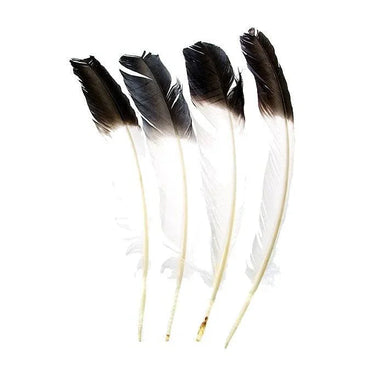

 Native American Style Imitation Eagle Feather 10–12″ - Smudging, Ritual & Prayer Feather
£1.80
/
Native American Style Imitation Eagle Feather 10–12″ - Smudging, Ritual & Prayer Feather
£1.80
/