
Peruvian Artisan Q’ero Paqo Black Alpaca Poncho • K’uychi Rainbow & Brown Earth Design

A distinctive black alpaca poncho made in Peru by Peruvian artisans for Q’ero Paqos and worn for ritual, ceremony and everyday life.

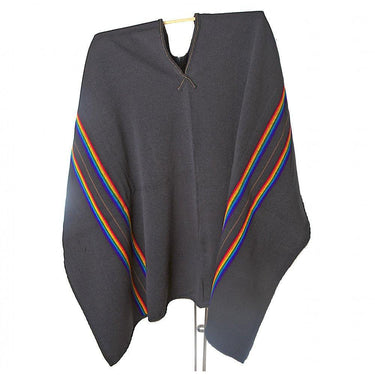
The design is the heart of this garment. A deep black body is crossed by vivid K’uychi rainbow stripes and finished with contrasting brown edging, creating a powerful combination of colour, earth tones and ceremonial presence.

Machine made rather than handwoven, the poncho is practical, robust and generously cut. Its approximately 1kg weight provides useful warmth without the structure or restriction of a conventional coat.

For Q’ero Paqo use, however, this is more than practical clothing. The colours and design carry a ritual language connected with the rainbow, Pachamama, protection and movement between worlds.

K’uychi Rainbow, Jaguar Bridge & Pachamama

In Quechua, K’uychi means rainbow.

Within the supplied Q’ero Paqo tradition, the rainbow is understood as the Jaguar Bridge between worlds — a symbol of passage, transformation and connection between different realms of experience.

The brown edging connects with Pachamama, Mother Earth, grounding the brightly coloured rainbow within the earth and the physical landscape.

The black body is associated within the supplied tradition with protection, concealment and inward ceremonial focus.

Together, the three elements give the poncho its distinctive symbolic character: black for protection and inward focus, K’uychi for the bridge between worlds, and brown for connection with Pachamama.

Ritual, Ceremony & Fire Ceremony Wear

This style of poncho is made for and worn by Q’ero Paqos and can be used during ritual gatherings, including fire ceremonies and other ceremonial practices.

Its generous construction allows it to fall freely over other garments, while the strong black ground and rainbow design give it a clear visual presence around a ceremonial fire or outdoor gathering.

The darker colouring also gives it a more restrained character than a completely brightly coloured ceremonial poncho.

For someone using the garment within their own spiritual practice, its Q’ero Paqo provenance and symbolism give it considerably more depth than a generic ceremonial cloak or modern “shamanic” garment.

Product Details

  • Product: Q’ero Paqo Black Alpaca Poncho
  • Design: K’uychi Rainbow Stripe
  • Base Colour: Black
  • Detail: Multicoloured rainbow stripes with brown edging
  • Material: Alpaca wool according to the supplied specification
  • Construction: Machine made
  • Made By: Peruvian artisans
  • Made For / Worn By: Q’ero Paqos
  • Approx. Size: 173cm × 124cm
  • Approx. Head Opening: 31cm
  • Approx. Weight: 1kg
  • Fit: Generous one-size traditional poncho
  • Origin: Peru
  • Use: Fire ceremony, ritual, ceremonial, outdoor, travel and casual wear
  • Variation: Allow approximately 10% variation in dimensions, stripe positioning and colour tone
  • Care: Hand wash in cool to lukewarm water using a mild detergent. Reshape gently while damp and air dry naturally. Avoid tumble drying and high heat.
  • Storage: Store clean and dry and avoid rough surfaces or sharp objects that may catch the fibres

Made in Peru for Q’ero Paqos

An important distinction with this garment is the relationship between the maker and the wearer.

The poncho is machine made in Peru by Peruvian artisans and produced for Q’ero Paqos who wear this style.

The artisans themselves should not automatically be described as Paqos or shamans unless that is separately documented.

Likewise, the garment should not be described as handmade or handwoven when its construction is machine based.

Its significance comes from its Peruvian production and contemporary Q’ero Paqo use rather than from suggesting an older manufacturing method that does not apply.

Alpaca Warmth & Traditional Poncho Form

The broad rectangular construction allows the poncho to drape naturally across the shoulders and body.

At approximately 173cm × 124cm, it provides substantial coverage while remaining straightforward to layer over ordinary clothing.

The supplied head opening is approximately 31cm.

Its loose one-size design accommodates a broad range of frames without requiring the fitted sizing of a jacket or coat.

If adjustment to the head opening is ever required, professional tailoring is preferable to cutting the garment without guidance.

Casual, Outdoor & Travel Wear

Although ceremonial use comes first in the story of this particular poncho, it remains a practical garment.

The open shape makes it easy to wear over everyday clothes, while the alpaca construction provides warmth without the bulk and structure of a conventional outer coat.

Its approximately 1kg weight also makes it practical for travel, outdoor gatherings and cooler evenings.

The black ground makes it relatively easy to incorporate into ordinary clothing despite the striking rainbow detail.

This allows the poncho to move naturally between ritual use and everyday life.

Q’ero Paqo Poncho • K’uychi, Pachamama & Contemporary Andean Ceremonial Tradition

The Q’ero are Indigenous Quechua-speaking communities of the Peruvian Andes with living cultural, textile and spiritual traditions.

The term Paqo is used within Andean spiritual contexts for a ritual or spiritual practitioner.

Although “shaman” is sometimes used as a convenient English translation, Paqo belongs to a specifically Andean framework and should not simply be treated as another word for a generic shaman.

That distinction is particularly relevant here because this poncho is made for people who participate in the Paqo tradition rather than simply borrowing the appearance of Q’ero clothing.

K’uychi • The Rainbow Bridge

K’uychi is the Quechua term for rainbow.

Within the supplied Q’ero Paqo symbolism associated with this design, K’uychi is understood as the Jaguar Bridge between worlds.

The rainbow therefore carries the idea of passage, transformation and connection between different states or realms of experience.

This is the symbolic meaning supplied for this particular Q’ero Paqo design rather than a claim that every Quechua-speaking or Andean community interprets the rainbow in exactly the same way.

Pachamama • The Brown Earth Connection

The brown edging represents the garment’s connection with Pachamama, Mother Earth.

Pachamama is an important Andean sacred concept associated with the living earth, place, fertility and reciprocity.

The brown border also has a strong visual role. It grounds the bright K’uychi colours against the black body of the garment and gives the design a warmer earth-toned finish.

This creates a natural symbolic relationship between earth, rainbow and the dark protective ground of the poncho.

Black, Protection & Concealment

Within the supplied Q’ero Paqo tradition, black is associated with protection and reduced visibility.

This can be understood through ideas of concealment, boundaries and inward ceremonial focus rather than a literal claim that the wearer becomes invisible.

The dark colour also gives the garment a more restrained ceremonial character than many highly coloured Andean textiles.

Its simplicity is part of its presence.

Fire Ceremony

Fire ceremony is one of the important settings in which this type of poncho may be worn.

The alpaca provides useful warmth for outdoor ritual, while the black body, brown earth edging and rainbow stripes bring the symbolic elements of the design together in a ceremonial setting.

Around fire, the visual contrast is particularly strong: black textile, bright flame, brown earth tones and K’uychi colour.

As with any loose garment, normal fire safety is essential. Keep the poncho well away from open flame, sparks, candles, charcoal and other hot surfaces.

A Living Contemporary Garment

One of the strongest qualities of this poncho is that it belongs to a living contemporary use-context.

It is not simply a reproduction of something preserved from the distant past.

It is machine made in Peru by Peruvian artisans and produced for Q’ero Paqos who wear this style today.

That continuing use is more meaningful than describing the garment vaguely as “ancient shamanic clothing”.

Rainbow Symbolism & Chakras

The rainbow colours should not be presented as traditional Q’ero chakra colours.

Chakra systems belong to South Asian religious and yogic traditions.

A modern wearer may personally connect rainbow colours with chakra symbolism, but that is a separate spiritual framework and should not be presented as the traditional Q’ero meaning of the design.

K’uychi already gives the poncho a strong cultural and symbolic identity of its own.

Ceremony Without Costume

For Q’ero Paqos, garments such as this exist within a living cultural and ceremonial context.

For someone outside that tradition, the poncho can still be appreciated and worn respectfully for personal ritual, outdoor gatherings, travel or ordinary use.

It is better approached as a genuine Peruvian garment with a specific cultural story than as a costume for performing a generic idea of “shamanism”.

Natural Variation

Slight differences in colour, stripe placement and measurements may occur between individual ponchos.

Allow approximately 10% variation in dimensions and colour tone.

These variations do not alter the central design: a black body with K’uychi rainbow stripes and brown edging.

Care Instructions

Hand wash the poncho in cool to lukewarm water using a mild detergent.

Wash gently without vigorous rubbing, twisting or wringing.

Reshape the garment carefully while it is still damp and allow it to air dry naturally.

Avoid tumble drying, radiators and other sources of high heat, as excessive heat may affect the alpaca fibres and the shape of the garment.

Store the poncho clean and dry. Take care around sharp jewellery, hooks and rough surfaces that could catch or pull the fibres.

Where the garment carries a specific care label, follow those instructions in preference to general guidance.

Quick FAQs

What colour is the poncho?
The main body is black with multicoloured K’uychi rainbow stripes and brown edging.

What does K’uychi mean?
K’uychi is Quechua for rainbow.

What does the rainbow represent?
Within the supplied Q’ero Paqo tradition, K’uychi represents the Jaguar Bridge between worlds and carries themes of passage, connection and transformation.

What does the brown edging represent?
It represents a connection with Pachamama, Mother Earth.

What does the black represent?
Within the supplied symbolism, black is associated with protection, concealment and inward ceremonial focus.

Who wears this type of poncho?
It is made for and worn by Q’ero Paqos.

Is it used for fire ceremonies?
Yes. Fire ceremony is one of the ritual and ceremonial settings in which this type of poncho may be worn.

Who makes the poncho?
It is made in Peru by Peruvian artisans.

Is it handmade or handwoven?
No. This poncho is machine made.

What is it made from?
The supplied specification identifies the material as alpaca wool.

What size is it?
Approximately 173cm × 124cm with a head opening of around 31cm.

How much does it weigh?
Approximately 1kg.

Is it one size?
Yes. It has a generous traditional poncho cut intended to suit a broad range of frame sizes.

Can it be worn casually?
Yes. Although the ceremonial use and symbolism are central to the garment, it is also suitable for outdoor, travel and everyday wear.

How should I wash it?
Hand wash in cool to lukewarm water with mild detergent, reshape while damp and allow to air dry naturally. Avoid tumble drying and high heat.

Please Note

Q’ero Paqo traditions are living Andean cultural and spiritual traditions, and interpretations may vary between practitioners and communities.

This poncho is machine made in Peru by Peruvian artisans for Q’ero Paqos and is worn by them.

References to K’uychi as the Jaguar Bridge between worlds, brown as a connection with Pachamama and black as protective or concealing describe the symbolism supplied with this particular Q’ero Paqo design.

Orders & Shipping
Orders placed before 3:00pm are processed and shipped the same day. We ship worldwide.

Tracking Information
Please monitor your parcel using the tracking details provided in your shipping confirmation email. Tracking is usually updated within 24 hours of dispatch and continues until delivery is confirmed.

Duties & Taxes
EU and international duties and taxes are the responsibility of the customer and must be paid locally where applicable. For non-UK customers, UK tax is automatically removed at checkout once the shipping destination is selected.

Customs Delays
Some international orders may be delayed due to customs checks, which are outside our control. Delays may be longer during busy periods.

Returns
For orders that qualified for free delivery, returned items may be subject to the original shipping fee and any collection costs.

Refused or Cancelled International Orders
International orders that are refused, returned, and then cancelled may be subject to a 10% surcharge. Parcels can be re-shipped on request, although an additional charge may apply.