



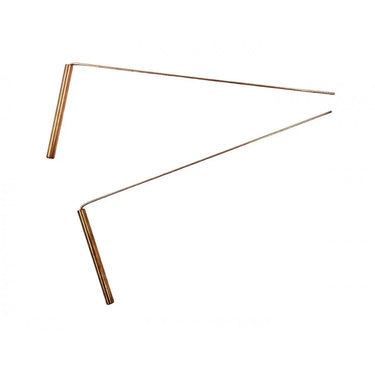
Copper Dowsing Rods 30cm • Pair with Free-Spinning Handles for Water Divining, Ley Lines & Energy Exploration

This pair of copper dowsing rods is designed for smooth, responsive movement during water divining, land exploration and personal energy work. Each rod sits within a free-spinning copper handle, helping it move with minimal resistance as the user walks, observes and works with a chosen intention.

Dowsing rods have traditionally been used to search for underground water, investigate land and explore places believed to hold stronger energetic activity. They are also popular in modern spiritual practice for ley line work, space clearing and intuitive investigation.

Copper is valued for its conductive nature and traditional connection with energy work. The rods are suitable for beginners as well as experienced dowsers, offering a simple, practical tool for learning how subtle movement, focus and observation interact.

Product Details:

  • Product: Copper Dowsing Rods
  • Sold: As a pair
  • Material: Copper
  • Design: L-shaped rods with free-spinning handles
  • Approximate rod length: 30cm
  • Approximate size: 30cm × 12cm
  • Batch variation: Rod length may vary approximately 25–35cm
  • Approximate weight: 160g per pair
  • Origin: UK
  • Common uses: Water divining, ley line exploration, land investigation, space clearing and intuitive practice
  • Other size available: 15cm version sold separately
  • Natural variation: Slight differences in bend angle, finish and exact length may occur

Traditional Water Divining

Dowsing rods are best known for their traditional use in searching for underground water.

The practitioner holds one rod in each hand and walks slowly across an area while keeping the rods level and free to move. Crossing, opening, dipping or twitching may then be interpreted as a response.

Traditional dowsers may use them when exploring:

  • possible underground water routes
  • wells and springs
  • changes in soil or land conditions
  • boundaries and pathways
  • areas of personal or environmental interest

Dowsing is a traditional practice rather than a scientifically reliable method of locating water, so any findings should be confirmed using appropriate practical survey methods.

Ley Lines & Earth Energy

Ley lines are commonly described in spiritual and earth-energy traditions as alignments connecting ancient sites, landmarks or places of sacred importance.

Some practitioners use dowsing rods to explore where these lines may cross or where the atmosphere of a location feels different. The rods can provide a physical focus while moving slowly through the landscape and observing subtle changes.

They may be used around:

  • stone circles
  • ancient paths
  • churches and sacred sites
  • gardens
  • homes
  • meditation spaces
  • places used for land-based ritual

Beliefs about ley lines vary widely, and their existence as measurable energy pathways has not been scientifically established.

Why Copper?

Copper has long been used in spiritual, practical and decorative tools because of its conductivity and ease of movement.

In dowsing practice, users often value copper for its lightness, responsiveness and traditional feel. The free-spinning handles reduce drag from the hands, allowing the rods to turn more easily.

The copper may naturally darken or develop a patina over time. This is a normal response to air, moisture and handling and does not usually affect use.

How to Use the Rods

Hold one rod in each hand by the spinning handles.

Keep your elbows relaxed and close to the body. Allow the rods to point forwards, level with one another.

Use a light grip so the handles can rotate freely.

Before beginning, choose one clear intention, such as locating a possible water route or observing changes within a particular space.

Walk slowly and notice how the rods move. Common responses may include:

  • crossing inward
  • opening outward
  • dipping
  • twitching
  • remaining steady

Decide in advance what each response will mean for your own session. This helps create a more consistent practice.

Understanding Rod Movement

Dowsing rods can move through very small, often unconscious changes in hand and body position. This is sometimes described as the ideomotor effect, where expectation or attention produces subtle movement without deliberate action.

For this reason, the rods are best used as tools for exploration and reflection rather than unquestioned proof.

A calm and neutral approach is helpful. Avoid trying to force a result, repeating the same question until the rods give the answer you prefer, or relying on them for decisions requiring professional evidence.

A Simple Practice for Beginners

Stand in a quiet, open area with the rods held level.

Take three slow breaths and allow your hands to settle.

Ask the rods to show you a neutral position.

Then decide what crossing and opening will mean for the session.

Walk slowly in a straight line and observe any changes without immediately interpreting them.

Repeat the exercise in a second direction and compare the movement. Keeping notes can help you recognise patterns over time.

Space Clearing & Personal Ritual

Some people use dowsing rods before meditation, Reiki or altar work to explore how a room feels.

You may walk around the edge of the space and observe where the rods move more strongly, then use those points as a focus for cleaning, ventilation, sound, incense or simple intention.

The rods may also be used when:

  • planning an altar position
  • exploring a garden
  • checking the atmosphere of a treatment room
  • marking areas for meditation
  • carrying out symbolic land work
  • These uses are personal and spiritual rather than scientifically verified.

Bend Angle & Handmade Variation

The exact bend angle of the rods may vary slightly between pairs.

This does not prevent the handles from rotating or the rods from moving during use. Dowsing rods have historically been made from many materials and in many different shapes, so small design differences are normal.

Batch-to-batch variation may also occur in:

  • total length
  • handle size
  • copper tone
  • surface finish
  • weight
  • bend position

These differences are part of the practical handmade character of the rods.

Quick FAQs

What are copper dowsing rods used for?

They are commonly used for traditional water divining, ley line exploration, land investigation and personal energy work.

How do the handles work?

The rods sit inside free-spinning copper handles, allowing them to rotate with minimal resistance.

Are they suitable for beginners?

Yes. Their simple design makes them suitable for learning basic dowsing technique.

Does the bend angle matter?

Slight variation in the angle is normal and should not affect the rods’ ability to move freely.

Are ley lines scientifically proven?

No. Ley lines belong mainly to spiritual, historical and earth-energy traditions and are not established as measurable energy pathways.

Can the rods reliably locate water?

Dowsing has a long history, but it should not replace geological surveys, professional testing or practical investigation.

What size are these rods?

They are sold as the 30cm version, although batch length may vary approximately from 25–35cm.

Are smaller rods available?

Yes. A 15cm version is also available separately.

Care & Safety

Wipe the rods with a soft, dry cloth after use.

Keep them dry to reduce tarnishing. Copper may naturally darken over time, and a suitable copper cloth can be used if a brighter finish is preferred.

Store the rods flat or upright where they will not become bent.

Keep away from babies and young children. The pointed ends may cause injury if handled carelessly.

Do not use near live electrical equipment, exposed wiring, roads or other hazardous areas.

Disclaimer

Dowsing is a traditional and spiritual practice. Rod movement may be influenced by subtle unconscious hand movements and should not be treated as scientific proof or used in place of professional surveying, engineering, medical, legal or safety advice.

Orders & Shipping
Orders placed before 3:00pm are processed and shipped the same day. We ship worldwide.

Tracking Information
Please monitor your parcel using the tracking details provided in your shipping confirmation email. Tracking is usually updated within 24 hours of dispatch and continues until delivery is confirmed.

Duties & Taxes
EU and international duties and taxes are the responsibility of the customer and must be paid locally where applicable. For non-UK customers, UK tax is automatically removed at checkout once the shipping destination is selected.

Customs Delays
Some international orders may be delayed due to customs checks, which are outside our control. Delays may be longer during busy periods.

Returns
For orders that qualified for free delivery, returned items may be subject to the original shipping fee and any collection costs.

Refused or Cancelled International Orders
International orders that are refused, returned, and then cancelled may be subject to a 10% surcharge. Parcels can be re-shipped on request, although an additional charge may apply.