What Is Pyrite?
Pyrite is a naturally occurring iron sulphide mineral with the chemical formula FeS₂.
Its metallic lustre and brass-yellow colour have caused it to be mistaken for gold throughout history, giving rise to the familiar nickname Fool’s Gold.
Unlike gold, Pyrite commonly forms highly geometric crystals, including cubes, pyritohedrons and other sharply defined forms. This natural tendency towards symmetry is one of the reasons Pyrite cube specimens are particularly popular with mineral collectors.
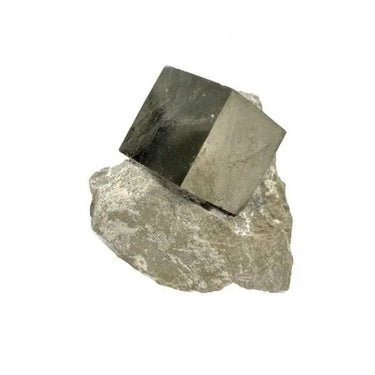
A Pyrite cube on matrix refers to naturally crystallised Pyrite remaining attached to the surrounding rock or mineral material in which it formed.
Pyrite Meaning
Within modern metaphysical and crystal traditions, Pyrite is commonly associated with confidence, personal power, determination, protection and abundance.
Its strong metallic appearance and natural cubic geometry have contributed to its reputation as a stone of structure, strength and focused intention.
These meanings are symbolic and spiritual associations rather than scientifically established effects.
Protection & Personal Boundaries
Pyrite has long been used symbolically as a protective stone.
In contemporary crystal practice, it may be chosen as a reminder of confidence, personal boundaries and resilience when dealing with challenging environments or situations.
Some people place Pyrite near a doorway, desk or workspace as part of a protection-themed arrangement.
Any protective effect should be understood symbolically rather than as a guaranteed physical or supernatural shield.
Abundance, Prosperity & Motivation
Pyrite is one of the best-known crystals associated with abundance and prosperity in modern crystal practice.
Its gold-like colour naturally lends itself to themes of wealth, opportunity, confidence and success.
For this reason, it is commonly included in:
- prosperity-themed crystal grids
- business or workspace displays
- abundance altars
- intention-setting practices
- goal-focused meditation
Pyrite does not guarantee financial gain, but it may be used as a symbolic reminder of ambition, resourcefulness and focused action.
Confidence, Willpower & Personal Power
Pyrite is also commonly associated with courage, determination and personal power.
Its strong cubic structure makes it an appealing symbolic stone for themes of discipline, organisation and staying focused on a goal.
Some practitioners use Pyrite during meditation or intention work when exploring confidence, motivation or assertiveness.
Pyrite & the Solar Plexus Chakra
Pyrite is most commonly associated with the Solar Plexus Chakra, or Manipura, within modern chakra-based crystal practice.
The Solar Plexus is traditionally linked with themes such as:
- confidence
- self-belief
- motivation
- personal power
- decision-making
- purposeful action
Pyrite may be placed nearby during meditation or incorporated into a crystal grid centred on these themes.
This chakra association is symbolic and comes from modern metaphysical practice rather than medical science.
Pyrite, Grounding & the Earth Element
Pyrite is frequently associated with the Earth element because it is a dense metallic mineral formed within the Earth.
In symbolic elemental systems, Earth may represent stability, grounding, structure, practicality and connection with the physical world.
Its cubic crystal habit also reinforces this sense of order and structure.
Some modern practitioners additionally associate Pyrite with Fire because of its reflective golden colour and links with confidence and action.
Higher Self & Spiritual Reflection
Some contemporary crystal practitioners use Pyrite during meditation or reflective work connected with self-awareness, discernment and personal direction.
The idea of the “higher self” is interpreted differently between spiritual traditions, but broadly it may refer to reflection on values, purpose and deeper personal awareness.
Pyrite can be incorporated into this type of practice as a symbolic focus rather than as a crystal that literally produces insight or spiritual communication.
Pyrite Healing Crystal
Pyrite is frequently sold and discussed as a healing crystal within metaphysical and crystal-therapy communities.
Traditional and contemporary claims may link it with energy, vitality, memory, emotional balance or physical wellbeing.
These claims are not scientifically established.
For Sacred Essence purposes, “healing crystal” describes the metaphysical category and traditional spiritual use of the stone rather than a medical effect.
Meditation, Crystal Grids & Everyday Use
Because of its distinctive appearance and compact size, a Pyrite cube matrix can be used in several ways.
It may be:
- displayed with a mineral or crystal collection
- placed on a desk or workspace
- added to a protection or abundance crystal grid
- positioned on an altar
- held nearby during meditation
- used as a symbolic focus for confidence or goal setting
Because these specimens may have rough or sharp crystal edges, they are better suited to display and intentional handling than carrying loose in a pocket.
Natural Pyrite Character
Pyrite is a naturally occurring mineral, so no two specimens will look identical.
Variation may include:
- cube size and number
- sharpness of crystal faces
- metallic lustre
- brass-gold or grey-gold colouring
- amount of visible matrix
- small natural fractures
- irregular edges
- surface markings
These natural features form part of the specimen's character and are not considered faults.
Care
Pyrite is best kept dry.
Avoid prolonged soaking, salt water, acids and harsh chemical cleaners. Moisture can encourage surface alteration or tarnishing over time.
For routine care:
- dust gently with a soft dry brush or cloth
- keep in a dry location
- avoid prolonged damp or humid conditions
- do not use chemical jewellery cleaners
- handle carefully around natural sharp edges
If used in crystal layouts, place it on a stable surface where the matrix cannot scratch delicate furniture.
Quick FAQs
What is Pyrite?
Pyrite is a natural iron sulphide mineral with the chemical formula FeS₂.
Why is Pyrite called Fool’s Gold?
Its metallic brass-gold colour historically caused it to be mistaken for genuine gold.
Is the cube shape natural?
Yes. Pyrite naturally forms cubic crystals because of its internal crystal structure.
What does “cube on matrix” mean?
It means the cubic Pyrite crystal remains attached to or embedded within the surrounding natural mineral or rock matrix.
Will my specimen look exactly like the photograph?
No. Cube size, matrix shape, colour, lustre and overall formation vary naturally.
How large is each piece?
Approximately 3–6cm, with a weight of up to 30g.
Which chakra is Pyrite associated with?
Most commonly the Solar Plexus Chakra in modern crystal practice.
Is Pyrite associated with abundance?
Yes, abundance and prosperity are among its best-known modern metaphysical associations, although it does not guarantee financial results.
Is Pyrite a protection crystal?
It is widely used symbolically as a protection stone in crystal and metaphysical practice.
Can Pyrite go in water?
Brief accidental contact is unlikely to be an issue, but prolonged soaking is best avoided. Keep Pyrite dry for long-term care.
Is Pyrite safe to carry in a pocket?
A matrix specimen may have rough or sharp edges, so it is generally better suited to display than loose pocket use.
NB
Each specimen is naturally formed and individually different.
Cube definition, crystal size, matrix shape, metallic colouring, markings and surface texture will vary from piece to piece.
Natural fractures, rough edges and irregular matrix formations are part of the character of the mineral.
Please Note / Disclaimer
Crystal meanings and chakra associations are based on traditional and modern metaphysical beliefs.
References to protection, abundance, prosperity, confidence, motivation, higher-self work, grounding or energetic balance describe symbolic and spiritual associations only and do not guarantee particular outcomes.
“Healing crystal” is used in the metaphysical sense and does not imply medical efficacy.
Crystals should not be used as a substitute for professional medical, psychological or financial advice.





 Pyrite Crystal Cube Matrix 3–6cm - Fool’s Gold Healing Crystal - Protection & Abundance
£18.00
/
Pyrite Crystal Cube Matrix 3–6cm - Fool’s Gold Healing Crystal - Protection & Abundance
£18.00
/