Tibetan Prayer Flags, Lungta & the Wind Horse Tradition
What Are Tibetan Prayer Flags?
Tibetan prayer flags are coloured pieces of cloth printed with sacred texts, mantras, prayers and symbolic imagery.
They are traditionally hung in exposed places where wind can pass through and around them.
Within Tibetan Buddhist culture, the flags are connected with ideas of:
prayer • auspiciousness • compassion • vitality • interdependence • impermanence
Their significance comes from the relationship between the printed cloth, the surrounding landscape and the movement of air.
They are therefore much more than colourful bunting.
Lungta — The Wind Horse
Lungta is commonly translated as Wind Horse.
It is an important symbol within Tibetan cultural and religious traditions, associated with vitality, good fortune, confidence and the uplifting of circumstances.
The image combines two powerful ideas.
The horse suggests strength, movement and grounded energy.
Wind suggests motion, openness and the ability to travel beyond boundaries.
Together they create the image of something strong enough to carry aspiration forward.
Is Lungta the Name for All Tibetan Prayer Flags?
Not quite.
Prayer flags encompass a wider Tibetan tradition, while Lungta specifically refers to the Wind Horse symbolismfrequently printed upon them.
The terms are often used together commercially because Wind Horse designs are among the most recognisable forms of Tibetan prayer flag.
This set is therefore best understood as Tibetan prayer flags featuring the traditional Lungta Wind Horse tradition.
The Five Sacred Colours
The familiar sequence is:
Blue • White • Red • Green • Yellow
These colours are commonly connected with a five-element system:
- Blue: sky or space
- White: air or wind
- Red: fire
- Green: water
- Yellow: earth
No single colour stands alone.
Together, the five create an image of balance and interdependence.
Five Colours, One Whole
The power of the colour sequence comes from relationship.
Sky contains the movement of wind.
Water meets earth.
Fire transforms.
Nothing exists entirely by itself.
Hung together, the flags form a constantly changing field of colour — almost a moving meditation on interconnectedness.
Mantras, Prayers & Sacred Imagery
Prayer flags may be printed with mantras, invocations, sacred syllables and symbolic images.
The precise texts can vary between designs and manufacturers.
For that reason, unless the Tibetan script on a particular batch has been individually translated and verified, it is better not to claim one specific mantra.
What can be said with confidence is that the printed texts and symbols belong within a tradition of prayer, auspicious intention and benefit for beings.
What Happens When the Wind Moves the Flags?
The popular image of prayers being "carried on the wind" expresses the tradition beautifully.
It should not necessarily be understood as the fabric mechanically releasing a substance or power.
Rather, the movement of the flags symbolises prayer and beneficial intention extending beyond the individual.
The cloth moves.
The landscape receives it.
The prayer is no longer confined to one place.
The Five-Metre Format
At approximately five metres long, this version creates a more substantial display than the smaller 3-metre set.
The larger 14 × 18cm flags are easier to appreciate from a distance and create more visual movement outdoors.
This makes the set particularly suited to:
- larger gardens
- longer balcony runs
- pathways
- meditation gardens
- retreat spaces
- yoga studios
- shrine areas
- sheltered courtyards
The larger format also allows the printed imagery to remain visually present when the flags are hung higher.
Prayer Flags & Impermanence
Outdoor prayer flags inevitably change.
Sunlight softens their colours.
Rain marks the fabric.
Wind frays the edges.
Eventually, a bright new string becomes pale and weathered.
Within Buddhist thought, this natural change can serve as a reminder of impermanence.
Beauty does not depend on remaining new.
Sometimes the fading is part of the meaning.
Weathering Is Part of Their Life
It is tempting to think a faded prayer flag has failed.
Within the traditional symbolism, the opposite can be true.
The gradual transformation of the cloth makes visible something that is happening everywhere all the time: forms change.
A new set will eventually become old.
An old set will eventually be replaced.
The cycle continues.
Where to Hang Tibetan Prayer Flags
Prayer flags are traditionally placed where wind can move freely.
Suitable locations include:
- between trees
- along garden boundaries
- across balconies
- beneath sheltered outdoor structures
- around meditation areas
- near shrines
- across courtyards
- along paths
Make sure the string is securely supported and does not repeatedly catch against sharp branches, nails or rough surfaces.
Respectful Placement
Because the flags may carry sacred text and imagery, respectful placement is appropriate.
Traditionally, they are hung above ground rather than used where they will routinely be stepped on or dragged through mud.
A high, open position also allows the fabric to move freely.
Indoor Prayer Flags
Prayer flags can also be displayed indoors.
They work beautifully in:
- meditation rooms
- yoga studios
- therapy spaces
- home shrines
- spiritual study rooms
- retreat spaces
Indoors, their meaning does not disappear simply because there is less wind.
The colours, text and Wind Horse imagery still create a visual connection with the tradition.
Cotton & Polyester Prayer Flags
Historically, Tibetan and Himalayan prayer flags have been produced using natural fibres.
Modern prayer flags are also widely manufactured in polyester.
Each material behaves differently.
Cotton has a softer, more natural feel and will generally deteriorate more quickly outdoors.
Polyester is lightweight, dries quickly and normally withstands rain and damp conditions for longer.
This particular set is polyester.
Why Use Polyester Outdoors?
For the British climate in particular, polyester has a practical advantage.
Repeated rain and damp can deteriorate lightweight cotton quickly.
Polyester generally retains its structure for longer and dries more readily after rain.
That does not make it weatherproof forever.
Strong sunlight, wind and prolonged exposure will still gradually fade and fray the material.
Material Does Not Determine Spiritual Worth
It is best to avoid describing one material as spiritually "purer" or another as equally "potent".
The sacred significance of prayer flags belongs to the prayers, symbols, tradition and way they are approached — not to a guarantee attached to fibre composition.
For customers who prioritise natural or biodegradable materials, cotton may be preferable.
For customers who want longer outdoor durability, polyester is generally the more practical choice.
Losar & Auspicious Times
Prayer flags may be raised at meaningful or auspicious times within Tibetan communities.
Losar, the Tibetan New Year, is one well-known period associated with renewal and the hanging of new flags.
Practices differ between communities, monasteries and lineages, so there is no need for a customer to imitate a particular ceremonial calendar without context.
For personal use, flags may also be hung at a time that carries genuine significance.
When Should Prayer Flags Be Replaced?
There is no need to replace them at the first sign of fading.
Natural weathering is expected.
Replacement becomes more practical when the material is heavily torn, the string is failing or the flags can no longer remain safely hung.
Many people choose to hang new flags alongside or in place of older ones as part of a continuing cycle of renewal.
Respectfully Retiring Old Flags
Traditional approaches to old sacred texts and prayer flags may include ceremonial burning.
However, these flags are polyester and should not be burned.
Burning synthetic fibres can produce harmful smoke and fumes.
For a modern polyester set, a more appropriate approach is to remove the flags respectfully, keep them from being casually discarded where possible, and use suitable local textile recycling or waste facilities.
Respect can be maintained without creating an environmental or health hazard.
Prayer Flags & the Himalayan Landscape
Images of prayer flags stretched across mountain passes are closely associated with the Himalayan world.
Wind, altitude and landscape become part of their visual meaning.
At home, the setting may be very different.
A British garden is not a Himalayan pass.
But the essential image remains recognisable: cloth carrying sacred words while moving between earth and sky.
Not Simply a Personal Good-Luck Charm
Lungta is connected with fortune and vitality, but prayer flags should not be reduced to a charm intended to bring one owner wealth or guaranteed luck.
A central quality of the tradition is outward-looking.
The prayers are associated with benefit extending beyond oneself.
That makes them particularly suited to spaces dedicated to meditation, compassion or reflection.
Care & Outdoor Longevity
These polyester flags require little maintenance.
To help them last:
- hang where they can move without snagging
- secure both ends firmly
- avoid rough or sharp surfaces
- allow wet flags to dry naturally
- do not machine wash
- do not tumble dry
- avoid ironing printed sacred imagery
- expect natural fading outdoors
- bring them under cover during severe weather if you wish to prolong their life
Weathering is normal.
Quick FAQs
How long is this string of prayer flags?
Approximately 5 metres.
How large is each flag?
Approximately 14 × 18cm.
How many flags are included?
Approximately 25 or more, according to the supplied product information.
What does Lungta mean?
Lungta means Wind Horse and is associated within Tibetan tradition with vitality, auspiciousness and upliftment.
Are all prayer flags called Lungta?
Not strictly. Lungta refers specifically to Wind Horse symbolism commonly found on Tibetan prayer flags.
What colours are used?
Blue, white, red, green and yellow.
What do the five colours represent?
They are commonly associated with sky or space, air or wind, fire, water and earth.
What are the flags made from?
Polyester.
Where are they made?
They are described as handmade in Nepal.
Can they be hung outdoors?
Yes. They are particularly suited to places where air can move through them.
Are they weatherproof?
Polyester provides useful outdoor durability, but no lightweight prayer flag is permanently weatherproof. Sun, rain and wind will eventually cause fading and wear.
Can they be displayed indoors?
Yes. They can be used in meditation rooms, yoga spaces, shrines and other contemplative settings.
Should prayer flags touch the ground?
Traditionally, flags carrying sacred text are treated respectfully, so allowing them to drag on the ground is generally avoided.
Why do prayer flags fade?
Weathering is natural and can also serve as a visible reminder of the Buddhist teaching of impermanence.
Should old flags be burned?
Traditional disposal practices may include burning natural-fibre prayer flags, but this polyester set should not be burned because synthetic material can release harmful fumes.
Are prayer flags intended to bring good luck only to the owner?
No. Although Lungta is associated with auspiciousness and good fortune, prayer flags traditionally carry a broader wish for benefit and wellbeing extending beyond the individual.
Please Note
Tibetan prayer flags belong to a living Tibetan Buddhist and Himalayan cultural tradition. Specific prayers, symbolism, hanging customs and renewal practices can vary between communities and lineages.
These flags should not be understood as guaranteeing healing, fortune or spiritual outcomes. Their deeper significance lies in prayer, aspiration, sacred symbolism and respectful intention.
As they move and gradually weather, they offer a simple but powerful image: nothing is held forever, and a prayer need not remain only with the person who first made it.

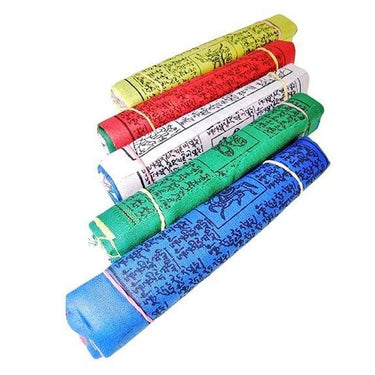

 Tibetan Prayer Flags 5m - Lungta Wind Horse - 14cm × 18cm Flags
£7.00
/