Chacana • The Andean Cross
The Chacana is a stepped-cross symbol strongly associated with the Andes and is commonly known today as the Andean Cross or Inca Cross.
Its balanced geometric form has become associated with ideas of:
- connection
- balance
- order
- integration
- relationship between different realms
- Earth and cosmos
- cycles and direction
- wholeness
Interpretations vary, and not every meaning now attached to the Chacana can be treated as a single unchanged ancient doctrine.
For this rattle, its symbolism centres on connection and balance — bringing different aspects of experience into relationship rather than holding them apart.
Inca Cross Meaning
“Inca Cross” is one of the most commonly used English names for the Chacana.
The symbol is closely associated with the cultural landscape of the Andes and is often used today to represent an ordered relationship between human life, the natural world and the cosmos.
Its stepped geometry gives it a sense of movement between levels rather than a simple flat cross.
That makes the Chacana particularly meaningful as a symbol of integration: different worlds, directions or stages remaining distinct while still forming part of one whole.
Chacana & the Three Worlds
A common contemporary interpretation connects the Chacana with the three-part Andean cosmological framework:
- Hanan Pacha — the Upper World
- Kay Pacha — the Middle or present world
- Ukhu Pacha — the Inner or Lower World
Within that framework, the Chacana may be approached as a symbol of relationship between different levels of existence.
These ideas belong specifically to Andean cosmological traditions and should not be presented as one universal Shipibo or Amazonian belief.
The rattle itself is Shipibo-made; the Chacana design carries Andean symbolism.
Balance & Sacred Order
The Chacana’s structured geometry gives it a very different character from the animal symbols in this Shipibo collection.
Serpent speaks of grounding and renewal.
Jaguar speaks of instinct, presence and transformation.
Hummingbird speaks of journey and resilience.
Eagle / Condor speaks of wider perspective.
Chacana draws those ideas towards relationship and integration.
Rather than representing one creature or force, it can symbolically ask:
How do the different parts belong together?
For personal ritual, that may make the Chacana especially meaningful during periods of:
- rebalancing
- transition
- decision-making
- integration
- seeking direction
- bringing different aspects of life together
- reconnecting with a sense of order
- reflection on one's place within a larger whole
Sacred Geometry
The stepped form of the Chacana has made it a powerful example of Andean sacred geometry in contemporary spiritual interpretation.
Its repeated levels, equal organisation and central form can evoke:
- orientation
- structure
- relationship
- centre and direction
- movement between levels
- balance between difference and unity
Sacred geometry here is symbolic language rather than a claim that the form itself produces an energetic or supernatural effect.
The Southern Cross Connection
The Chacana is sometimes associated in modern explanations with the Southern Cross constellation, and the name is frequently translated or interpreted through ideas of a “cross” or “bridge”.
These astronomical and linguistic interpretations vary, so it is better not to reduce the entire Chacana tradition to one fixed explanation.
What remains especially powerful is the relationship between the stepped cross, the Andean landscape, direction, orientation and the wider cosmos.
Llama & Andean Sky Symbolism
Your supplier material also associates the design with the Llama and the night sky.
Llama imagery has genuine importance within Andean culture and cosmology, including celestial traditions associated with the dark areas of the Milky Way.
That broader Andean sky symbolism can sit alongside the Chacana, but it should not be presented as though “Llama eyes” are universally recognised as the literal meaning of the Chacana itself.
This distinction keeps the symbolism rich without merging separate Andean traditions into one story.
Handmade Shipibo Gourd Rattle
This ceremonial rattle is formed from a natural dried gourd filled with jungle seeds and attached to a wooden handle.
Dyed blue thread, beads and feather details complete the piece.
The natural materials give each rattle its own individual voice.
Tone can vary according to:
- gourd size and thickness
- quantity and type of jungle seeds
- natural shell density
- shape
- handle construction
- individual craftsmanship
Some rattles may have a softer or deeper pulse, while others produce a brighter or more pronounced seed sound.
That variation is part of the character of a handmade Amazon rattle.
Amazon Craft & Andean Symbolism
This piece brings together two cultural elements that are related geographically but should remain distinct.
The rattle is handmade by Shipibo craftspeople of the Amazon.
The Chacana is an Andean symbol.
Presenting both accurately gives the piece greater meaning than simply calling all of its imagery “Amazonian”.
It is an Amazon-made ceremonial instrument carrying a symbol whose strongest cultural associations belong to the Andes.
Shamanic & Ceremonial Practice
A shamanic rattle is broadly understood today as a rhythmic instrument used within shamanic, ceremonial and journeying practice.
Rattles occur across many different cultures and there is no single universal shamanic rattle or ceremonial method.
Within contemporary practice, this Chacana rattle may be used for:
- shamanic journeying
- meditation
- ceremonial rhythm
- prayer
- altar work
- opening or closing ritual
- reflective sound practice
- transition rituals
- balance and integration intentions
- sacred-space preparation
A steady rhythm can provide an auditory focus during meditation or journeying.
The rattle itself does not guarantee healing, cleansing, protection, altered states or spiritual outcomes.
Sound, Rhythm & Presence
Although compact, a natural gourd rattle can produce a clear and expressive rhythmic sound.
Played slowly, the jungle seeds create an earthy pulse suited to meditation and reflection.
With a more continuous movement, the rhythm can accompany journeying, ceremony or group sound work.
The natural gourd and seed filling mean every piece sounds slightly different.
That individuality is part of working with a handmade ceremonial instrument.
A Simple Chacana Balance Ritual
Hold the rattle quietly before beginning.
Consider an area of life where different needs, responsibilities or directions feel out of balance.
Begin with a slow, steady rhythm.
Rather than attempting to force all differences away, use the Chacana as a symbol of allowing separate parts to find relationship within a greater whole.
You might hold the intention:
“May I find the centre.
May I recognise what connects.
May balance emerge between the different parts.”
Continue for as long as feels appropriate.
Gradually slow the rhythm before bringing the practice to a close.
Why Choose a Chacana Rattle?
The Chacana has a particularly structured and integrative symbolism.
Where an animal design may embody qualities associated with a particular creature, the Andean Cross speaks more directly to relationship, orientation and the organisation of a whole.
It may therefore appeal especially to someone drawn to:
- Andean symbolism
- the Inca Cross
- sacred geometry
- balance
- integration
- the three-world cosmological model
- Earth and cosmos symbolism
- ceremonial rhythm
- meditation and personal ritual
What Is a Shamanic Rattle?
“Shamanic rattle” is a broad contemporary term used for rattles incorporated into shamanic, ceremonial and journeying practices.
Rattles occur within many distinct cultures, so there is no single universal shamanic rattle design or method.
Shipibo gourd rattles belong within specific Amazonian cultural contexts, while contemporary practitioners outside those traditions may use them differently.
This piece is therefore best approached as a handmade Shipibo ceremonial instrument carrying Chacana symbolism rather than as a representation of every Indigenous, Amazonian or Andean tradition.
Care
Keep the rattle dry and away from excessive or prolonged moisture.
Avoid dropping or striking the natural gourd against hard surfaces.
Store away from strong direct sunlight where possible to help preserve the dyed thread, beadwork and feather details.
Handle the decorative wrapping and feathers gently.
Quick FAQs
What is this Chacana rattle made from?
It is made from a natural dried gourd filled with jungle seeds and finished with a wooden handle, blue dyed thread, beads and feather details.
How large is the rattle?
The gourd is approximately 3–4", with a handle around 6–7" and an overall length around 10–12".
What is a Chacana?
The Chacana is a distinctive stepped-cross symbol strongly associated with the Andes and commonly called the Andean Cross or Inca Cross.
Is the Chacana the same as the Inca Cross?
“Inca Cross” is a widely used English name for the Chacana, although “Andean Cross” can be a broader and more culturally useful description.
What does the Chacana symbolise?
Contemporary interpretations commonly associate it with balance, connection, sacred order, integration and relationships between different levels of existence.
What is the meaning of the Andean Cross?
The Andean Cross is commonly interpreted through ideas of connection between human life, nature, the cosmos and different cosmological realms. Meanings vary between traditions and modern interpretations.
Does the Chacana represent three worlds?
It is frequently interpreted in relation to Hanan Pacha, Kay Pacha and Ukhu Pacha within Andean cosmological frameworks.
Is the Chacana a Shipibo symbol?
Its strongest cultural associations are Andean rather than specifically Shipibo. This rattle is handmade by Shipibo artisans and decorated with a Chacana design.
Is the Chacana a medicine wheel?
No. “Medicine Wheel” belongs to distinct Indigenous North American contexts and is not an appropriate generic name for the Chacana.
Is the Chacana connected with the Southern Cross?
The Chacana is sometimes associated with the Southern Cross in contemporary explanations of Andean symbolism, although interpretations vary and the symbol should not be reduced to a single astronomical explanation.
Who makes this rattle?
It is handmade by Shipibo artisans in the Amazon.
Where does the rattle come from?
Its origin is the Peruvian & Bolivian Amazon.
Is this an Amazon rattle?
Yes. It is a handmade Amazon gourd rattle crafted by Shipibo artisans.
Is this a shamanic rattle?
Yes. It is suitable for contemporary shamanic, ceremonial, journeying and meditation practice.
Can it be used as a ceremonial rattle?
Yes. Its natural gourd rhythm and Chacana symbolism make it suitable for personal ceremonial, meditative and ritual practice.
What does the rattle sound like?
It has a natural jungle-seed-filled gourd sound. Tone and intensity vary between individual handmade pieces.
Will every rattle look identical?
No. Gourd shape, blue thread, beadwork, feather details, colour, tone and finish will vary naturally.
NB:
As this item is made from natural gourd and individually finished by hand, slight variations in colour, thread, bead detail, feather detail, shape, size, sound and finish are to be expected. These natural and handcrafted differences give each piece its own character and are not considered faults.
Please Note
The Chacana is primarily associated with Andean cultural and cosmological traditions rather than being one universal Shipibo or Amazonian symbol.
Modern explanations of the Chacana vary, particularly around its precise relationship with the Southern Cross, sacred geometry and different cosmological systems.
References to balance, integration, sacred space, journeying and spiritual connection describe symbolic or contemporary spiritual interpretations rather than guaranteed physical, psychological, energetic or supernatural effects.


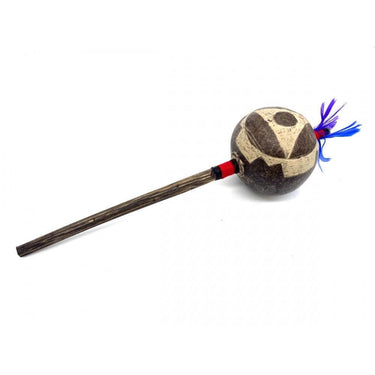

 Shipibo Chacana (Inca Cross) Gourd Rattle 3" Medium Blue - Amazon Shamanic Rattle
£21.95
/
Shipibo Chacana (Inca Cross) Gourd Rattle 3" Medium Blue - Amazon Shamanic Rattle
£21.95
/