The Meaning of Ishana
The name Ishana comes from the Sanskrit Īśāna.
Within Hindu tradition, Ishana is associated with Shiva and with ideas of spiritual authority, awareness and sacred orientation. The name is also connected with the north-east direction in some Indian cosmological and architectural traditions.
For this singing bowl, the name works beautifully as a symbolic identity rather than as a claim that “Ishana” is a historic category of Tibetan singing bowl.
It reflects the bowl's contemplative character: an instrument centred on listening, awareness and the movement from sound into silence.
Black & Gold • Grounding Meets Illumination
The colour and finish are among the strongest features of the Ishana bowl.
Its dark exterior has a quiet, almost inward-looking quality. Against that, the golden interior feels warmer and more radiant, drawing the eye naturally towards the centre.
Within contemporary symbolic interpretation, black may suggest depth, stillness, mystery, grounding and reflection, while gold is often associated with illumination, sacredness, warmth and spiritual aspiration.
Together, the two create a compelling visual balance:
grounding and illumination • stillness and resonance • inner depth and outward radiance
The contrast becomes particularly beautiful on an altar or in softer light, where the golden interior can glow against the darker outside surface.
A Distinctive Black & Gold Singing Bowl
Compared with a plain polished bowl, the Ishana has a stronger visual personality.
The darker outside feels earthy and understated, while the gold-toned inner surface immediately draws attention towards the bowl's centre.
Hand-beaten markings and natural variation prevent the finish from feeling overly manufactured. Each piece retains subtle irregularities in tone, texture and form, giving it a more soulful artisan character.
That makes the Ishana equally appealing as a working meditation instrument and as a meaningful object within a sacred or contemplative space.
Hand-Beaten Character & Sound
Each bowl is individually shaped and finished by hand.
Rather than being completely uniform, the surface may carry small hammer marks, slight irregularities around the rim and individual tonal characteristics.
These differences are part of the appeal.
At 10–11cm, the bowl tends to produce a relatively bright, responsive tone compared with larger singing bowls, but its weight gives the sound enough body to feel warm and satisfying.
The resonance can be explored through either a gentle strike or by circling the rim with the supplied striker.
How to Play the Ishana Singing Bowl
Rest the bowl lightly on your open palm or on a suitable cushion so the sides remain free to vibrate.
Gently strike the outer rim and allow the note to open and fade naturally.
For a sustained singing tone, move the striker slowly around the outside of the rim using smooth, even pressure.
There is no need to force the sound. Smaller bowls often respond better to patience, consistency and a lighter hand.
Part of the pleasure lies in learning how your individual bowl responds.
The Included Striker
A striker or beater is supplied with the bowl, although the exact design may vary.
Wood tends to create a clearer, brighter initial note, while softer surfaces such as felt or velour generally produce a rounder and gentler response.
If the included striker offers two usable surfaces, both are worth exploring.
Subtle changes in contact, pressure and speed can reveal surprisingly different tonal qualities from the same bowl.
Meditation, Yoga & Mindful Listening
A singing bowl can give a meditation practice a simple beginning and end.
One clear note can mark the point where ordinary activity stops and attention turns inward.
Listening as that tone gradually disappears can become a meditation in itself — sound moving slowly back towards silence.
The Ishana can also be used before or after yoga, during breathwork, beside an altar or simply as a small sound instrument for moments of quiet attention throughout the day.
Sound Healing & Contemporary Wellbeing Practice
“Tibetan sound healing” and “singing bowl sound healing” are widely used terms for contemporary wellbeing practices involving resonance, vibration and attentive listening.
The Ishana bowl can be incorporated into those settings, as well as into chakra-focused or energy-based spiritual practice.
Its reliable qualities are its sound, tactile vibration and ability to provide a clear auditory focus.
Claims that the bowl directly clears energy fields, heals the body or produces specific psychological effects should instead be understood as spiritual or contemporary wellbeing beliefs rather than established medical effects.
Chakra & Spiritual Practice
Within modern chakra practice, smaller and brighter singing bowls are sometimes chosen for upper-chakra meditation because of their lighter tonal character.
This is not a fixed acoustic rule, and individual bowls are not tuned to a specific chakra unless explicitly measured and supplied as such.
The Ishana works particularly well where the intention is simply to bring sound, stillness and focused listening into a spiritual practice.
Its black-and-gold appearance also makes it a natural focal point for altar work and reflective ritual.
Sound, Stillness & the Ishana Character
What makes this bowl memorable is the relationship between its appearance and its sound.
The outside is dark and grounded.
The inside is luminous.
The first strike introduces movement and vibration.
Then, gradually, the bowl returns to silence.
There is something beautifully fitting in that contrast — the visible meeting of dark and gold mirrored by the audible meeting of sound and stillness.
That is where the Ishana earns its own identity within the Sacred Essence singing-bowl range.
A Compact Bowl with Strong Presence
Although only around 10–11cm in diameter, the Ishana does not feel insignificant.
Its 300–375g weight gives it a satisfying solidity, while the contrasting finish adds visual richness.
This makes it a lovely choice for personal meditation, smaller treatment spaces or anyone looking for a more distinctive alternative to a plain brass singing bowl.
It is also an approachable size for someone purchasing their first bowl.
Care
Wipe the bowl gently with a soft dry cloth after use.
Avoid abrasive pads, harsh chemical cleaners and prolonged moisture, as these may affect the contrasting surface finish.
Protect the rim from hard knocks and store the bowl somewhere dry.
If you use a cushion, make sure the bowl remains stable while still being free enough to resonate.
Quick FAQs
How large is the Ishana singing bowl?
Approximately 10–11cm in diameter and around 6–7cm high.
How much does it weigh?
Approximately 300–375g.
What does Ishana mean?
Ishana derives from Sanskrit Īśāna, a name associated with Shiva, spiritual authority and sacred orientation within Hindu tradition.
What makes the black-and-gold finish significant?
Visually, the dark exterior creates depth and grounding while the golden interior brings warmth and luminosity. Symbolically, some people may associate this with the meeting of stillness and illumination.
Is it handmade?
Yes. Each bowl is individually hand beaten and finished in India.
Does it include a striker?
Yes. A wooden or soft-ended striker is included, although exact style may vary.
What does it sound like?
The bowl produces a warm, clear tone with a sustained resonance. Because it is handmade, each bowl will have its own individual voice.
Is this a Tibetan singing bowl?
It is a Himalayan-style singing bowl handmade in India and associated with the wider Tibetan and Himalayan singing-bowl tradition.
Can it be used for sound healing?
Yes, it can be used within contemporary sound-healing and wellbeing practice. This should not be understood as a medical treatment or guaranteed therapeutic effect.
Is it tuned to a specific chakra or musical note?
No specific tuning has been supplied, so we would not claim a fixed chakra or musical note for this bowl.
Is a cushion included?
No. A cushion is not included.
NB
As this bowl is individually hand beaten and finished, slight variations in size, weight, surface texture, hammer markings, colour, rim shape, finish and tone are to be expected.
These handcrafted differences give each Ishana bowl its own individual character and are not considered faults.
Please Note / Disclaimer
The term Ishana is used here as the symbolic name of this particular bowl and should not be taken to mean that “Ishana singing bowl” is a distinct historic Tibetan bowl tradition.
References to chakras, sound healing, energy work, spiritual awareness, grounding or illumination describe traditional, symbolic or contemporary wellbeing practices.
This singing bowl is not intended to diagnose, treat or cure any medical or psychological condition.





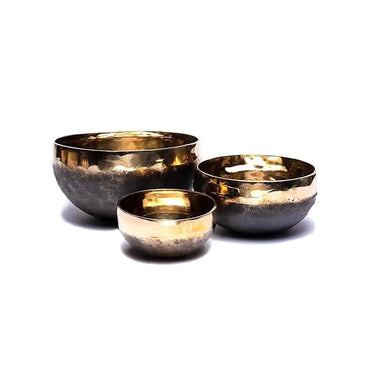


 Ishana Black & Gold Tibetan Singing Bowl 10–11cm - Hand-Beaten with Striker
£60.00
/
Ishana Black & Gold Tibetan Singing Bowl 10–11cm - Hand-Beaten with Striker
£60.00
/