Serpent Symbolism • Transformation, Renewal & Earth Wisdom
Serpent symbolism appears in cultures across the world, although its meaning differs considerably between traditions.
For this Shipibo rattle, the Serpent is approached through themes of:
- transformation
- renewal
- instinct
- grounding
- rebirth
- release
- embodied awareness
- Earth connection
- cycles of change
- quiet strength
The serpent’s ability to shed its skin offers one of its clearest symbolic associations.
What has become old is released.
The creature continues forward.
Because of this, the Serpent has become a natural image for change, renewal and the movement from one stage of life into another.
Snake Symbolism & Spiritual Meaning
“Snake symbolism” is a broader phrase, but it overlaps naturally with the spiritual meaning of the serpent.
In contemporary spiritual interpretation, snake spiritual meaning is often explored through themes such as:
- shedding an old identity
- renewal after change
- trusting instinct
- moving through transition
- reconnecting with the body
- grounding
- transformation
- beginning again
These are symbolic interpretations rather than fixed meanings shared by every culture.
For this rattle, the snake or serpent is not presented as a universal spiritual symbol. Instead, these themes offer a way of approaching its imagery within personal ceremonial or reflective practice.
Grounded Transformation
Unlike an Eagle or Condor that rises into the sky, the Serpent stays close to the ground.
That gives its symbolism a very different feeling.
Its movement can represent:
- staying connected with the Earth
- listening to instinct
- moving with awareness
- allowing transformation to unfold gradually
- remembering the body during spiritual practice
- staying rooted while something changes
Transformation does not always happen dramatically.
Sometimes it begins quietly, close to the ground, before anything is visible on the surface.
Shedding the Old
The image of a snake shedding its skin makes the Serpent especially suited to rituals around release and renewal.
It may be chosen during periods of:
- transition
- endings
- new beginnings
- personal growth
- changing identity
- releasing an old pattern
- moving beyond something completed
- consciously entering a new stage
The rattle does not create that transformation.
Its symbolism gives the practice a focus.
Serpent & Sachamama
Sachamama appears within Andean and Quechua-associated mythic traditions as a great serpent or snake-like being connected with Earth and landscape.
This makes Sachamama relevant to broader serpent symbolism in parts of the Andes.
It should not, however, be treated as simply another word for every serpent, nor as one universal Shipibo or Amazonian belief.
For this rattle, Sachamama is best understood as a related Andean serpent association rather than the sole meaning of the design.
Serpent & the Lower World
Within some Andean cosmological frameworks, serpent imagery is associated with the Lower World.
Symbolically, this realm can be connected with:
- Earth
- roots
- instinct
- body
- hidden processes
- deep memory
- transformation beneath the surface
This is one specific cosmological framework rather than a universal Indigenous interpretation.
The Serpent design can still be approached more broadly through grounding, renewal and transformation without requiring a particular cosmological belief.
Handmade Shipibo Gourd Rattle
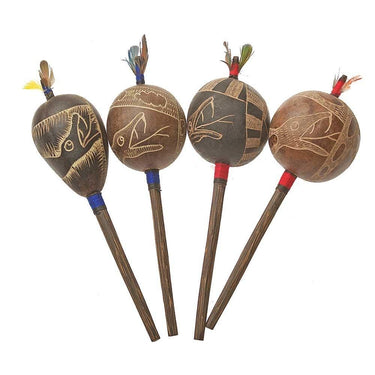
This ceremonial rattle is made from a dried natural gourd filled with jungle seeds and attached to a wooden handle.
Dyed blue thread, beads and feather details complete the piece.
The natural materials give each gourd rattle its own individual voice.
Tone can vary according to:
- gourd size and thickness
- type and quantity of jungle seeds
- shell density
- natural shape
- handle construction
- individual craftsmanship
Some rattles may sound softer or deeper, while others have a brighter or more pronounced seed movement.
That variation is part of the character of a handmade Amazon rattle.
Shamanic & Ceremonial Practice
A shamanic rattle is broadly understood today as a rhythmic instrument used within shamanic, ceremonial and journeying practice.
Rattles occur across many different cultures, so there is no single universal shamanic method or ceremonial rattle design.
Within contemporary practice, this Shipibo Serpent rattle may be used for:
- shamanic journeying
- meditation
- ceremonial rhythm
- prayer
- grounding
- sacred-space preparation
- opening or closing ritual
- transition ceremonies
- renewal intentions
- reflective sound practice
A steady rhythm can provide an auditory focus during meditation or journeying.
The instrument itself does not guarantee trance, healing, protection, cleansing or any particular spiritual outcome.
Sound, Rhythm & Presence
Although compact, a natural gourd rattle can produce a clear and expressive sound.
Played slowly, the jungle seeds create an earthy pulse suited to meditation, grounding and reflective practice.
A more continuous rhythm may be used during journeying, ceremony or group sound work.
The natural gourd and seed filling mean every piece sounds a little different.
That individuality is part of working with a handmade ceremonial instrument.
A Simple Serpent Renewal Ritual
Hold the rattle quietly before beginning.
Bring to mind something that feels complete — an old pattern, expectation, chapter or way of seeing yourself.
Begin with a slow, grounded rhythm.
Rather than trying to force something away, allow the Serpent symbolism to represent a natural shedding of what is ready to be released.
You might hold the intention:
“May I release what has completed.
May I remain grounded through change.
May I make space for renewal.”
Continue for as long as feels appropriate.
Gradually slow the rhythm when you are ready to close.
Why Choose a Serpent Rattle?
The Serpent carries a different symbolic quality from the other rattles in this Shipibo collection.
Hummingbird speaks of journey and resilience.
Jaguar speaks of instinct, presence and transformation.
Eagle / Condor speaks of wider perspective.
Serpent brings the focus back towards Earth, body, roots, renewal and the beginning of change.
For someone drawn to snake spiritual meaning, cycles of transformation or grounded ceremonial work, this design has a particularly earthy character.
What Is a Shamanic Rattle?
“Shamanic rattle” is a broad contemporary term used for rattles incorporated into shamanic, ceremonial and journeying practices.
Rattles appear in many distinct cultures and traditions, and there is no single universal shamanic rattle or method of use.
Shipibo gourd rattles belong within specific Amazonian cultural contexts, while contemporary practitioners outside those traditions may work with them differently.
This piece is therefore best approached as a handmade Shipibo ceremonial instrument rather than as a representation of every Indigenous or Amazonian tradition.
Care
Keep the rattle dry and away from excessive or prolonged moisture.
Avoid dropping or striking the natural gourd against hard surfaces.
Store away from strong direct sunlight where possible to help preserve the dyed thread, beads and feather details.
Handle decorative feathers and wrapping gently.
Quick FAQs
What is this Serpent rattle made from?
It is made from a natural dried gourd filled with jungle seeds and finished with a wooden handle, dyed blue thread, beads and feather details.
How large is the rattle?
The gourd is approximately 3–4", with a handle around 6–7" and an overall length around 10–12". Natural handmade variation of around ±10% should be expected.
What does the Serpent symbol represent?
In this design, the Serpent represents transformation, renewal, instinct, grounding, Earth connection and the shedding of old cycles.
What is serpent symbolism?
Serpent symbolism varies between cultures. Common themes include transformation, renewal, rebirth, instinct, Earth connection and cyclical change.
What does snake symbolism mean spiritually?
Snake spiritual meaning is often associated in contemporary practice with shedding old layers, transformation, instinct, grounding, renewal and beginning again. These are symbolic interpretations rather than one universal cultural meaning.
Is snake symbolism the same as serpent symbolism?
They overlap, but “serpent” is often used more deliberately in mythic, ceremonial and spiritual contexts, while “snake” is the broader everyday term.
Why is the snake associated with transformation?
Its natural shedding of skin provides a powerful visual symbol of releasing an old layer and continuing forward renewed.
What is Sachamama?
Sachamama is a great serpent or snake-like figure found in Andean and Quechua-associated mythic traditions. It is connected with Earth and landscape symbolism but should not be treated as a universal Shipibo serpent meaning.
Is the Serpent connected with the Lower World?
Within some Andean cosmological frameworks, serpent imagery is associated with the Lower World and themes of Earth, roots, instinct and transformation.
Does the Serpent guarantee spiritual protection?
No. Protection may appear as a symbolic association in some traditions, but the rattle does not guarantee protection or any other spiritual result.
Who makes the rattle?
It is handmade by Shipibo artisans in the Amazon.
Where does the rattle come from?
Its origin is the Peruvian & Bolivian Amazon.
Is this an Amazon rattle?
Yes. It is a handmade Shipibo gourd rattle originating from the Peruvian & Bolivian Amazon.
Is this a shamanic rattle?
Yes. It is suitable for contemporary shamanic, ceremonial, journeying and meditation practice.
Can it be used as a ceremonial rattle?
Yes. Its natural gourd sound and Serpent symbolism make it suitable for personal ceremonial and ritual practice.
What does the rattle sound like?
It has a natural seed-filled gourd sound. Tone and intensity vary between individual handmade pieces.
Will my rattle look exactly like the photograph?
No. Natural gourd shape, blue thread, beadwork, feather details, colour and finish will vary slightly.
NB:
As this item is made from natural gourd and individually finished by hand, slight variations in colour, thread, bead detail, feather detail, shape, size, sound and finish are to be expected. These natural and handcrafted differences give each piece its own character and are not considered faults.
Please Note
Serpent and snake symbolism differs significantly between cultures and traditions.
References to Sachamama and Lower World symbolism relate to specific Andean and Quechua-associated frameworks and should not be presented as one universal Shipibo, Amazonian or Indigenous belief.
References to transformation, renewal, protection, grounding, journeying, energy work and sacred space describe symbolic or contemporary spiritual use rather than guaranteed physical, psychological, energetic or supernatural effects.




 Shipibo Serpent Gourd Rattle 3" Medium Blue - Grounding - Amazon Shamanic Rattle
£21.95
/
Shipibo Serpent Gourd Rattle 3" Medium Blue - Grounding - Amazon Shamanic Rattle
£21.95
/