



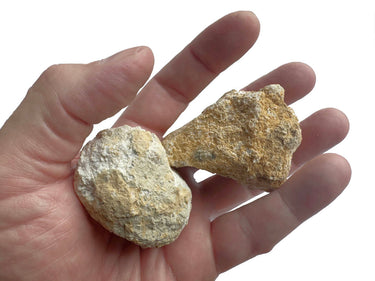
Calcite & Quartz Geode 4–8cm Uncracked – Natural Break-Open Crystal

Discover what is hidden inside a natural uncracked geode, supplied whole and unopened for you to keep intact or carefully break open yourself.

These geodes vary naturally in shape and size, typically measuring around 4–8cm. You can choose between two weight options — up to 150g or up to 180g — depending on the size and presence you prefer.

Most contain Calcite, while some may reveal Quartz or a combination of natural mineral growth. Because the interior cannot be seen before opening, the crystal type, colour, cavity and formation remain part of the surprise.

Product Details:

  • Product: Calcite & Quartz Uncracked Geode
  • Choose size: Up to 150g / Up to 180g
  • Approx. size range: 4–8cm
  • Mineral content: Mainly Calcite; some may contain Quartz
  • Possible composition: Calcite – calcium carbonate (CaCO₃) / Quartz – silicon dioxide (SiO₂)
  • Condition: Whole and unopened
  • Exterior: Natural rough stone shell
  • Interior: Hidden crystal cavity or mineral formation
  • Colour: Naturally variable
  • Uses: Mineral collecting, display, gifting or opening at home
  • Sold as: One uncracked geode in your selected weight option

NB: These are natural geodes, so the dimensions do not correspond to an exact fixed weight. Both variants may fall within the approximate 4–8cm size range, with natural differences in shape, density and shell thickness.

The exact mineral, crystal colour, cavity size and formation cannot be confirmed until the geode is opened.

Choose Your Geode Size

The geodes are available in two weight-based variants.

Up to 150g
A smaller/lighter option within the natural 4–8cm range, suitable for gifting, first-time geode opening or a compact mineral collection.

Up to 180g
A slightly heavier option for those wanting a more substantial natural specimen and potentially a larger overall form.

Because these are natural stones, weight does not guarantee a particular cavity size or crystal formation. A heavier geode may simply have a thicker or denser outer shell.

What You May Find Inside

Most pieces in this batch are expected to contain Calcite, although some may reveal Quartz.

Calcite commonly appears white, cream, pale honey or softly translucent. Quartz may appear milky white, clear or more glass-like with sharper crystal points.

Some geodes may contain characteristics of both minerals, while others may have a smaller cavity or a more compact interior.

That natural uncertainty is part of the appeal of opening an uncracked geode.

Keep It Whole or Open It

You do not have to break the geode.

It can be kept intact as a natural mineral specimen, or you can open it yourself to reveal the formation hidden within.

If the stone separates into two larger sections, the resulting pieces naturally correspond because they came from the same original geode.

More About Your Natural Geode

A geode forms when minerals gradually develop inside a cavity within rock.

From the outside, there may be very little indication of what has formed within. Once opened, the contrast between the rough exterior and crystalline interior can be striking.

The internal formation may be densely crystallised, partly hollow or contain only a small cavity. Crystal size, density and colour can also vary considerably.

No two geodes will produce exactly the same result.

Calcite & Quartz – What Is the Difference?

Because these geodes may contain either Calcite or Quartz, it helps to understand how the two minerals differ.

Calcite is calcium carbonate, CaCO₃. It often appears white, cream, honey-toned or softly translucent and may form layered, clustered or blockier crystal shapes.

Quartz is silicon dioxide, SiO₂. It is generally harder and may appear clearer, glassier or more sharply pointed.

A Calcite-rich interior may show soft creamy crystal growth, while a Quartz-rich geode may contain more defined points or sparkling druzy areas.

Some pieces may show characteristics of both.

Because each geode is unopened, the exact mineral cannot be confirmed before the stone is split.

Opening Your Geode

Part of the appeal of this product is the reveal.

If you decide to open the geode yourself, work on a stable, protected surface. Wrap the stone securely in a thick cloth or towel and wear suitable eye protection.

A small hammer and appropriate chisel can be used with light, controlled taps. Gradually working around the stone may help encourage a split.

Natural stone does not always fracture evenly. Your geode may divide into two larger halves, split unevenly or produce several smaller sections.

The final break pattern and crystal appearance cannot be guaranteed.

Calcite Meaning

Within contemporary crystal traditions, Calcite is commonly associated with clarity, balance, renewal and motivation.

Its lighter crystalline appearance is often linked symbolically with fresh perspective and positive movement.

These are traditional metaphysical associations rather than scientifically established properties.

Quartz Meaning

Quartz is commonly associated in contemporary crystal practice with clarity, focus, intention and amplification.

Clear and milky Quartz are widely collected for both their natural appearance and traditional spiritual symbolism.

These associations are symbolic rather than scientifically measurable effects.

Natural Variation

Every geode is different.

Variation may occur in:

  • overall size and shape
  • exact weight
  • exterior colour
  • shell thickness
  • mineral type
  • cavity depth
  • crystal size
  • crystal density
  • transparency

The photographs should therefore be treated as representative examples only.

A geode selected in the up to 150g variant may be similar in dimensions to one in the up to 180g variant because natural density and shell thickness vary.

Care After Opening

Once a geode has been split, the exposed crystal surfaces and freshly broken edges may require more careful handling.

Remove loose dust gently with a soft brush and avoid harsh chemicals or abrasive cleaners.

Calcite is softer than Quartz and can react with acidic cleaners such as vinegar, so dry cleaning is generally the safest approach when the mineral type is uncertain.

Handle freshly broken edges carefully and keep loose fragments away from children and pets.

Quick FAQs

What size options are available?
Choose from up to 150g or up to 180g.

How large are the geodes?
They vary naturally and are approximately 4–8cm.

Does the heavier option always mean a larger geode?
Not necessarily. Natural density, shape and shell thickness affect weight, so two geodes of similar dimensions can weigh differently.

Is the geode supplied already opened?
No. Each geode is supplied whole and uncracked.

Is it Calcite or Quartz?
Most are expected to contain Calcite, but some may contain Quartz or mixed mineral growth.

Can I choose which mineral I receive?
No. The interior cannot be confirmed before opening.

What might be inside?
You may find white, cream, honey, clear or milky crystal growth, with either a visible cavity or a more compact mineral formation.

Will it split into two matching halves?
It may, but this cannot be guaranteed because natural rock fractures unpredictably.

Can I keep it unopened?
Yes. It can be kept whole as a natural mineral specimen.

Disclaimer

This is a natural mineral specimen. Mineral type, exact size, colour, cavity depth, crystal formation and break pattern cannot be guaranteed.

Opening a geode involves striking natural stone and may produce sharp fragments or flying chips. Suitable protective equipment and care should be used.

Traditional crystal meanings are provided for descriptive and spiritual context only and are not medical or scientific claims.

Orders & Shipping
Orders placed before 3:00pm are processed and shipped the same day. We ship worldwide.

Tracking Information
Please monitor your parcel using the tracking details provided in your shipping confirmation email. Tracking is usually updated within 24 hours of dispatch and continues until delivery is confirmed.

Duties & Taxes
EU and international duties and taxes are the responsibility of the customer and must be paid locally where applicable. For non-UK customers, UK tax is automatically removed at checkout once the shipping destination is selected.

Customs Delays
Some international orders may be delayed due to customs checks, which are outside our control. Delays may be longer during busy periods.

Returns
For orders that qualified for free delivery, returned items may be subject to the original shipping fee and any collection costs.

Refused or Cancelled International Orders
International orders that are refused, returned, and then cancelled may be subject to a 10% surcharge. Parcels can be re-shipped on request, although an additional charge may apply.