


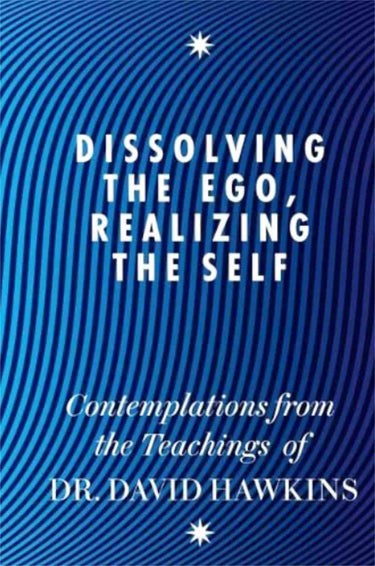
Dissolving the Ego, Realizing the Self • Spiritual Awakening Book by David R. Hawkins

Explore the themes of ego, surrender, non-duality and spiritual awakening with Dissolving the Ego, Realizing the Selfby David R. Hawkins, a collection of teachings focused on moving beyond fear, attachment and identification with the separate self.

Drawing from Hawkins’s lectures, workshops and spiritual writings, the book presents short teachings on humility, forgiveness, surrender and inner peace. It is written for readers interested in consciousness, meditation, self-inquiry and the idea of loosening the hold of ego-based patterns.

Rather than functioning as a conventional self-help programme, the book is best approached as a reflective spiritual text centred on the question of what remains when personal identity, judgement and attachment are examined more deeply.

Product Details:

  • Product: Dissolving the Ego, Realizing the Self
  • Author: David R. Hawkins, M.D., Ph.D.
  • Format: Book
  • Publisher: Hay House
  • Publication date: 28 July 2011
  • Print length: 240 pages
  • ISBN: 9781848504202
  • Themes: Ego, surrender, non-duality, consciousness, forgiveness and spiritual awakening
  • Uses: Spiritual study, meditation, journalling and self-inquiry
  • Suitable for: Readers interested in consciousness studies, inner work and contemplative spirituality

NB: The source presents Hawkins’s work as “consciousness research” and refers to the “verification of spiritual realities”. Those are claims associated with his own framework and should not be treated as established scientific findings.

About David R. Hawkins

David R. Hawkins, M.D., Ph.D., was an author, lecturer and spiritual teacher whose work focused on consciousness, surrender, healing themes and spiritual development.

His books include Power vs. Force, Letting Go: The Pathway of Surrender and work associated with his Map of Consciousness framework.

The supplied biography emphasises his medical and clinical background alongside his later spiritual teaching. His writings often combine personal spiritual experience, philosophical ideas and his own system for describing levels of consciousness.

What Is Dissolving the Ego, Realizing the Self About?

The book focuses on one central spiritual question: how do we move beyond identification with the ego?

Hawkins presents the ego as a structure built around fear, pride, judgement, attachment and personal will. The book encourages readers to observe these patterns and gradually release their grip.

Key themes include:

  • the illusion of the separate self
  • surrender and letting go
  • humility and forgiveness
  • fear, pride and attachment
  • inner peace
  • non-duality
  • spiritual awakening
  • consciousness and identity

The material is drawn from Hawkins’s wider body of teaching rather than presented as a step-by-step course.

Ego, Identity & the Separate Self

A recurring idea in the book is that much of human suffering comes from over-identification with thoughts, roles, opinions and personal stories.

Within Hawkins’s framework, the ego creates a sense of separation and continually reinforces itself through judgement, resistance and attachment.

The book invites readers to notice these patterns rather than automatically believe them.

A reflective question might be:

“What am I defending because I believe it defines who I am?”

Another might be:

“What happens if I observe this thought without making it my identity?”

This makes the book especially relevant to readers already interested in meditation or self-inquiry.

Surrender & Letting Go

Surrender is one of Hawkins’s central themes.

Here, surrender does not mean passivity or giving up. It refers more to releasing the need to control, resist or cling to a particular internal position.

The book explores how fear, pride and attachment may soften when they are observed without being continually reinforced.

A simple way to approach this idea is:

notice → allow → release

The emphasis is on inner response rather than trying to force external circumstances to change.

Humility, Forgiveness & Inner Peace

Hawkins also gives significant attention to humility and forgiveness.

These are presented as ways of loosening rigid self-identification and reducing the need to remain caught in blame or defensiveness.

The book suggests that spiritual progress is reflected less in dramatic experiences and more in qualities such as greater peace, compassion and reduced reactivity.

That makes it suitable for slow reading and reflection rather than rushing through the material.

Non-Duality & Realising the Self

The title points towards a non-dual spiritual perspective.

In non-dual traditions, the “Self” can refer to a deeper level of awareness beyond the ordinary personality or separate ego.

Hawkins explores this through the idea that identity becomes less confined when thoughts, emotions and personal narratives are no longer treated as the whole of who we are.

Readers familiar with contemplative philosophy, Advaita-style teachings or self-inquiry may recognise similar themes, although Hawkins develops them through his own terminology.

Consciousness & the Hawkins Framework

The supplied material also refers to Hawkins’s ideas about different levels of consciousness.

His wider work includes a Map of Consciousness, which he used to describe spiritual and emotional states in a hierarchical way.

This framework is influential among some spiritual readers, but it is not an accepted scientific measurement system.

It is therefore best approached as part of Hawkins’s own spiritual model rather than as an objective clinical scale.

Using the Book for Reflection

This is a book that can be read in short sections.

After a passage, you might pause and ask:

  • what am I resisting?
  • what am I trying to control?
  • which judgement feels difficult to release?
  • what would humility look like here?
  • what am I identifying with too strongly?
  • what would greater inner peace require?

A simple journalling prompt could be:

“What am I holding onto that I could observe more lightly?”

The aim is not to force a spiritual breakthrough, but to use the text as a prompt for closer self-observation.

Quick FAQs

What is Dissolving the Ego, Realizing the Self about?
It is a spiritual book by David R. Hawkins focused on ego, surrender, non-duality, forgiveness and spiritual awakening.

Who wrote the book?
David R. Hawkins, M.D., Ph.D.

How long is the book?
240 pages.

When was it published?
28 July 2011.

What is the ISBN?
9781848504202.

Who publishes it?
Hay House.

Is the book about meditation?
Meditation and self-inquiry fit naturally with its themes, although the book is broader than a meditation manual.

What does “dissolving the ego” mean?
Within Hawkins’s teaching, it refers to loosening identification with fear, pride, judgement, attachment and the separate self.

Does the book discuss the Map of Consciousness?
It relates to Hawkins’s wider framework around levels of consciousness, although the book is mainly focused on ego and spiritual realisation.

Is the Map of Consciousness scientifically proven?
No. It is Hawkins’s own spiritual framework and should not be treated as an established scientific measurement system.

Does the book promise enlightenment?
No book can guarantee a particular spiritual outcome. The material is best used for reflection, contemplation and personal study.

Care & Storage

Store the book in a dry place away from excessive moisture and prolonged direct sunlight.

Avoid heavily bending the spine if you want to preserve the book in good condition.

Disclaimer

This book is intended for spiritual, reflective and educational use. References to consciousness, healing, spiritual realities, ego dissolution and higher states of awareness reflect David R. Hawkins’s own teachings and should not be interpreted as established medical or scientific findings.

The book should not replace professional medical, psychological or other qualified advice.

Orders & Shipping
Orders placed before 3:00pm are processed and shipped the same day. We ship worldwide.

Tracking Information
Please monitor your parcel using the tracking details provided in your shipping confirmation email. Tracking is usually updated within 24 hours of dispatch and continues until delivery is confirmed.

Duties & Taxes
EU and international duties and taxes are the responsibility of the customer and must be paid locally where applicable. For non-UK customers, UK tax is automatically removed at checkout once the shipping destination is selected.

Customs Delays
Some international orders may be delayed due to customs checks, which are outside our control. Delays may be longer during busy periods.

Returns
For orders that qualified for free delivery, returned items may be subject to the original shipping fee and any collection costs.

Refused or Cancelled International Orders
International orders that are refused, returned, and then cancelled may be subject to a 10% surcharge. Parcels can be re-shipped on request, although an additional charge may apply.