Larimar Meaning, Communication & Oceanic Symbolism
What Is Larimar?
Larimar is a rare blue variety of the mineral pectolite.
It is especially known for its distinctive mixture of blue, turquoise, green-blue and white patterning, which often resembles shallow tropical water, clouds or breaking waves.
Larimar is associated geologically with the Dominican Republic, and this limited geographical connection is one reason the material is regarded as unusual.
The older supplied copy also lists “Dominican Republic / Brazil” under origin for a different Larimar chip product, so I would not use Brazil as the origin of this tumblestone unless your supplier has specifically confirmed it.
Larimar Meaning
Within contemporary crystal practice, Larimar is commonly associated with:
calm • communication • tranquility • reflection • emotional balance • self-expression • personal freedom
Its soft blue colouring naturally reinforces themes of spaciousness, water and clear communication.
Rather than suggesting that Larimar directly changes emotions, it can be used as a physical focus during meditation, journalling or quiet reflection when you want to approach a conversation or situation more thoughtfully.
Calm, Tranquility & Reflection
Larimar has a particularly gentle visual character.
Its pale blue and turquoise tones make it well suited to practices centred around slowing down, reflecting and creating more space before responding.
A tumblestone can be held during meditation, carried in a pocket or kept nearby during journalling or reflective practice.
The stone does not medically reduce stress or anxiety, but it can serve as a symbolic reminder of calm and deliberate communication.
Communication & Self-Expression
Communication is one of Larimar's strongest modern metaphysical themes.
Some practitioners choose it when reflecting on how openly, honestly or calmly they are expressing themselves.
A useful question to work with might be:
“How can I express this more clearly and gently?”
This keeps the symbolism practical and reflective rather than suggesting that the stone itself removes communication difficulties.
Larimar & the Throat Chakra
Larimar is most strongly associated with the Throat Chakra.
Within contemporary chakra practice, the Throat Chakra represents communication, expression, listening and speaking with awareness.
Larimar's blue colouring makes the relationship visually intuitive, which is one reason it is so frequently used in Throat Chakra layouts.
A 2–3cm tumblestone is a useful size for holding during meditation or placing within a chakra-themed crystal arrangement.
Larimar & the Heart Chakra
Some modern crystal traditions also connect Larimar with the Heart Chakra.
This secondary relationship reflects themes of compassion, emotional awareness and communicating from a place of care rather than reaction.
Used symbolically together, the Heart and Throat associations suggest the idea of expressing thoughts and feelings with both clarity and sensitivity.
The Dolphin Stone, Goddess Stone & Atlantis Stone
Larimar is sometimes called the Dolphin Stone, Goddess Stone or Atlantis Stone within modern crystal traditions.
These are symbolic metaphysical names rather than geological classifications.
They arise largely from Larimar's ocean-like appearance and its associations with water, intuition, feminine symbolism and spiritual reflection.
The Atlantis connection belongs to modern crystal mythology and should not be treated as established history.
Divine Feminine Symbolism
Larimar is also associated with divine feminine themes in contemporary crystal practice.
This is not a statement about gender.
Instead, it is generally used to represent qualities such as receptivity, intuition, creativity, compassion and emotional awareness.
Larimar's Water Element symbolism and oceanic appearance make it a natural visual fit for these themes.
Larimar & Personal Freedom
Personal freedom is another recurring Larimar association.
Within reflective practice, this can be interpreted as considering where habits, expectations or old ways of communicating may be limiting present choices.
Rather than claiming that Larimar removes emotional blockages, it is more grounded to use it as a reminder to make conscious choices and communicate deliberately.
Larimar & the Water Element
Water is Larimar's strongest elemental correspondence.
Within contemporary metaphysical systems, Water represents emotion, intuition, adaptability, flow and reflection.
Larimar's blue-green colouring and strong visual connection with the Caribbean Sea reinforce this relationship.
Zodiac Associations
Larimar is commonly linked with Leo and Pisces in modern crystal astrology.
Leo contributes themes of confidence, creativity and self-expression, while Pisces adds sensitivity, intuition and Water symbolism.
These associations vary between metaphysical traditions and should not be treated as fixed astrological rules.
Larimar is not generally recognised as a traditional calendar birthstone.
Where Does Larimar Come From?
SpyFu shows “where does larimar come from” at around 185 UK searches, making this a worthwhile long-tail topic.
Larimar is associated with the Dominican Republic, where the blue pectolite material is found.
Because the supplied product-specific notes do not clearly state the sourcing country for these exact B-grade tumblestones, I would keep the geological origin separate from the actual supplier origin unless that information is confirmed.
Is Larimar Rare?
Larimar is commonly regarded as an unusual gemstone because gem-quality blue pectolite is geographically limited.
Its distinctive blue colouring and restricted source are part of the reason it can command higher prices than more widespread decorative stones.
Grade, colour intensity, patterning, size and polish can all affect commercial value.
Can Larimar Go in Water?
SpyFu shows “is larimar safe in water” at around 60 UK searches.
For routine care, there is no need to soak Larimar.
A soft, slightly damp cloth followed by careful drying is a safer approach for a polished tumblestone.
Avoid prolonged soaking, salt water, harsh chemicals and abrasive cleaning methods.
Meditation with Larimar
Larimar can be held during meditation when the focus is communication, reflection or slowing down before making a decision.
You might hold the tumblestone while breathing slowly and considering a simple question such as:
“What do I need to communicate more clearly?”
or:
“Where would a calmer response serve me better?”
The stone acts as a focus for reflection rather than a source of guaranteed insight.
Natural Larimar Character
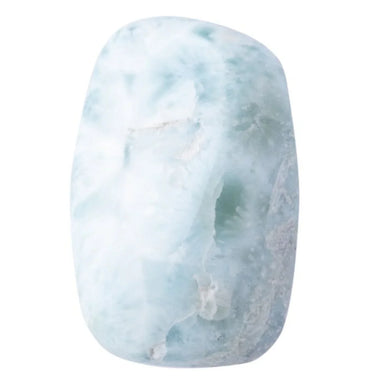
Every Larimar tumblestone will look different.
A piece may show:
- pale sky blue areas
- turquoise or blue-green tones
- white cloud-like patterning
- natural mineral veining
- darker or black areas
- differences in colour balance
- slight variation in shape and polish
Because this particular product is B grade, darker areas and greater natural variation are more likely than in highly uniform display-grade Larimar.
These differences are part of the material rather than faults.
Care
Larimar should be treated gently.
Clean with a soft dry or slightly damp cloth and dry afterwards.
Avoid harsh chemicals, abrasive surfaces, prolonged soaking and strong prolonged sunlight.
Store it separately from harder minerals if possible to reduce the risk of surface scratching.
Quick FAQs
What is Larimar?
Larimar is a rare blue variety of pectolite best known for its blue, turquoise and white colouring.
What does B-grade Larimar mean?
For this product, it means the stones may have darker areas, natural matrix and less-even blue-green colouring than higher visual grades.
What is Larimar meaning?
Its strongest contemporary symbolic associations include calm, communication, tranquility, emotional balance and personal freedom.
What chakra is Larimar associated with?
It is most strongly linked with the Throat Chakra and is also sometimes associated with the Heart Chakra.
Where does Larimar come from?
Larimar is geologically associated with the Dominican Republic.
Is Larimar rare?
Yes, blue Larimar is considered relatively unusual because of its limited geographic occurrence.
Can Larimar go in water?
Brief contact is not the same as soaking, but for routine care it is safer to use a slightly damp cloth and dry the stone afterwards.
What zodiac signs are associated with Larimar?
Leo and Pisces are common modern associations, although correspondence systems vary.
Is Larimar a birthstone?
It is not generally recognised as a traditional calendar birthstone.
How large is this Larimar tumblestone?
Approximately 2–3cm.
How much does it weigh?
Approximately 15–20g each.
Will every stone look the same?
No. Blue intensity, white patterning, darker markings, shape and finish will naturally vary.
NB
These are natural B-grade Larimar tumblestones.
Variations in blue tone, turquoise colouring, white patterning, darker mineral areas, shape, size, weight and polish are expected.
Please allow approximately ±10% variation.
These natural differences give each piece its own individual appearance and are not considered faults.
Please Note / Disclaimer
Larimar meanings, chakra associations, zodiac correspondences, elemental symbolism and references to calm, communication, tranquility or emotional balance describe traditional and contemporary metaphysical beliefs.
Names such as Dolphin Stone, Goddess Stone and Atlantis Stone are modern metaphysical terms rather than geological or historical classifications.
Larimar should not be used to diagnose or treat stress, emotional distress, communication disorders or any other medical or psychological condition.







 Larimar Tumblestone 2–3cm - Healing Crystal - Calm & Communication
£16.50
/
Larimar Tumblestone 2–3cm - Healing Crystal - Calm & Communication
£16.50
/