Mestana Mesa Cloths, Personal Altars & Q'ero Weaving Tradition
What Is a Mestana Mesa Cloth?
A mestana is a ceremonial Andean textile used within some traditions as the outer cloth of a personal mesa or medicine bundle.
It has both a practical and symbolic purpose.
Opened out, it provides the ground upon which the personal altar is arranged.
Wrapped closed, it contains and carries that altar.
The textile therefore becomes part of the mesa rather than simply something placed underneath it.
Building a Personal Mesa
A personal mesa can begin with very little.
Perhaps one meaningful stone.
One object from a place that matters.
One gift.
One memory made tangible.
Over time, other objects may be added because of their relationship with:
- mountains or rivers
- ancestors
- teachers
- journeys
- ceremonies
- offerings
- significant places
- important periods of change
The mesa develops as the person carrying it develops.
Nothing needs to be rushed.
Outer Mestana & Inner Unkuna or Wachala
The larger mestana commonly forms the outer layer of the medicine bundle.
Inside, a smaller unkuna or wachala may be used for particularly intimate or significant stones and objects.
Within some contemporary Andean ceremonial teachings, these layers are contemplated through the relationship between the outer and inner worlds.
The outer cloth may reflect the visible world of body, family, community, land and everyday life.
The inner cloth may hold memory, prayer, intention and the quieter personal world.
One rests within the other.
The inner world is carried by the outer.
Holding the Worlds Together
Once the objects and inner cloth are gathered inside the mestana, the complete bundle can be wrapped and tied.
A mesa tie or decorative beaded tie may bring together:
outer cloth • inner cloth • khuyas • offerings • sacred objects • personal memories
into one contained form.
Within some contemporary teachings, this is described as holding the worlds together.
The phrase speaks both to what the tie physically does and to what the completed mesa can represent.
Many relationships are gathered into one whole.
What Are Khuyas?
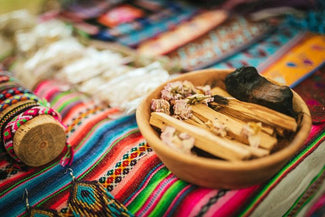
Khuyas are sacred or personally meaningful stones and objects used within some Andean ceremonial traditions.
A khuya may carry significance because of its relationship with:
- a mountain
- a river
- a teacher
- an ancestor
- a ceremony
- a journey
- a particular place
- a period of transformation
Its meaning does not necessarily come from rarity or monetary value.
A simple stone can become deeply important because of where it was found or what happened around it.
Rich & Subtle Colour
The supplied description for this cloth speaks of both rich and subtle tones.
That balance is characteristic of many handwoven Andean textiles.
Brighter colour may appear beside quieter sections, allowing the eye to move between areas of intensity and rest.
Because the exact palette is not specified for this individual piece, it is better understood through the complete composition rather than assigned colours that may not accurately reflect the textile.
Colour in Andean Weaving
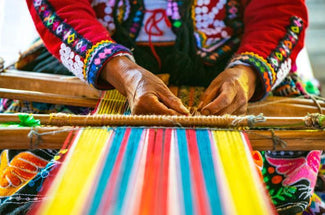
Colour can carry family, regional, ceremonial and aesthetic meaning within Q'ero and wider Andean weaving traditions.
Some cloths are brightly contrasted.
Others are far more restrained.
Colour choices may reflect:
family • locality • available dye materials • weaving tradition • ceremonial context • individual preference
There is therefore no single universal colour key that explains every textile.
The relationships between colours are often as important as individual shades.
Two Halves & Complementarity
Many Andean ceremonial textiles are woven in two sections that are brought together as one complete cloth.
Within contemporary interpretation, this construction can resonate with ideas of complementarity:
inner and outer • left and right • receiving and acting • feminine and masculine
The important idea is not opposition.
It is relationship.
Two parts remain distinct while becoming one whole.
Specific interpretations vary between weaving families, communities and ceremonial traditions.
A Cloth of Birth, Holding & Becoming
Woven textiles have accompanied important stages of life throughout the Andes.
They have been used for carrying, wrapping, protecting and receiving.
In some Andean communities, cloths have also played roles around childbirth and the wrapping or receiving of newborn children.
That gives textile a powerful relationship with birth, protection and becoming.
Within contemporary mesa practice, the same symbolism can become personal.
A bundle can carry objects connected with what has already been lived while creating space for what is still emerging.
Specific customs vary between communities and should not be treated as one universal Andean tradition.
Sheep's Wool & Alpaca
This cloth is described as made from a hand-spun mixture of sheep's wool and alpaca.
Sheep's wool brings body and structure.
Alpaca contributes softness and flexibility.
Together, the fibres produce a textile substantial enough to hold stones and ritual objects while remaining comfortable to fold and wrap repeatedly.
Small differences in yarn thickness are natural to hand-spun fibre.
Natural Dyes
The textile is described as naturally dyed.
Natural dyeing creates tonal depth rather than factory uniformity.
A section may appear slightly warmer or darker than another.
Some bands may carry softer transitions in colour.
Please allow approximately 10% variation in size and colour from batch to batch.
These differences belong to the handmade process.
Q'ero & Living Weaving Tradition
The Q'ero are an Indigenous Andean people associated with the highlands of the Cusco region and with distinctive ceremonial and textile traditions.
Their weaving belongs to a living cultural landscape in which cloth can hold relationships with:
land • mountain • family • community • animals • memory • ceremony
A textile is therefore more than patterned fabric.
Its significance begins with the making.
In contemporary spiritual writing, the Q'ero are sometimes described poetically as Rainbow Children. This is best understood as a contemporary symbolic description rather than a universal formal title used by every Q'ero community.
Weaving as Story
A handwoven textile can carry story without written language.
A colour may recall a landscape.
A repeated form may belong to a family tradition.
A seam may create a relationship between two halves.
The natural variations of hand-spun yarn preserve something of the movement and labour of its making.
The cloth carries its story through fibre and pattern.
Landscape, Apus & Relationship with Place
The mountains of the Andes hold profound cultural and spiritual importance.
Within some Andean traditions, mountains may be understood as apus — sacred presences connected with particular landscapes and communities.
A personal mesa may gradually gather objects associated with such places.
One stone may hold the memory of a mountain.
Another may recall a river.
Another may mark a journey.
The mestana becomes the place where those relationships can remain together.
Personal Altars & Medicine Bundles
A mestana can be opened as a temporary or portable sacred space.
Khuyas and other meaningful objects may be arranged upon it during:
prayer • meditation • ceremony • offerings • reflection • personal spiritual practice
When the work is complete, everything can be gathered back into the textile.
The altar becomes the bundle.
The bundle becomes the altar.
Opening & Closing the Mesa
The repeated act of opening and wrapping a mesa can itself become part of the practice.
The outer mestana unfolds.
The smaller inner cloth is opened.
Khuyas and personally meaningful objects are arranged.
When the work is complete, they are gathered again.
Over time, the fibres soften.
The folds become familiar.
The cloth begins to carry the physical memory of being handled and used.
Mesa Ties & Beaded Ties
A mesa tie holds the completed bundle securely closed.
It may be woven, braided, textile or beaded.
Its practical purpose is simple, but symbolically it becomes the final element that gathers together the inner cloth, outer cloth and everything they contain.
Newly Handwoven
This cloth is described as newly handwoven.
It has not been presented as having carried another person's established ceremonial history.
For someone creating a new personal altar or beginning another stage of mesa work, that can be particularly meaningful.
Its relationship with practice begins with its new keeper.
Direct Sourcing & Fair Exchange
The supplied information describes these textiles as obtained through individuals and weaving families rather than conventional factory production.
Fair exchange can help sustain artisan livelihoods, weaving knowledge and community continuity within ancestral landscapes.
The value of the cloth therefore lies not only in the finished textile, but in the time, skill and inherited knowledge behind its creation.
Cleaning & Care
Because this textile contains natural wool, alpaca and natural dyes, cleaning should remain gentle.
Suitable care includes:
- careful hand washing in cool to slightly warm water
- mild wool-safe or natural soap
- minimal agitation
- gentle rinsing
- drying flat
- specialist gentle textile cleaning where appropriate
Avoid:
- hot water
- bleach
- strong detergent
- abrasive stain treatment
- vigorous rubbing
- wringing
- machine washing
- tumble drying
Natural dyes may soften or shift if treated aggressively.
Wax & Ceremonial Residue
If candle wax or ceremonial residue comes into contact with the cloth, avoid forceful scraping or strong direct heat.
Gentle specialist treatment is preferable to harsh removal.
Marks that develop naturally through future use may eventually become part of the history of the cloth.
Storage
Store the textile completely dry and away from persistent damp.
Avoid prolonged exposure to strong direct sunlight, which can gradually soften naturally dyed colours.
If stored as a wrapped mesa for extended periods, occasionally open and check the natural fibres.
Quick FAQs
What is a mestana?
A ceremonial Andean textile commonly used as the outer cloth of a personal mesa or medicine bundle.
What colours are in this cloth?
The supplied description only specifies a mixture of rich and subtle tones, so exact shades should not be assumed.
What is it made from?
A hand-spun mixture of sheep's wool and alpaca.
Is it newly woven?
Yes. The supplied information describes this piece as newly handwoven.
Is the exact size fixed?
No. Handmade textiles naturally vary. Please allow approximately 10% variation.
Will every cloth look exactly the same?
No. Natural dyes and hand weaving create individual changes in colour, yarn and pattern placement.
What is a mesa?
A portable personal altar containing khuyas, sacred stones and other personally meaningful objects.
What is an unkuna or wachala?
A smaller inner ceremonial cloth that may sit inside the outer mestana.
What are khuyas?
Sacred or personally meaningful stones and objects used within some Andean ceremonial traditions.
What do the inner and outer cloths represent?
Within some contemporary teachings, they can symbolise the relationship between inner and outer worlds.
How is the mesa closed?
The cloths and contents may be wrapped together and secured with a mesa tie or decorative beaded tie.
Can it be used as a personal altar?
Yes. It can be opened as an altar surface and wrapped again around the contents of a medicine bundle.
Were woven cloths used around childbirth?
Textiles have been used for wrapping, carrying and receiving infants in some Andean communities. Customs vary between communities.
How should it be cleaned?
Use gentle hand washing in cool to slightly warm water with mild wool-safe soap or appropriate specialist textile cleaning.
Can it be machine washed?
No. Machine washing and aggressive cleaning may damage the fibres, weave and natural dyes.
Please Note
This textile belongs within a living Q'ero and wider Andean weaving and ceremonial context.
Descriptions of mesas, khuyas, inner and outer worlds, complementarity, apus, birth symbolism and ceremonial use reflect broad and contemporary understandings. Meanings and practices differ between families, communities and ceremonial lineages.
Its significance lies not only in the textile itself, but in what may eventually be gathered within it — stones, landscapes, memories, offerings and personal relationships carried together over time.




 Sacred Mestana Mesa Cloth M73-Q - Shamanic Altar & Ceremonial Cloth
£175.00
/
Sacred Mestana Mesa Cloth M73-Q - Shamanic Altar & Ceremonial Cloth
£175.00
/