



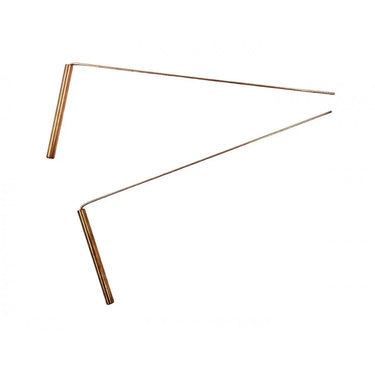


Copper Dowsing Rods 30cm - Pair with Free-Spinning Handles for Water Divining
 Copper Dowsing Rods 30cm - Pair with Free-Spinning Handles for Water Divining
£17.98
/
Copper Dowsing Rods 30cm - Pair with Free-Spinning Handles for Water Divining
£17.98
/
RRP£17.98

products.product.pickup_availability.unavailable
Your payment information is processed securely. We do not store credit card details nor have access to your credit card information.
Copper Dowsing Rods 30cm • Pair with Free-Spinning Handles for Water Divining, Ley Lines & Energy Exploration
This pair of copper dowsing rods is designed for smooth, responsive movement during water divining, land exploration and personal energy work. Each rod sits within a free-spinning copper handle, helping it move with minimal resistance as the user walks, observes and works with a chosen intention.
Dowsing rods have traditionally been used to search for underground water, investigate land and explore places believed to hold stronger energetic activity. They are also popular in modern spiritual practice for ley line work, space clearing and intuitive investigation.
Copper is valued for its conductive nature and traditional connection with energy work. The rods are suitable for beginners as well as experienced dowsers, offering a simple, practical tool for learning how subtle movement, focus and observation interact.
Product Details:
- Product: Copper Dowsing Rods
- Sold: As a pair
- Material: Copper
- Design: L-shaped rods with free-spinning handles
- Approximate rod length: 30cm
- Approximate size: 30cm × 12cm
- Batch variation: Rod length may vary approximately 25–35cm
- Approximate weight: 160g per pair
- Origin: UK
- Common uses: Water divining, ley line exploration, land investigation, space clearing and intuitive practice
- Other size available: 15cm version sold separately
- Natural variation: Slight differences in bend angle, finish and exact length may occur
Traditional Water Divining
Dowsing rods are best known for their traditional use in searching for underground water.
The practitioner holds one rod in each hand and walks slowly across an area while keeping the rods level and free to move. Crossing, opening, dipping or twitching may then be interpreted as a response.
Orders & Shipping
Orders placed before 3:00pm are processed and shipped the same day. We ship worldwide.
Tracking Information
Please monitor your parcel using the tracking details provided in your shipping confirmation email. Tracking is usually updated within 24 hours of dispatch and continues until delivery is confirmed.
Duties & Taxes
EU and international duties and taxes are the responsibility of the customer and must be paid locally where applicable. For non-UK customers, UK tax is automatically removed at checkout once the shipping destination is selected.
Customs Delays
Some international orders may be delayed due to customs checks, which are outside our control. Delays may be longer during busy periods.
Returns
For orders that qualified for free delivery, returned items may be subject to the original shipping fee and any collection costs.
Refused or Cancelled International Orders
International orders that are refused, returned, and then cancelled may be subject to a 10% surcharge. Parcels can be re-shipped on request, although an additional charge may apply.