Communication, Truth & Self-Expression
Lapis Lazuli is commonly linked with the throat chakra and is often used in symbolic work around communication and authentic expression.
It may be chosen when reflecting on:
- speaking honestly
- expressing thoughts more clearly
- listening with greater care
- finding the confidence to use one’s voice
- writing or creative expression
- approaching difficult conversations with calm
The stone does not guarantee better communication, but it can serve as a physical reminder to speak with integrity and listen with patience.
Writers, teachers, speakers and creative practitioners may also enjoy keeping Lapis nearby while working with language, ideas or personal expression.
Clarity, Intuition & the Third Eye
Lapis Lazuli is also associated with the third-eye chakra, a symbolic centre connected with intuition, insight and inner awareness.
During meditation, it may be used as a focus when seeking:
- greater self-understanding
- clearer thought
- intuitive reflection
- awareness of recurring patterns
- spiritual perspective
- calm observation before action
Its deep blue colour often supports a quiet, inward mood, making it well suited to meditation, dream journalling and contemplative practice.
Rather than being used to force visions or answers, Lapis is best approached as a stone of patient observation and thoughtful awareness.
A Stone of Royalty & Ancient History
Lapis Lazuli has a long and significant history across the ancient world.
It was highly valued in ancient Egypt, where it was used in jewellery, amulets, decorative objects and ceremonial settings. Its blue colour was associated with the heavens, divinity and royal status.
Lapis was also prized in Mesopotamia and across ancient trade routes, travelling long distances from major sources in Central Asia. Historically, finely ground Lapis was used to create ultramarine pigment, one of the most valuable blue pigments in art.
Its enduring symbolic associations include:
- wisdom
- nobility
- truth
- divine connection
- protection
- inner authority
These meanings vary across cultures and should be understood as historical and symbolic rather than universal.
Connection with Sea & Sky
Lapis Lazuli is not traditionally known specifically as an ocean stone, but its deep blue colouring naturally evokes both sea and sky.
For this reason, some modern practitioners use it in symbolic work connected with:
- emotional depth
- calm reflection
- the movement of intuition
- stillness beneath surface activity
- connection with water imagery
- expansive thought
It may be placed beside shells, water bowls or ocean-themed altar objects where its colour supports the intended symbolism.
This sea connection is interpretive and personal rather than a fixed historical property of the stone.
Meditation & Reflective Practice
Lapis Lazuli is widely chosen for meditation because of its quiet, inward character.
To use it, hold the stone gently in one hand or place it in front of you.
Take several slow breaths and bring one question to mind.
You may ask:
“What truth needs to be spoken clearly?”
or:
“What am I ready to understand more deeply?”
Sit with the question without forcing an answer. Notice what thoughts, feelings or images arise.
The stone can also be placed beside a journal to support reflective writing or used as a marker at the beginning of a meditation session.
Writing, Journalling & Creative Work
Because of its association with communication and inner truth, Lapis Lazuli is often used in practices involving writing.
It may be kept beside:
- a journal
- a notebook
- a desk
- a writing altar
- creative tools
- cards or divination materials
Some practitioners also use Lapis during automatic or stream-of-consciousness writing. In this context, it acts as a symbolic focus for openness and honesty rather than guaranteeing spiritual messages.
A simple prompt might be:
“What would I say if I trusted my own voice?”
Manifestation & Intention Work
Lapis Lazuli is sometimes described as a manifestation stone, especially for goals involving truth, communication, knowledge or spiritual development.
It may be used when setting intentions around:
- speaking with confidence
- expressing a creative idea
- developing a spiritual practice
- improving organisation
- strengthening personal integrity
- making a thoughtful decision
For a simple intention practice, hold the stone while naming one quality you wish to develop.
Keep the intention realistic and connected with practical action. The stone can serve as a reminder, but it does not replace effort, planning or responsibility.
Crystal Grids, Altars & Symbolic Protection
Lapis Lazuli may be placed in crystal grids or on personal altars where themes of wisdom, truth, insight or communication are central.
It may be paired with:
- clear quartz for focus
- sodalite for communication
- amethyst for contemplation
- smoky quartz for grounding
- rose quartz for compassionate expression
Some people also use Lapis symbolically in protection work, particularly where the intention is to maintain clear boundaries, discernment and confidence.
Such uses belong to spiritual and personal belief systems and should not be treated as guaranteed outcomes.
Zodiac & Birthstone Associations
Lapis Lazuli is often associated in modern crystal traditions with:
- Sagittarius, through themes of truth, wisdom and exploration
- Taurus, through steadiness and thoughtful expression
- Virgo, through clarity, organisation and communication
It is also sometimes offered as an alternative September birthstone.
These associations vary between crystal guides and astrological traditions, so they are best treated as symbolic correspondences rather than fixed rules.
A Simple Lapis Lazuli Clarity Ritual
Place the stone on a clean cloth or hold it in your hand.
Take three slow breaths.
Bring to mind one situation where you need greater clarity or more honest communication.
Repeat:
“May I see clearly, speak truthfully and listen with wisdom.”
Sit quietly for several minutes.
When finished, write down one practical step you can take.
Natural Variation & Appearance
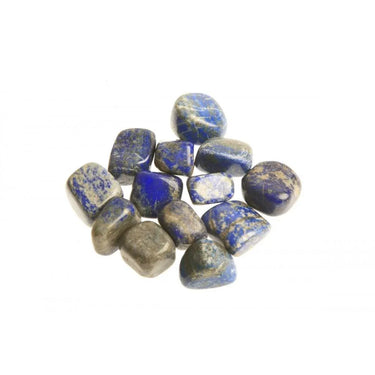
Each Lapis Lazuli tumblestone is unique.
The stone may range from deep navy to brighter royal blue and may include:
- golden pyrite flecks
- white calcite patches
- pale veining
- darker mineral areas
- softer blue sections
Please allow approximately ±10% natural variation in colour and markings, along with reasonable differences in size, shape and weight.
Some pieces may show more pyrite, while others may contain more calcite. These differences reflect the natural structure of the stone and are not considered faults.
Quick FAQs
What is Lapis Lazuli associated with?
It is commonly associated with communication, truth, wisdom, intuition, meditation and spiritual insight.
Which chakras is Lapis Lazuli linked with?
It is most often connected with the throat and third-eye chakras.
Is Lapis Lazuli a mineral?
Lapis Lazuli is technically a rock made from several minerals, including lazurite, pyrite and calcite.
Does every stone contain golden flecks?
No. Some pieces show visible pyrite, while others may have very little or none.
Is Lapis Lazuli connected with the sea?
Its sea association is mainly symbolic and based on its deep blue colour. Historically, it is more strongly connected with royalty, wisdom, the heavens and spiritual insight.
Can it be used for meditation?
Yes. Its deep colour and traditional associations make it a popular stone for meditation, journalling and reflective practice.
Is each stone the same?
No. Colour, shape, mineral pattern and markings will vary naturally.
Is this listing for one stone?
Yes. Each tumblestone is priced and sold individually.
Care & Safety
Lapis Lazuli is softer than many common crystals and should be handled with care.
Avoid soaking it in water, exposing it to salt, or using harsh chemical cleaners. These can damage the surface or affect softer mineral components such as calcite.
Wipe gently with a soft, dry cloth.
Keep away from babies, young children and pets. Small stones can present a choking risk.
Do not place the stone in drinking water or use it to prepare crystal elixirs.
Disclaimer
Crystal meanings are based on traditional, cultural and modern metaphysical beliefs. This stone is intended for personal reflection, meditation, decoration and spiritual practice. It is not intended to diagnose, treat, cure or prevent any medical or psychological condition, and no spiritual or therapeutic outcome is guaranteed.





 Lapis Lazuli Tumblestone 1–2cm - Communication, Clarity & Inner Truth
£0.98
/
Lapis Lazuli Tumblestone 1–2cm - Communication, Clarity & Inner Truth
£0.98
/