What Is Lapis Lazuli?
Lapis Lazuli is a naturally occurring blue metamorphic rock that has been valued for thousands of years for its extraordinary colour.
Unlike Quartz or Amethyst, Lapis Lazuli is not a single mineral.
Its rich blue appearance is primarily associated with lazurite, while other minerals commonly found within the stone can include calcite, pyrite and sodalite-group minerals.
Calcite may appear as pale or white streaks and patches, while pyrite can create distinctive gold or brass-coloured flecks.
The proportion of these materials varies naturally, which is why one piece of Lapis Lazuli can look quite different from another.
Lapis Lazuli Meaning
Lapis Lazuli meaning centres strongly around truth, communication, wisdom and inner awareness.
Within contemporary crystal traditions, it is often chosen when thoughtful communication and honest self-expression are important themes.
Its connection with both the Throat and Third Eye Chakras gives Lapis a distinctive symbolic balance between insight and expression — recognising what feels true inwardly and finding a clearer way to communicate it outwardly.
Rather than promising instant wisdom or clarity, Lapis can be used as a physical reminder to reflect carefully, listen deeply and speak with greater intention.
Communication & Inner Truth
Communication is one of Lapis Lazuli's strongest metaphysical associations.
Its deep blue colouring creates a natural connection with the Throat Chakra and themes of voice, expression and truth.
Within reflective practice, Lapis may be chosen when preparing for an important conversation, working through something in a journal or considering whether words and actions are aligned with personal values.
Writers, teachers, speakers and creative practitioners may also appreciate it as a symbolic stone for expression and thoughtful communication.
The stone itself does not guarantee confidence or better communication, but it can provide a meaningful focus for these intentions.
Clarity & Wisdom
Lapis Lazuli has a longstanding symbolic association with wisdom.
Its historical use in important objects, jewellery and pigments has helped reinforce its reputation as a stone connected with knowledge, insight and contemplation.
Within contemporary practice, clarity can be understood as the willingness to look carefully at a situation rather than accepting the first or easiest interpretation.
A rough Lapis stone can therefore be used during journalling, meditation or quiet reflection when greater perspective is wanted.
Lapis Lazuli & the Throat Chakra
Lapis Lazuli is strongly associated with the Throat Chakra.
Within contemporary chakra traditions, the Throat Chakra represents communication, authenticity, truth and self-expression.
Its vivid blue colouring makes this correspondence particularly natural.
A rough Lapis Lazuli stone may be placed within a Throat Chakra crystal layout, kept beside a journal or used as a symbolic focus during practices centred on honest communication.
These associations are metaphysical rather than claims that the stone physically changes communication ability.
Lapis Lazuli & the Third Eye Chakra
The Third Eye Chakra is another major association for Lapis Lazuli.
Within chakra practice, the Third Eye represents intuition, insight, perspective and reflective awareness.
Lapis's deep blue colouring, sometimes scattered with golden pyrite flecks, has naturally encouraged associations with night skies, contemplation and deeper vision.
Used alongside its Throat Chakra symbolism, Lapis can represent bringing inner understanding into clearer outward expression.
It should not be presented as a stone that guarantees psychic sight or supernatural insight.
Intuition & Reflective Awareness
Lapis Lazuli is often associated with intuition and inner wisdom.
In grounded spiritual practice, intuition can simply mean listening more carefully to instinct, experience and personal values.
The stone may be held or placed nearby during meditation as a reminder to observe rather than rush towards an answer.
Its symbolism works particularly well with reflective questions such as:
“What feels true here?”
or:
“What needs to be expressed more clearly?”
History, Royalty & Sacred Blue
Lapis Lazuli has an exceptionally long cultural history.
It was highly prized across parts of the ancient Near East and Egypt and was used for jewellery, decorative objects and ceremonial items.
Its intense blue colouring became associated in various historical contexts with status, the heavens, sacred imagery and authority.
Ground Lapis Lazuli was also historically used to produce natural ultramarine pigment, once among the most precious blue pigments available to artists.
These historical associations help explain why modern crystal traditions so often connect Lapis with wisdom, truth and spiritual insight.
They should not, however, be treated as a single universal belief shared by every culture.
Lapis Lazuli, Sea & Sky Symbolism
Lapis Lazuli is not historically defined as an ocean stone, but its deep blue colouring naturally evokes both water and the night sky.
For some people, this visual connection makes it meaningful in spiritual work centred on depth, stillness, reflection or expansive thought.
A rough Lapis stone may therefore sit naturally alongside shells, water bowls or celestial altar objects.
This is a personal symbolic use rather than a fixed historical property of Lapis Lazuli.
Astrology, Zodiac & Birth Sign Associations
Lapis Lazuli is commonly associated with Sagittarius and Libra in contemporary crystal astrology.
Sagittarius symbolism centres on truth, wisdom, exploration and broader perspective, which complements Lapis Lazuli's traditional meanings particularly well.
Libra contributes themes of communication, balance, discernment and considered judgement.
Different crystal traditions may assign additional zodiac signs, so these correspondences should be understood as contemporary metaphysical associations rather than fixed astrological rules.
Lapis Lazuli & Birthstone Traditions
Lapis Lazuli is not one of the principal stones in the most widely used modern birthstone calendar.
However, it appears in some older, traditional and alternative birthstone lists, particularly in association with September.
This is distinct from the modern September birthstone tradition, which is most strongly associated with Sapphire.
Lapis Lazuli's appearance in alternative birthstone traditions adds another useful symbolic layer without making it a universal birthstone.
Lapis Lazuli & the Air Element
Air is one of Lapis Lazuli's strongest elemental correspondences in contemporary metaphysical practice.
Air represents thought, communication, perspective, ideas and clarity.
These qualities fit especially well with Lapis Lazuli's Throat Chakra connection and its symbolism around truth and expression.
Some traditions also connect Lapis with Water, reflecting intuition, emotional depth and its strong visual association with deep blue.
For this stone, Air is the closest primary correspondence, with Water acting as a secondary association.
Lapis Lazuli Healing Crystal
Lapis Lazuli is frequently described as a healing crystal within contemporary spiritual and wellbeing traditions.
Its strongest symbolic themes include communication, clarity, truth, wisdom and intuition.
These meanings belong to metaphysical and reflective practice rather than established medical or psychological treatment.
Lapis Lazuli can therefore be enjoyed during meditation, chakra practice, journalling, crystal grids, altar work or simply as a beautiful naturally formed stone.
Why Choose Rough Lapis Lazuli?
A rough Lapis Lazuli stone retains more of the material's natural structure and texture than a polished tumblestone.
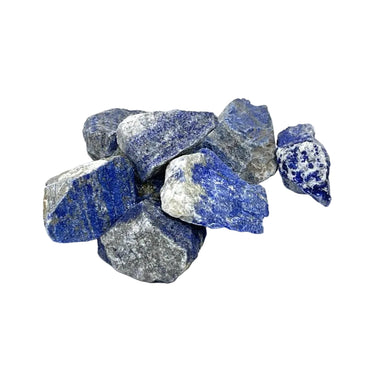
Edges may be irregular, surfaces may be uneven and different minerals can often be seen more clearly across the stone.
For collectors, this gives rough Lapis a particularly authentic geological character.
For meditation and altar work, the raw form can also feel visually more grounded and elemental.
At approximately 3–4cm and up to around 50g, this size gives the stone enough presence to work well as a focal piece without becoming overly large.
Meditation, Journalling & Intention Work
Rough Lapis Lazuli is particularly suited to quiet reflective practice.
It can be placed beside a journal when working through questions around communication, truth or decision-making.
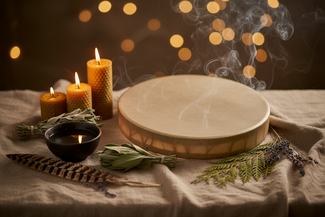
During meditation, place the stone securely nearby or hold it carefully if the edges are comfortable.
A simple reflection might be:
“May I see clearly, speak truthfully and listen with wisdom.”
The aim is not to expect the stone to supply an answer, but to use it as a symbolic anchor for thoughtful attention.
Crystal Grids & Altar Use
The irregular shape and deep blue colouring of rough Lapis make it particularly effective within crystal grids and altar arrangements.
It may be paired symbolically with Clear Quartz for clarity, Sodalite for communication, Amethyst for contemplation or Smoky Quartz for grounding.
Rose Quartz can introduce a softer theme of compassionate expression.
These crystal pairings come from contemporary metaphysical practice rather than scientifically established energetic interactions.
Natural Lapis Lazuli Character
Every rough Lapis Lazuli stone is unique.
Some pieces may be predominantly deep royal blue, while others show more white calcite, darker mineral areas or visible pyrite flecks.
Golden-looking pyrite is not present in exactly the same quantity in every stone, and some pieces may show very little.
Rough edges, natural cavities, uneven surfaces and irregular shapes are all expected.
These variations are part of the natural formation of Lapis Lazuli and are not considered faults.
Care & Safe Handling
Lapis Lazuli should be treated carefully, particularly in rough form.
Natural edges may be uneven or occasionally sharp, so inspect the stone before holding it firmly.
Clean gently using a soft dry cloth or soft brush.
Avoid prolonged soaking, saltwater and harsh chemical cleaners because Lapis Lazuli contains several different minerals that can respond differently to moisture and chemicals.
Store separately from harder crystals to reduce the risk of scratching or chipping.
Do not place Lapis Lazuli directly into drinking water or use it to prepare crystal elixirs.
Quick FAQs
What is Lapis Lazuli traditionally used for?
Within crystal practice, Lapis Lazuli is associated with communication, truth, clarity, wisdom, intuition and reflective awareness.
What is Lapis Lazuli meaning?
Its strongest symbolic meanings centre on truth, wisdom, self-expression, clarity and insight.
Is Lapis Lazuli a crystal?
Lapis Lazuli is technically a rock composed of several minerals rather than a single mineral crystal. It is commonly grouped with crystals and gemstones in spiritual and retail settings.
What chakras are associated with Lapis Lazuli?
Lapis Lazuli is most strongly associated with the Throat and Third Eye Chakras.
What zodiac signs are associated with Lapis Lazuli?
Sagittarius and Libra are common contemporary crystal-astrology associations.
Is Lapis Lazuli a birthstone?
It appears in some traditional and alternative September birthstone lists, but it is not the principal modern September birthstone.
What element is associated with Lapis Lazuli?
Air is one of its strongest elemental correspondences because of its links with communication and clarity. Some traditions also associate it with Water.
What is the difference between rough and polished Lapis Lazuli?
Rough Lapis retains its natural irregular texture, edges and mineral patterning, while polished Lapis has been smoothed to create a more uniform surface.
Does every Lapis Lazuli stone contain gold-coloured flecks?
No. The golden-looking areas come from pyrite, and the amount visible varies naturally from stone to stone.
How large is this rough stone?
Approximately 3–4cm.
How much does it weigh?
Up to approximately 50g.
Will every stone look the same?
No. Blue tone, calcite markings, pyrite content, shape, texture and weight vary naturally from piece to piece.
NB
As this item is made from natural rough Lapis Lazuli, variations in blue colour, calcite markings, pyrite content, mineral patterning, shape, size and surface texture are to be expected.
These natural differences give each rough stone its own individual character and are not considered faults.
Please Note / Disclaimer
Lapis Lazuli is technically a naturally occurring rock composed of several minerals rather than a single mineral crystal, although it is commonly grouped with healing crystals and gemstones in spiritual retail.
Crystal meanings, chakra associations, zodiac correspondences, elemental associations and references to healing, communication, clarity, intuition, wisdom or protection describe traditional, cultural and contemporary metaphysical beliefs.
Historical uses of Lapis Lazuli vary between cultures and should not be interpreted as evidence for modern metaphysical claims.
Astrological and elemental correspondences can vary between different traditions.
Lapis Lazuli should not be used to diagnose, treat or manage anxiety, communication difficulties or any other medical or psychological condition.
Adult use only. Natural rough edges may be sharp and can cause cuts if handled carelessly. Handle with care and keep out of reach of children and pets.






 Lapis Lazuli Rough Stone 3–4cm - Healing Crystal - Communication, Clarity & Inner Truth
£2.98
/
Lapis Lazuli Rough Stone 3–4cm - Healing Crystal - Communication, Clarity & Inner Truth
£2.98
/