Tree of Life Meaning, Symbolism & Nature-Inspired Décor
What Does the Tree of Life Mean?
SpyFu shows strong UK search demand around this question, so it deserves clear coverage.
The Tree of Life is commonly interpreted as a symbol of growth, connection, strength, renewal and continuity.
Its roots suggest grounding, ancestry and foundation, while its branches reach outward and upward, creating a visual relationship between past and future, earth and sky, stability and growth.
Because the symbol appears across many cultures and spiritual traditions, there is no single universal meaning.
What Is the Tree of Life?
The Tree of Life is a symbolic tree motif found in religious, mythological, philosophical and decorative traditions around the world.
Different cultures have used tree imagery to represent ideas such as:
growth • ancestry • connection • wisdom • fertility • renewal • creation • continuity
Its wide appeal comes partly from the structure of a tree itself: roots below, trunk at the centre and branches reaching outward.
That natural form lends itself easily to symbolism around connection and development.
Roots, Branches & Connection
The roots and branches are central to Tree of Life symbolism.
Roots can represent foundation, ancestry, stability and the unseen support beneath visible growth.
The trunk can represent continuity and strength.
The branches can represent expansion, possibility, family, learning or spiritual development.
Together, the image creates a natural metaphor for the way life grows from a foundation while continually moving outward.
Growth & Renewal
Growth is one of the strongest contemporary meanings associated with the Tree of Life.
Trees move through visible seasonal cycles, losing leaves, becoming dormant and returning to growth.
That makes the tree a natural symbol of renewal, resilience and continuing development.
A Tree of Life plaque may therefore appeal to someone marking a new beginning, personal change or a period of growth.
Balance Between Earth & Sky
The form of a tree creates a natural relationship between earth and sky.
Roots extend downward while branches reach upward.
Within spiritual symbolism, this can represent balance between practical life and aspiration, grounding and growth, or the physical and spiritual worlds.
The meaning is symbolic rather than a claim that the plaque itself creates balance or grounding.
Tree of Life Across Different Traditions
Tree symbolism appears in many different cultural and religious traditions.
It is found in Celtic-inspired symbolism, Norse mythology, Christianity, Judaism, Buddhism and other systems, although the meaning and form differ from one tradition to another.
For that reason, it is better to describe the Tree of Life as a widespread symbolic motif rather than claim that one modern decorative version represents every tradition equally.
Celtic Tree of Life Associations
The Tree of Life is especially popular within modern Celtic-inspired spirituality.
It is commonly associated with interconnectedness, ancestry, nature and cycles of life.
SpyFu also shows long-tail interest around “what does the Tree of Life mean Celtic”, making this a useful supporting topic.
However, modern Celtic Tree of Life artwork often combines historical inspiration with later spiritual interpretation, so exact meanings should not be presented as universally fixed.
Nature & Interconnectedness
The Tree of Life is frequently used to represent the idea that living things exist within larger interconnected systems.
Roots depend on soil, branches respond to light and weather, and the tree supports a wider ecosystem.
That makes the image especially appealing within nature-based spirituality and ecological symbolism.
As decorative art, it can simply serve as a reminder of connection with the natural world.
Family & Ancestry Symbolism
Trees are also commonly used as symbols of family and ancestry.
The idea of a family tree naturally mirrors the structure of roots, trunk and branches.
For some people, a Tree of Life therefore represents heritage, generations and connection between past and future.
This can also make the plaque suitable as a housewarming, family or milestone gift.
Circular Design & Cyclical Symbolism
The circular shape of this plaque strengthens the Tree of Life motif.
Circles commonly represent continuity, wholeness and cycles.
Together, the visual relationship becomes:
tree → roots → branches → seasons → circle → continuity
This gives the design a coherent symbolic structure without needing to assign special properties to the material itself.
Bronze-Effect Terracotta
The plaque is made from terracotta with a bronze-effect painted finish.
The earthy terracotta base complements the natural Tree of Life motif, while the bronze and copper tones highlight the raised surface detail.
It should consistently be described as bronze-effect terracotta, not solid bronze.
I would also avoid calling it “handcrafted” unless the supplier specifically confirms that manufacturing detail.
Indoor Display
At approximately 20cm across, the plaque is suitable for:
- living rooms
- hallways
- meditation spaces
- altar areas
- reading corners
- bedrooms
- garden rooms
- nature-inspired interiors
Its warm bronze-effect finish works especially well alongside wood, greenery and other earth-toned décor.
Sheltered Outdoor Display
The supplied product information describes the plaque as suitable for sheltered outdoor use.
A covered patio, garden room or protected exterior wall is preferable to an exposed garden position.
Avoid prolonged exposure to heavy rain, frost, persistent damp and strong direct sunlight to help preserve the painted finish and hanging loop.
Tree of Life as a Gift
The plaque makes a thoughtful decorative gift for someone interested in:
nature • spirituality • symbolic art • Celtic-inspired décor • Pagan décor • family symbolism • woodland interiors
Its meaning is broad enough to suit both spiritual and purely decorative settings.
Care & Display
Dust gently with a soft dry cloth.
Avoid abrasive cleaners or strong chemicals that may damage the painted surface.
Hang securely using an appropriate wall fixing and check the twine loop periodically, particularly if displayed in a sheltered outdoor location.
Quick FAQs
What does the Tree of Life symbolise?
Common interpretations include growth, connection, renewal, strength, ancestry and continuity.
What is the Tree of Life?
It is a symbolic tree motif found across many religious, cultural and spiritual traditions.
Is the Tree of Life a Celtic symbol?
It is strongly associated with modern Celtic-inspired spirituality, although tree symbolism appears in many cultures and traditions.
What do the roots represent?
They are commonly interpreted as foundation, ancestry, stability and connection with the earth.
What do the branches represent?
They may symbolise growth, possibility, family, development and connection.
Who is associated with the design?
The supplied product information identifies Lisa Parker.
What is the plaque made from?
Terracotta with a bronze-effect painted finish.
Is it real bronze?
No. It is terracotta with a decorative bronze and copper-effect finish.
How large is it?
Approximately 20cm in diameter and around 1–1.5cm deep.
How heavy is it?
Up to approximately 450g.
Can it be displayed outdoors?
Yes, in a sheltered location. Avoid prolonged rain, frost and strong sunlight.
How does it hang?
It has an attached twine hanging loop.
NB
This is a decorative terracotta plaque with a bronze-effect painted finish.
Minor variation in tone, texture and surface finish may occur as part of the decorative manufacturing process.
For outdoor use, display only in a sheltered location and avoid prolonged exposure to rain, frost, damp and strong direct sunlight.
Please Note / Disclaimer
Tree of Life meanings vary between cultural, religious and spiritual traditions.
References to Celtic, Pagan, spiritual, grounding or symbolic meanings describe contemporary and traditional interpretations rather than one universally accepted definition.
This product is decorative and is not intended to produce spiritual, emotional or therapeutic effects.


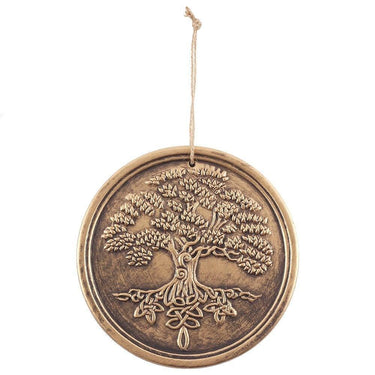


 Tree of Life Wall Plaque 20cm - Lisa Parker - Bronze Effect Terracotta
£5.98
/
Tree of Life Wall Plaque 20cm - Lisa Parker - Bronze Effect Terracotta
£5.98
/