Suyu Mestana Cloths, Personal Mesas & the Andean Ceremonial World
What Is a Suyu Mestana Mesa Cloth?
A mestana is a ceremonial textile used within some Andean spiritual traditions as the outer cloth of a personal mesa or medicine bundle.
The Suyu form is distinguished here by its balanced two-part visual arrangement.
Although the textile is woven as one continuous cloth, the design creates two complementary fields that can be contemplated through ideas of relationship and balance.
This makes the cloth especially suited to mesa work, where the bringing together of different parts — inner and outer, seen and unseen, personal and collective — is already central to the structure of the bundle.
A Personal Altar That Can Be Wrapped
A mesa is not only an altar that is opened and displayed.
It can also be wrapped, carried and kept close.
The mestana forms the outer boundary of this personal altar. Within it may be placed a smaller inner cloth and the objects gathered through the practitioner's spiritual path.
These may include:
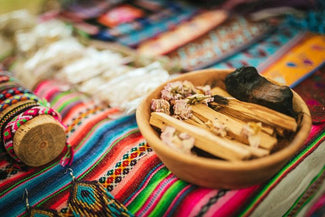
- khuyas or sacred stones
- objects connected with mountains or rivers
- offerings
- inherited pieces
- gifts from teachers
- ritual items
- personal symbols
- objects connected with ceremonies or important life transitions
When opened, the cloth becomes an altar surface.
When wrapped, it becomes the body of the medicine bundle.
Outer Mestana & Inner Unkuna or Wachala
The outer mestana is commonly paired with a smaller inner cloth such as an unkuna or wachala.
These layers can be understood symbolically as holding different dimensions of experience.
The outer cloth may reflect the world we move through visibly — body, family, community, land and daily life.
The inner cloth may hold what is more intimate — prayer, memory, personal meaning, relationship and intention.
One sits inside the other.
The inner world is not separate from the outer world; it is held within it.
Pairing with a Coordinated Inner Cloth
This Suyu mestana is especially suited to pairing with a colour-coordinated inner cloth from the same family of textiles.
Using related colours and patterns can create a visually harmonious mesa while reinforcing the symbolic relationship between the outer and inner layers.
The pairing is practical, but it can also deepen the sense that the bundle is being built intentionally rather than simply assembled.
Holding the Mesa Together
Once the inner cloth and its contents are placed inside the larger mestana, the complete bundle can be wrapped and tied.
A mesa tie or decorative beaded tie gathers together:
outer cloth • inner cloth • khuyas • altar stones • offerings • personal objects
In some contemporary Andean teachings, the tie is spoken of as holding the worlds together.
That phrase describes both what the tie physically does and what the completed bundle can represent.
Many relationships are gathered into one form.
What Are Khuyas?
Khuyas are sacred or personally significant stones and objects used within some Andean ceremonial traditions.
Their importance comes from relationship.
A khuya may be connected with:
- a mountain
- a river
- a journey
- an ancestor
- a teacher
- a ceremony
- an important place
- a personal transformation
A stone that looks ordinary to another person may carry profound meaning because of where it came from or what it has witnessed.
The mesa cloth creates a place where these objects can remain in relationship with one another.
The Meaning of Suyu
The word suyu appears within Andean cultural and geographic language and is associated with ideas of region, division and ordered space.
Within this textile, the two-part layout creates a visual sense of complementary fields held within one whole.
That gives the cloth a particularly strong relationship with the symbolic language of mesa work: different dimensions brought together rather than separated.
Two Panels, One Cloth
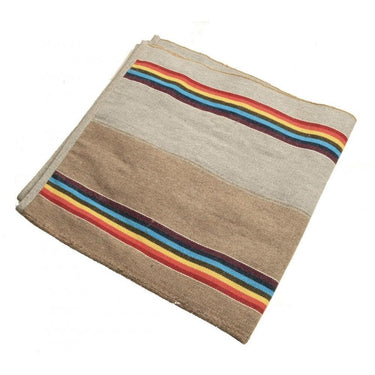
The two-panel quality is one of the most distinctive features of this mestana.
Rather than being two unrelated textiles simply placed together, the design is woven as one continuous piece.
Visually, however, the cloth still holds two sides.
This can evoke:
left and right • inner and outer • earth and sky • visible and unseen • receiving and giving
These interpretations should not be treated as one fixed universal code, but the sense of complementarity is an important part of the design.
Rainbow as Bridge
The rainbow detail is one of the most expressive elements in this cloth.
Within the supplied tradition, the rainbow or Kuichi can be understood as a bridge — something that appears between earth and sky, connecting what might otherwise seem separate.
Its colour brings movement into the quiet greys and tans of the textile.
Symbolically, it can suggest:
transformation • passage • connection • balance • movement between worlds
The rainbow is not merely decorative here.
It changes the entire character of the cloth.
Earth Colours & Grounding
The more subdued foundation of this textile gives it a different presence from many strongly coloured Andean cloths.
Greys, tans and natural tones bring the eye back to earth, stone and mountain landscape.
Against that quieter background, the rainbow colours become more vivid.
This contrast gives the cloth a strong visual rhythm:
earth • colour • stillness • movement
It feels grounded without becoming muted.
Protective Eye-Style Patterns
The design includes eye-like motifs described within the supplied textile tradition as protective elements.
Patterns such as these can carry cultural, symbolic or familial associations depending on the weaver, village and context.
They are best understood as part of the living language of Andean weaving rather than reduced to a single fixed interpretation.
Weaving as Sacred Craft
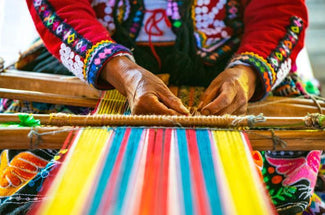
In the Andes, weaving has long carried more than practical purpose.
A textile may hold relationships with:
land • family • community • animals • weather • mountains • memory • ceremony
The loom becomes a place where fibre, colour and inherited knowledge meet.
A cloth like this is therefore not merely made.
It is woven into a cultural world.
Q'ero, Chinchero & Living Tradition
Q'ero and Chinchero are distinct Andean communities with their own histories, weaving traditions and ceremonial relationships.
Both are frequently discussed within contemporary mesa practice, but they should not be treated as interchangeable.
This cloth is best appreciated as a Chinchero Suyu-style ceremonial textile within the broader Andean mesa tradition.
Its value lies not in claiming that it represents every Q'ero or Chinchero teaching, but in recognising the living cultural context from which these textile traditions emerge.
Colour, Symbolism & Meaning
Andean textiles can be extraordinarily rich in colour.
Some use intense rainbow palettes, while others work with specific earthy, regional or ceremonial tones.
Colour can communicate:
- place
- family
- identity
- season
- landscape
- ceremonial context
- individual weaving tradition
That means there is no single universal key for interpreting every red, blue, grey or rainbow stripe.
The meaning belongs to context.
Natural Alpaca Fibre
This Suyu mestana is made from high-quality natural alpaca yarn.
Alpaca fibre is known for its softness, smoothness and fine handle.
It allows the cloth to drape easily around stones and irregular objects within a medicine bundle while still feeling substantial enough to form the outer layer.
Because the cloth may be opened and wrapped many times, the tactile character of the fibre becomes part of its use.
Natural Dyes & Handmade Colour
The textile is described as naturally dyed.
Natural dyes create depth and variation rather than absolute uniformity.
A grey may lean warmer in one batch and cooler in another.
A rainbow accent may vary in intensity.
The balance between earthy and bright tones may shift.
Please allow approximately 10% variation in size and colour from batch to batch.
These differences are characteristic of natural fibres, handmade weaving and traditional dyeing.
Landscape, Mountains & the Andean World
The high Andes are deeply woven into the spiritual and cultural life of the region.
Mountains may be understood as apus, sacred presences connected with particular communities and places.
The earth itself is not merely scenery.
It is relationship.
A personal mesa can hold stones or objects gathered from significant landscapes, making the bundle a portable record of those relationships.
In a cloth dominated by greys and tans, that connection with mountain, stone and earth feels especially present.
Divination & Reflective Practice
The balanced two-part structure of the Suyu design can also make it suitable for reflective or divinatory practice within traditions where textiles are used to define a sacred working space.
The cloth can be opened and used as a surface upon which stones, symbols or ceremonial objects are placed and contemplated.
Its role is to create a defined container for the practice, not to guarantee an outcome.
Despacho & Offering Work
Andean textiles may also be used around offering practices such as despacho work, depending on the practitioner's lineage and teaching.
The cloth can provide a contained sacred surface during preparation and ceremony.
Specific ceremonial protocols vary and should be learned from appropriate teachers rather than assumed from the textile alone.
Fresh Cloth, Personal Journey
A new cloth begins without another person's ceremonial history.
That can make it particularly meaningful for someone starting or rebuilding a personal mesa.
The textile begins clean and unworn.
From there, its story develops through use.
The first fold.
The first stone placed inside.
The first tie around the bundle.
The first journey it accompanies.
Over time, the cloth becomes associated with the person carrying it.
Ethical & Cultural Appreciation
Andean ceremonial textiles belong to living Indigenous cultures.
Respectful ownership means recognising the skill, time, knowledge and continuity behind the weaving.
These textiles should not be treated simply as exotic decoration.
Using a mestana personally does not itself confer initiation into Q'ero, Chinchero or another Andean ceremonial lineage.
The cloth can still become deeply meaningful while being held with cultural respect.
Cleaning & Care
Because this textile uses alpaca fibre and natural dyes, cleaning should always be light and gentle.
Suitable options include specialist gentle dry cleaning or careful hand washing in cool to slightly warm water.
Use a mild wool-safe or natural soap and keep agitation to a minimum.
Avoid:
- hot water
- bleach
- strong detergents
- abrasive stain treatments
- vigorous rubbing
- wringing
- machine washing
- tumble drying
Natural dyes can shift or soften under aggressive cleaning.
If washing is necessary, gently reshape the cloth and dry flat away from strong heat and prolonged direct sunlight.
Caring for Natural Dyes
Natural colour is part of the life of the textile.
Avoid long soaking, abrasive brushing or strong chemical cleaners.
Small changes in tone over years of use are natural and can become part of the cloth's story.
Storage
Store the cloth completely dry.
If used as a medicine bundle, keep the wrapped mesa somewhere protected from damp, excessive heat and prolonged direct sunlight.
Natural-fibre textiles should be checked occasionally if stored for long periods.
Quick FAQs
What is a Suyu Mestana Mesa Cloth?
A handwoven Andean ceremonial textile used as the outer cloth of a personal mesa, altar or medicine bundle.
What makes this cloth different?
Its natural earth-toned alpaca weave, rainbow accents and distinctive two-part Suyu design give it a quieter, more grounded character than many brightly coloured ceremonial textiles.
Is it made from alpaca?
Yes. The supplied product information describes this cloth as made from high-quality natural alpaca yarn.
Is the exact size fixed?
No. Each cloth is handmade. Please allow approximately 10% variation in dimensions from batch to batch.
Will the colours be identical to the photograph?
No. Natural dyes and individual weaving mean the balance of greys, tans and rainbow colours will vary.
What does the rainbow represent?
Within the supplied tradition, Kuichi is associated with a bridge between worlds, transformation and connection.
What is a mestana used for?
It may form the outer cloth of a personal mesa containing khuyas, sacred stones and other significant objects.
What is an unkuna or wachala?
A smaller inner cloth that may be placed inside the outer mestana.
Can this cloth be paired with an inner cloth?
Yes. It is especially suited to pairing with a colour-coordinated inner unkuna or wachala.
What are khuyas?
Sacred or personally significant stones and objects used within some Andean ceremonial traditions.
How is the completed mesa closed?
The cloth is wrapped around its contents and secured with a mesa tie or decorative beaded tie.
Can it be used for divination?
It may be used as a defined ceremonial surface within personal or taught divinatory practices.
Can it be used for despacho work?
It may be used around offering practices depending on the practitioner's tradition and training.
Are the colours naturally dyed?
Yes, according to the supplied product information.
How should it be cleaned?
Use specialist gentle dry cleaning or careful hand washing in cool to slightly warm water with mild soap.
Can it be machine washed?
No. Machine washing and abrasive cleaning may damage the alpaca fibres and natural dyes.
Please Note
This textile comes from a living Andean weaving and ceremonial tradition.
Descriptions of Suyu, Kuichi, mesas, khuyas, inner and outer cloths, divination, apus and symbolic relationships reflect broad and contemporary understandings of Andean practice. Meanings and teachings vary between communities, individual weavers and ceremonial lineages.
Its significance does not lie only in the pattern woven into the cloth, but in the relationship that may develop with what is eventually placed inside it — stones, places, memories, offerings and personal meaning held together over time.




 Chinchero Suyu Mestana Mesa Cloth M61-C - Earth & Rainbow - Shamanic Altar & Ceremonial Cloth
£185.00
/
Chinchero Suyu Mestana Mesa Cloth M61-C - Earth & Rainbow - Shamanic Altar & Ceremonial Cloth
£185.00
/